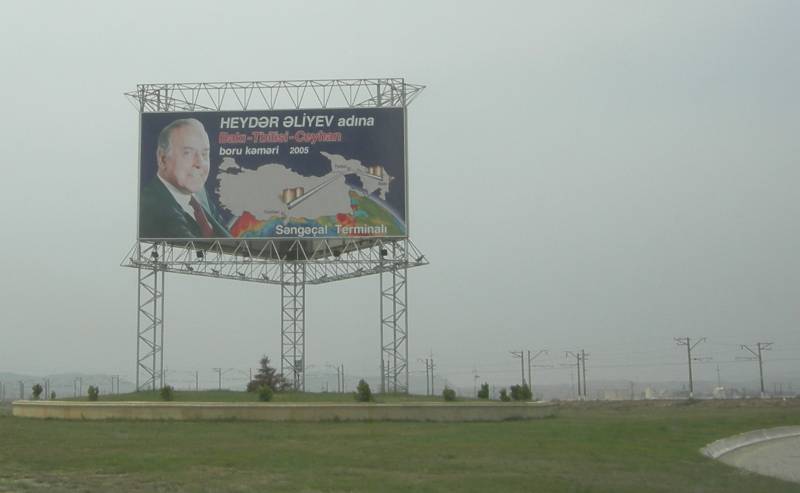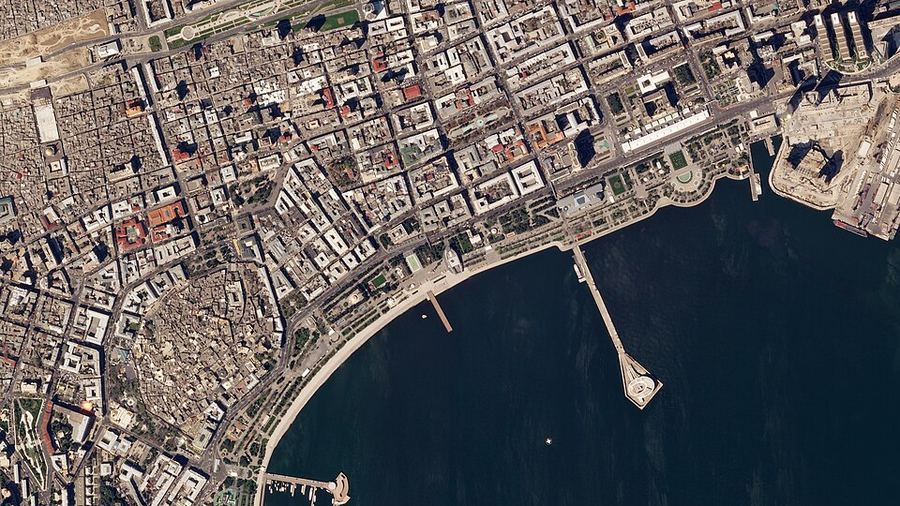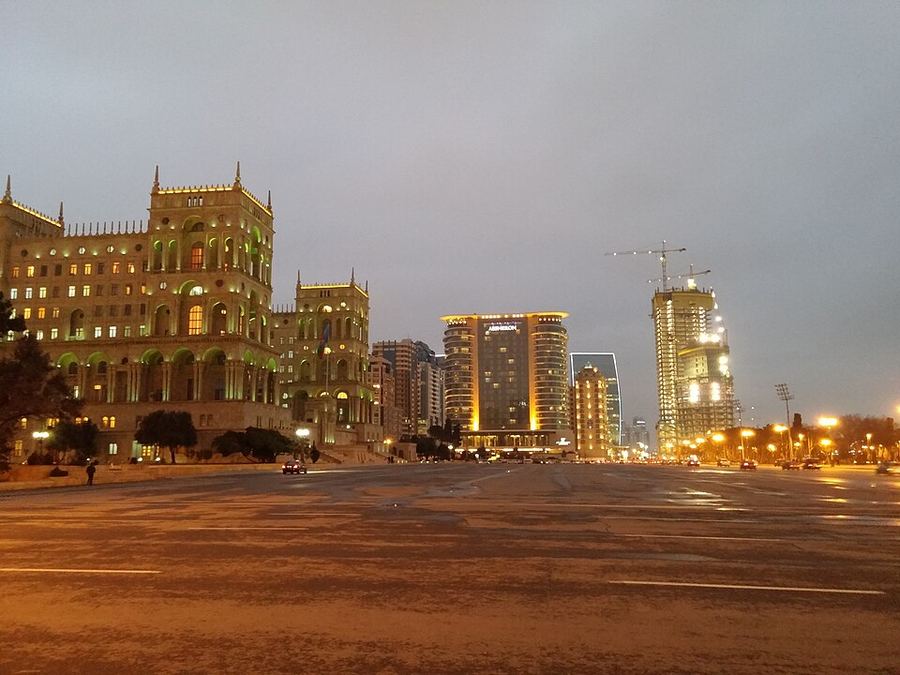
Azerbaijan is a presidential republic of about 10.7 million people on the western shore of the Caspian Sea, occupying the eastern end of the South Caucasus between Russia, Georgia, Armenia, Iran and — through the Nakhchivan exclave, separated from the main territory by Armenian land — Turkey. The capital, Baku, sits on the Absheron Peninsula, a windswept spur of oil-bearing land that made the city the centre of the world petroleum industry at the end of the nineteenth century and rebuilt it again after 2000. The population is overwhelmingly Azerbaijani and speaks a Turkic language written in the Latin alphabet since independence, and is overwhelmingly Muslim, predominantly Shia, though state and society are strongly secular in practice. Hydrocarbons dominate the economy: crude oil, natural gas and refined products account for the great bulk of exports, carried west through the Baku–Tbilisi–Ceyhan pipeline and the Southern Gas Corridor, and Italy and Turkey are the largest buyers. GDP per capita is around $22,100 in purchasing-power terms. Azerbaijan declared independence from the Soviet Union in 1991, and the following three decades were shaped above all by the conflict with Armenia over Nagorno-Karabakh, which ended in 2023 with Azerbaijan in full control of the territory and its Armenian population gone.
Baku's urban core is home to about 1,973,054 people.
That's bigger than Amsterdam — each a great world city in its own right.
Among the world's megacities, though, it's one of many — the giants of Asia and Latin America run larger still:
Azerbaijan has pursued international sporting visibility deliberately and with hydrocarbon money. Baku hosted the inaugural European Games in 2015, the Islamic Solidarity Games in 2017, four matches of the 2020 European Football Championship and the 2019 Europa League final, and has staged a Formula One grand prix on a street circuit past the medieval walls since 2016, one of the fastest and most distinctive layouts on the calendar. State sponsorship has extended to European football, with Azerbaijani tourism branding on shirts and stadium boards. On the field, the country's global standing rests on wrestling and judo, where Azerbaijani competitors are consistent Olympic and world-championship medallists, and on chess, where its grandmasters are fixtures of the elite circuit and the national team has won the European team title. Qarabağ FK's regular appearances in European club competition give the country a continuing presence in continental football, though the national team has never reached a World Cup or European Championship finals. Azerbaijan's Olympic squads have also recruited naturalised athletes, a practice that has drawn criticism but has raised medal counts in wrestling and weightlifting.
Azerbaijan Manat — AZN (₼)
GDP (PPP): $225.198 billion (2024 est.)
Per capita: $22,100 (2024 est.)
$34.113 billion (2024 est.)
crude petroleum, natural gas, refined petroleum, plastics, electricity (2023)
Partners: Italy 37%, Turkey 19%, Israel 5%, Greece 4%, Russia 4% (2023)
$27.339 billion (2024 est.)
cars, crude petroleum, refined petroleum, broadcasting equipment, garments (2023)
Partners: Russia 17%, China 16%, Turkey 14%, Georgia 4%, Germany 4% (2023)
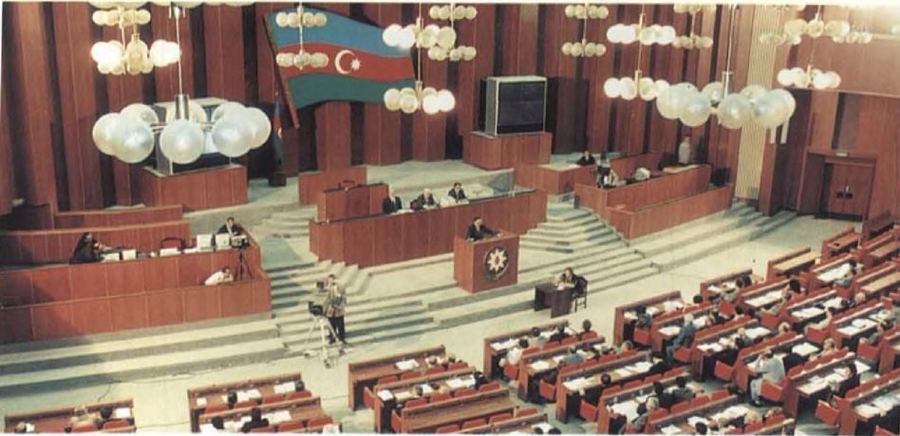
Type: presidential republic
Independence: 30 August 1991 (declared from the Soviet Union); 18 October 1991 (adopted by the Supreme Council of Azerbaijan)
How mountains, coasts, and rivers shape settlement (LandScan).
Coming — dataWhere groups settled and how people move (GeoEPR + UNHCR).
Coming — dataNotable institutions, mappable as points.
Coming — data