HERA · Human Entity Reference Atlas by Masego Inc

← Bahamas 🌐 3D View
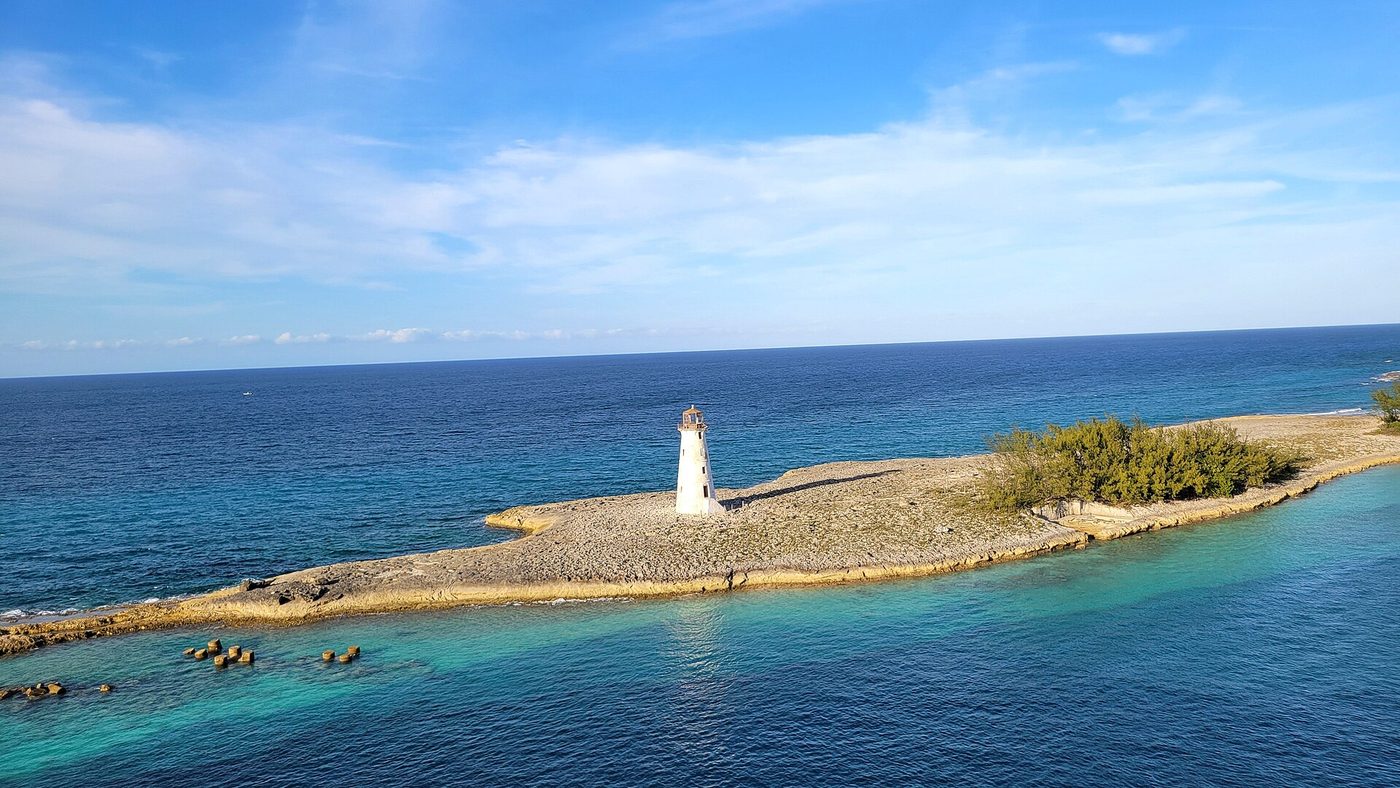
Nassau Bahamas harbour, Bahamas
Bahamas BHS
Nassau Bahamas harbour — Photo: Kiran891 / CC BY-SA 4.0 via Wikimedia Commons
Did You Know The Exuma Cays Land and Sea Park, created in 1958, is generally recognised as the first protected area anywhere designed to cover land and sea together, and became a full no-take reserve in 1986. — Encyclopaedia Britannica

The Bahamas is an archipelago of about 700 islands and some 2,400 cays strung across roughly 800 kilometres of the western Atlantic, beginning some 80 kilometres off the Florida coast and running southeast toward Cuba and Hispaniola. Around 30 of the islands are inhabited by a population of just over 400,000, of whom the great majority live on New Providence, where the capital Nassau stands, or on Grand Bahama around Freeport. Andros is the largest island by area but thinly settled; Abaco, Eleuthera, Exuma, Long Island, Cat Island and Inagua make up the rest of what Bahamians call the Family Islands. The country is a parliamentary democracy and a Commonwealth realm, independent from the United Kingdom since 10 July 1973 and governed under a Westminster system from Nassau. The population is overwhelmingly of African descent and overwhelmingly Protestant, with Baptists the largest single denomination. There is almost no agriculture or manufacturing: tourism, driven by cruise arrivals and resorts, is by far the largest employer, followed by offshore financial services, and the ship registry is among the world's biggest. The Bahamian dollar is pegged at par to the United States dollar, and living standards are high by regional measures.

CIA World FactbookEncyclopaedia BritannicaWorld Bank
Population
415,306
Capital
Nassau
Currency
$ BSD
Time zones
Largest city
Nassau
Human Geography Themes
Loading national figures…
Largest Cities
Nassau261,235
In Perspective

Nassau's urban core is home to about 261,235 people.

Among the world's megacities, though, it's one of many — the giants of Asia and Latin America run larger still:

Nassau261,235
Jakarta40,545,126
Dhaka37,307,160
Tokyo33,244,670
Shanghai30,678,616
Cairo25,230,325
The Country & Its People

History

The islands were settled by Lucayan Taino people who arrived from the Greater Antilles by about the ninth century. On 12 October 1492 Columbus made his first American landfall on an island the Lucayans called Guanahani and which he renamed San Salvador, an event conventionally located at the island that carries that name today. Within about 25 years the entire Lucayan population, perhaps 40,000 people, had been shipped to Hispaniola and Cuba as forced labour and destroyed, leaving the archipelago essentially empty. English settlement began in 1648 when a company of Bermudian Puritans, the Eleutheran Adventurers, founded a colony they named for the Greek word for freedom. Weak governance made Nassau a pirate haven between 1706 and 1718, when Woodes Rogers arrived as the first royal governor and expelled or pardoned the buccaneers under a motto about restoring commerce. Loyalists fleeing the American Revolution after 1783 arrived with enslaved Africans and attempted cotton planting, which failed on thin soils, leaving a mostly Black population when slavery was abolished in 1834. The economy boomed on Civil War blockade running and again on Prohibition rum running. Black political power arrived with majority rule on 10 January 1967, and Lynden Pindling led the country to independence on 10 July 1973.
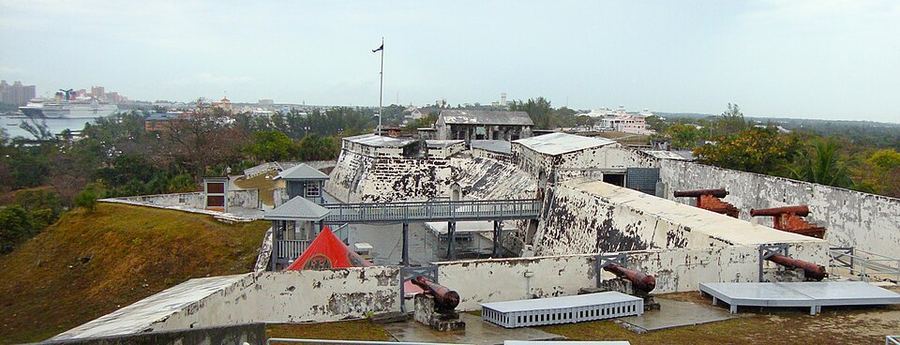
History, Bahamas
Ahodges7 / CC BY-SA 3.0

Culture

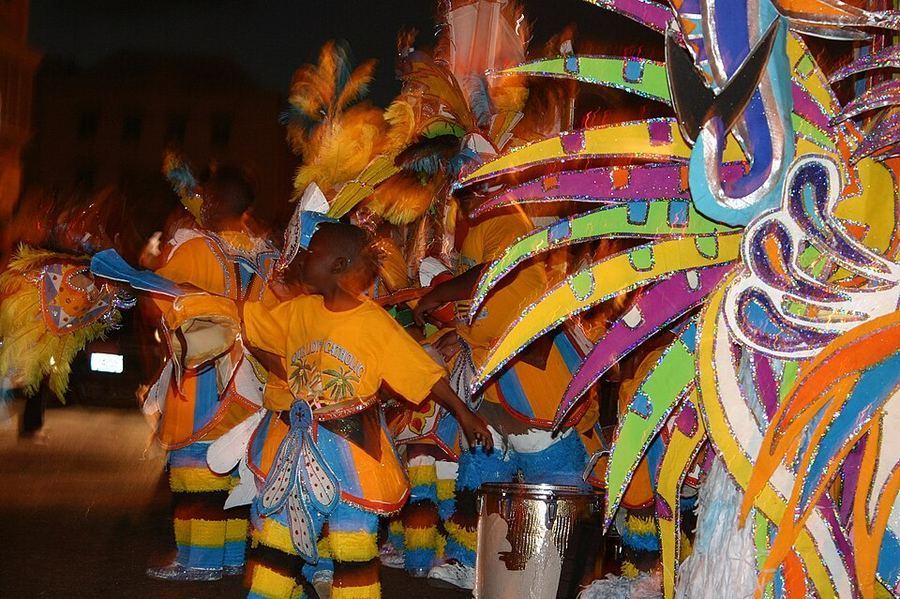
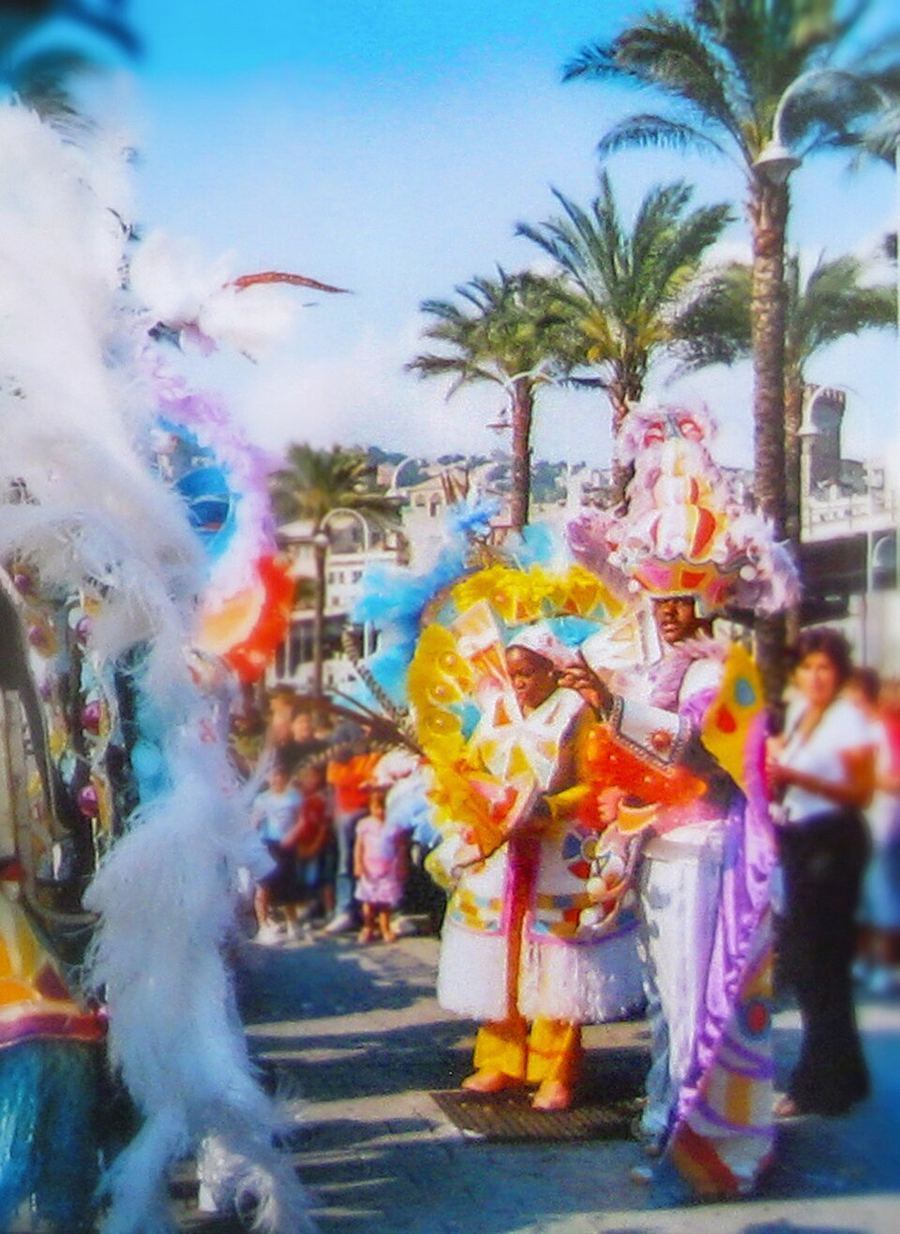
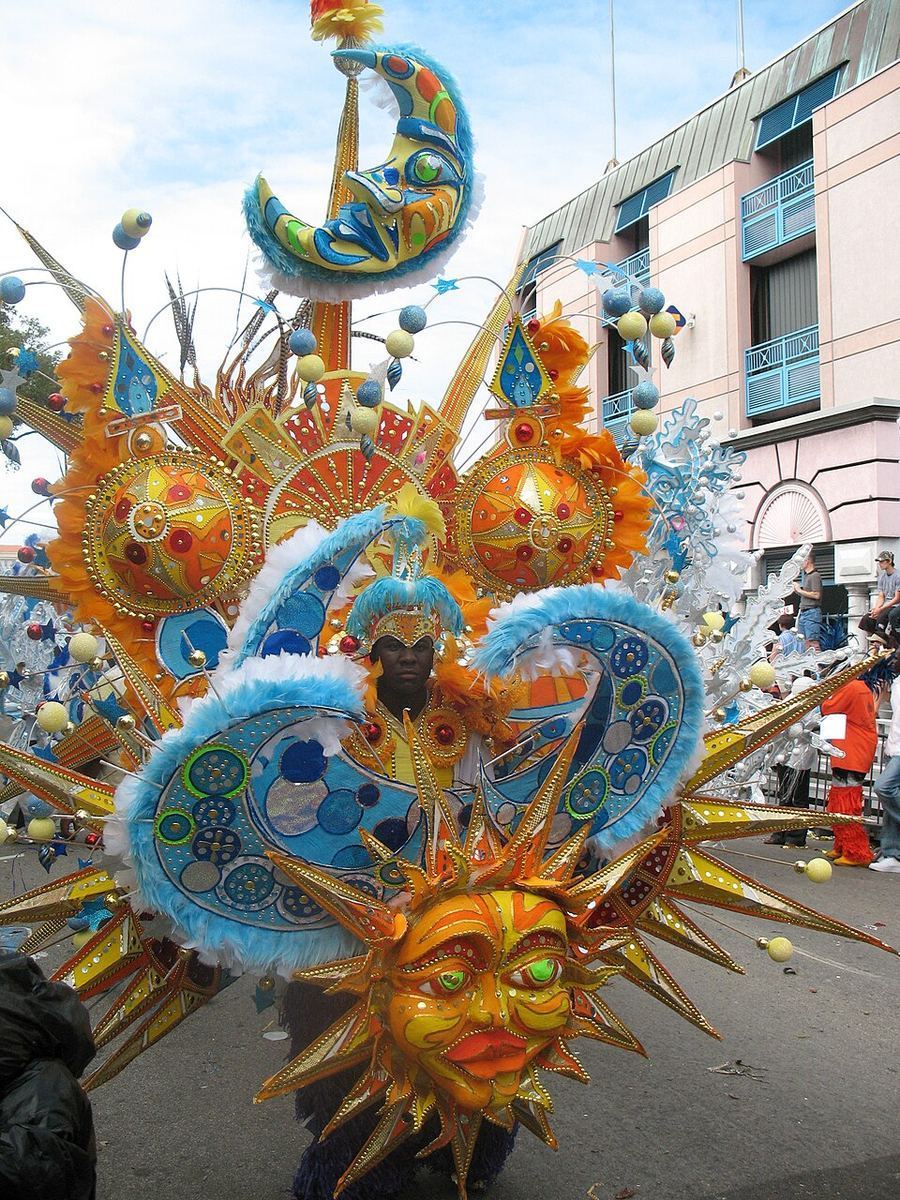
Bahamian culture is Afro-Caribbean at its base, British in its institutions and continuously exposed to the United States 80 kilometres away. Church membership is high and denominationally fragmented, with Baptist, Anglican, Methodist, Pentecostal and Seventh-day Adventist congregations shaping the week; Sunday dress and church music are central to social life, and the rhyming spiritual, an unaccompanied form of anthem singing with a lead and interlocking parts, is a distinctively Bahamian sacred style. Alongside formal religion, bush medicine and the folk practice known as obeah persist quietly. The great national expression is Junkanoo, a street parade of masked and costumed groups that rushes down Bay Street in Nassau in the small hours of Boxing Day and New Year's Day to goatskin drums, cowbells, whistles and brass; its rival organisations, among them the Valley Boys, Saxons Superstars and One Family, work all year on costumes of pasted crepe paper and are judged competitively. Family Island identity remains strong, and Bahamians commonly speak of themselves by their home island generations after moving to Nassau. Bahamian dialect, storytelling with the trickster figure of B'Rabby, and a strong tradition of boat building and sailing round out the picture.
Culture, Bahamas
Jon Worth / CC BY-SA 2.0

Points Of Pride

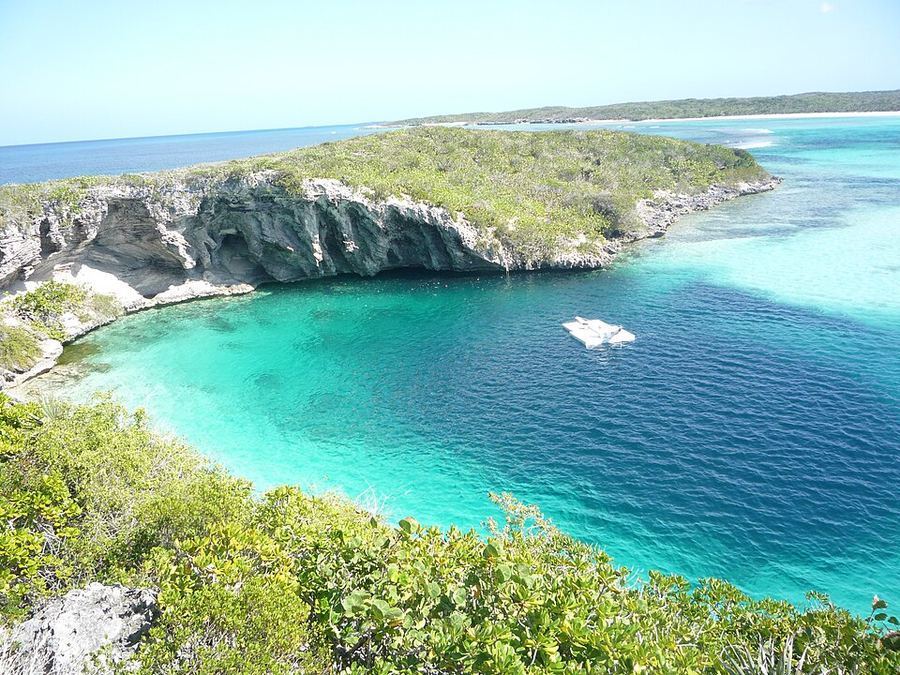
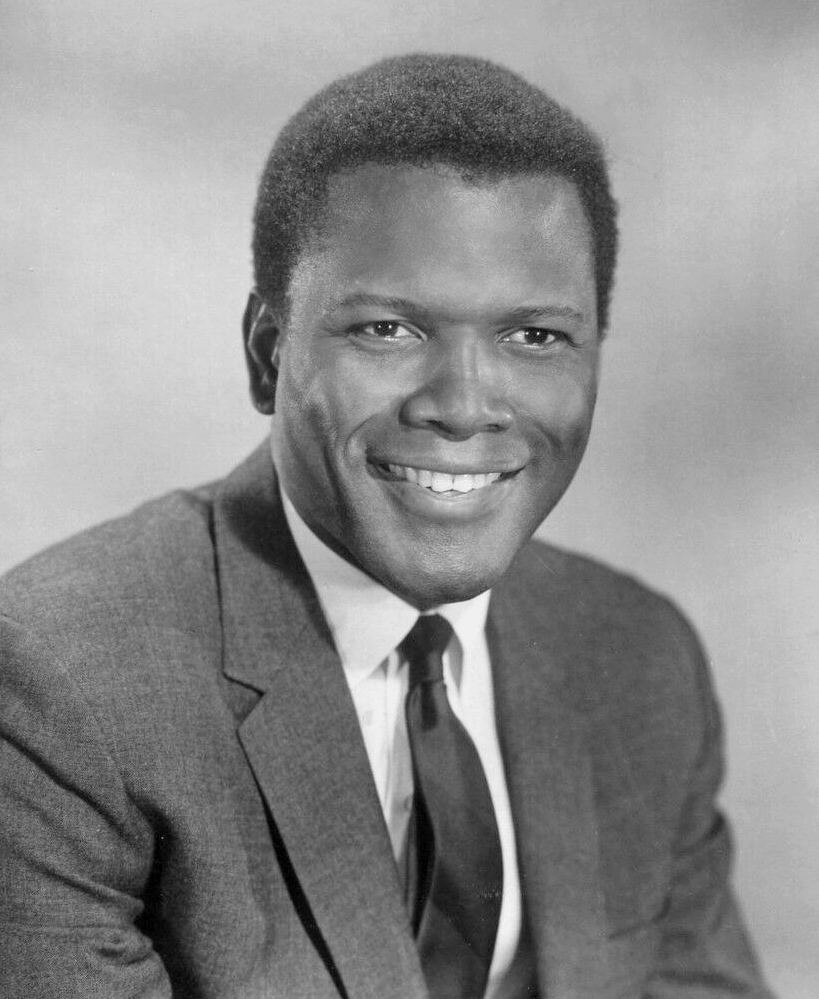
Junkanoo is the first thing Bahamians name, a parade tradition traced to the brief holidays allowed to enslaved people at Christmas and now the country's largest cultural event and a substantial year-round industry in costume construction. Environmentally, the Bahamas has a record other small states cite: the Exuma Cays Land and Sea Park, created in 1958, is generally described as the first park anywhere to protect land and sea together, and it became a full no-take reserve in 1986; the Bahamas National Trust, established by act of parliament in 1959, is an unusual arrangement in which a statutory non-governmental body manages the national park system. Inagua National Park protects the world's largest breeding colony of West Indian flamingos, the national bird, a population brought back from near-collapse. Andros is fringed by the third-largest barrier reef system in the world and riddled with more blue holes than anywhere else on earth, and Dean's Blue Hole on Long Island, some 200 metres deep, hosts world freediving competition. Sidney Poitier, whose family came from Cat Island, was the first Black man to win the Academy Award for best actor. Bahamian sprinters have won Olympic gold at a rate few larger nations match.
Points Of Pride, Bahamas
Banja-Frans Mulder / CC BY 3.0

Cultural Fusion

Bahamian society is a mixture assembled by the Atlantic. Its African foundation came with enslaved people from West and Central Africa, whose musical time, masking traditions and foodways underlie Junkanoo, goombay and bush medicine. British rule supplied the Westminster parliament, common law, the Anglican and Methodist churches, cricket and the wigs still worn in court. Loyalist planters from the Carolinas and Georgia brought both American Southern names and, involuntarily, the Black majority that outlived their failed plantations. At Red Bays on Andros, Black Seminoles who escaped Florida in the 1820s founded a settlement whose descendants still make coiled palm-top basketry in a recognisably Seminole style. Greek sponge merchants and divers settled in Nassau during the sponge boom and left a small but visible community and an Orthodox church. Chinese, Lebanese and Syrian trading families arrived in the twentieth century. Haitian migration, long-standing and continuing, has produced a large Haitian-descended population that speaks Kreyol at home and contributes food, music and labour while remaining the country's most contested social question. American influence is constant, through tourism, television, the currency peg and the shopping trip to Florida.
Cultural Fusion, Bahamas
Bluerasberry / CC BY 4.0

Music & Dance

Junkanoo music is the national sound: a marching rhythm carried by goatskin drums heated over fires until the head tightens, cowbells shaken in a two-handed rattle, whistles and, since the mid-twentieth century, brass and percussion sections playing arranged melodies over the top. The parade itself is a dance, with each group rushing in choreographed formation behind lead costumers. Rake-and-scrape is the older rural dance music, played on a carpenter's handsaw scraped with a screwdriver, a goatskin drum and an accordion or concertina, and it is most closely associated with Cat Island, where it accompanies the quadrille and the heel-and-toe polka inherited from European colonial dance and reworked locally. Goombay, named for the drum, became the popular song form of mid-century Nassau. The guitarist Joseph Spence of Andros, whose idiosyncratic thumb-driven arrangements of hymns were recorded in the 1950s, became an underground influence on American musicians including Ry Cooder and Taj Mahal. Blind Blake Higgs entertained Nassau's hotel circuit with calypso-inflected topical songs, and Ronnie Butler is remembered as the godfather of Bahamian popular music. The Baha Men took a Bahamian junkanoo-pop arrangement to a Grammy in 2001.
Music & Dance, Bahamas
kall_e from Ottawa, Canada / CC BY 2.0

Cuisine & Misattributed Foods

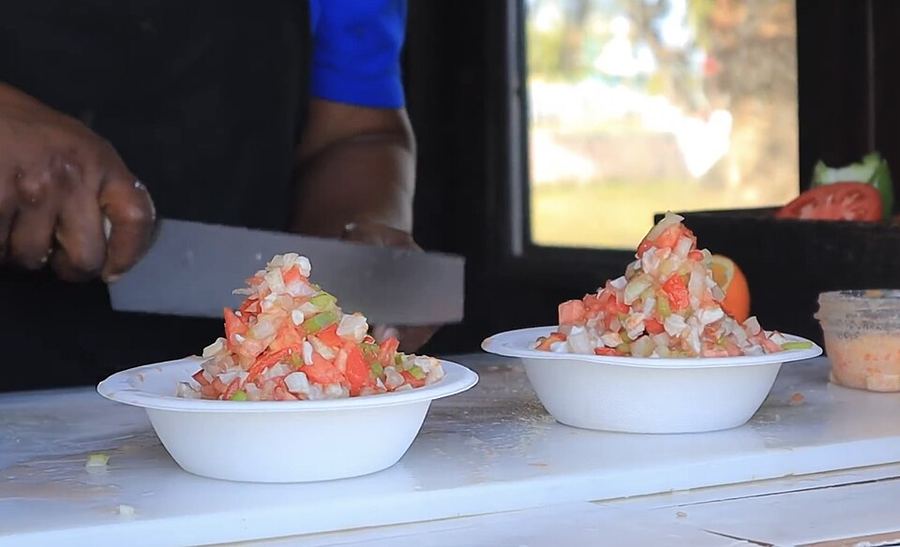
Conch, the large sea snail pronounced conk, is the national food and appears in every register: cracked conch pounded and fried in batter, conch fritters, conch chowder, and above all conch salad, cut raw at a counter and dressed with lime, sour orange, onion, sweet pepper and bird pepper while the customer watches. Spiny lobster, called crawfish locally, is the main export catch and a festive dish. Peas and rice, cooked with pigeon peas, salt pork, thyme and tomato, accompanies almost everything. Breakfast on the Family Islands means boil fish, a light broth of grouper with lime, onion and potato, eaten with johnnycake or with grits. Souse, a clear sharp broth of lime, onion and pepper with chicken, sheep tongue or pig's feet, is the standard weekend morning dish. Baked crab is an Andros speciality, and guava duff, a rolled steamed pudding of guava with a rum butter sauce, is the classic dessert. Drinks include switcha, the local limeade, sky juice made from gin and coconut water, and the domestic Kalik and Sands beers. The Fish Fry at Arawak Cay in Nassau and the stalls at Potter's Cay are the public face of the cuisine.
Cuisine & Misattributed Foods, Bahamas
Hannah On The Go / CC BY 3.0

National Dress

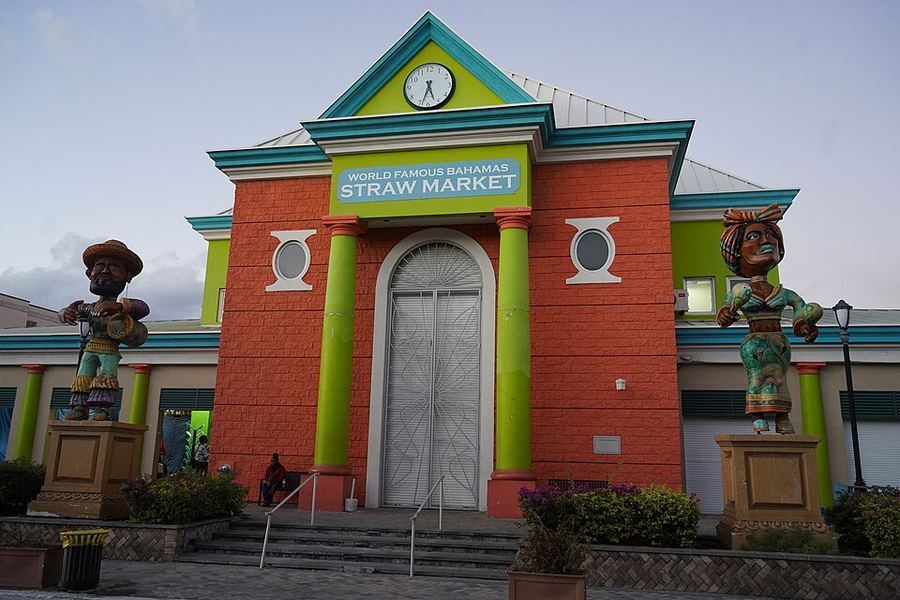
The Bahamas has no codified national costume in the sense of a fixed historical garment, and everyday dress is thoroughly Western, but three distinctly Bahamian traditions serve the same purpose. The first is the Junkanoo costume, an elaborate structure of cardboard and wire pasted over with finely fringed crepe paper in dense colour patterns, built over months by group members and worn once; the largest lead pieces are several metres across and are carried rather than worn. The second is Androsia, the hand-batiked cotton produced at Fresh Creek on Andros since 1973, in bold prints of shells, hibiscus, pineapples and fish on saturated grounds; it is used for shirts, dresses and resort wear, appears in school and hotel uniforms, and functions in practice as the national fabric. The third is straw work, the plaiting of palm and sisal fronds into hats, bags and mats, a craft associated with Long Island and the Nassau Straw Market and taught across generations of women. Formal public life retains British forms, with judges in wigs and gowns and men in tailored shirt-jackets rather than suits in the heat, and church dress on Sunday remains notably formal.
National Dress, Bahamas
EvelinaRibarova / CC BY-SA 4.0

Sports & Inspiring Athletes

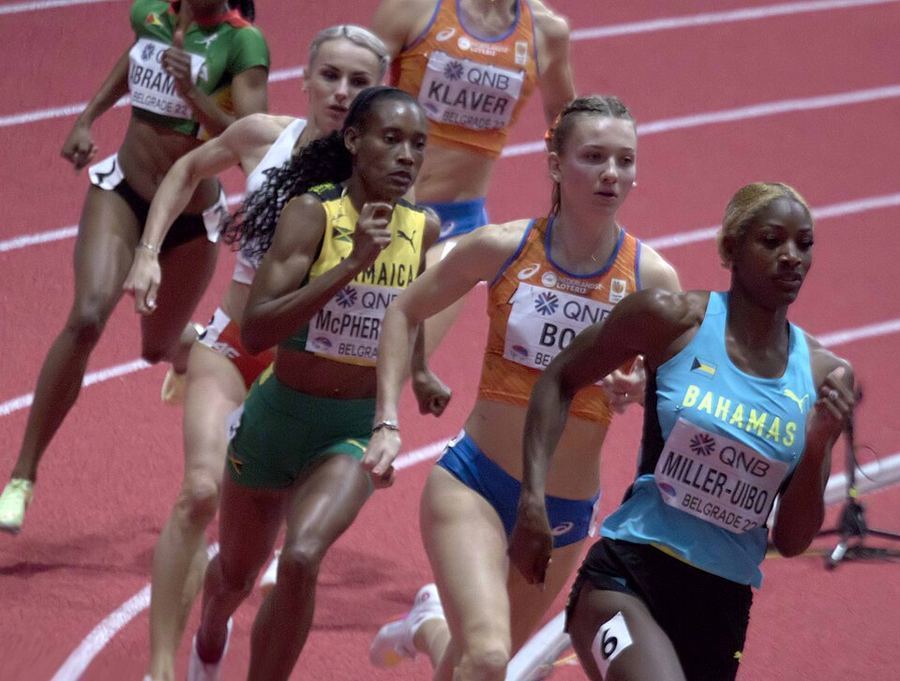
Track and field is the national sport in a way unusual for the Caribbean outside Jamaica, and the school system's inter-island athletics meets feed a pipeline that regularly produces world-class sprinters and quarter-milers from a population of a few hundred thousand. Sailing runs it close in cultural weight: the Bahamian sloop class raced at the Family Island regattas is governed by rules requiring locally built wooden boats, and the George Town regatta in Exuma has been held since 1954. Softball is the most widely played team sport at community level, and basketball has grown enormously, sustained by the visibility of Bahamian players in the NBA and by outdoor courts in every settlement. Football and rugby have smaller but organised followings, and cricket, once dominant under British rule and still played at Haynes Oval in Nassau, declined sharply after independence as American sport took over the television schedule. Water sports are ubiquitous, from spearfishing and free diving to sport fishing tournaments for marlin and bonefish. Boxing has produced national champions, and the country has hosted major international events, including the World Relays in Nassau in 2014, 2015, 2017 and 2024.
Sports & Inspiring Athletes, Bahamas
Iles du francois / CC0

Notable Educational Programs

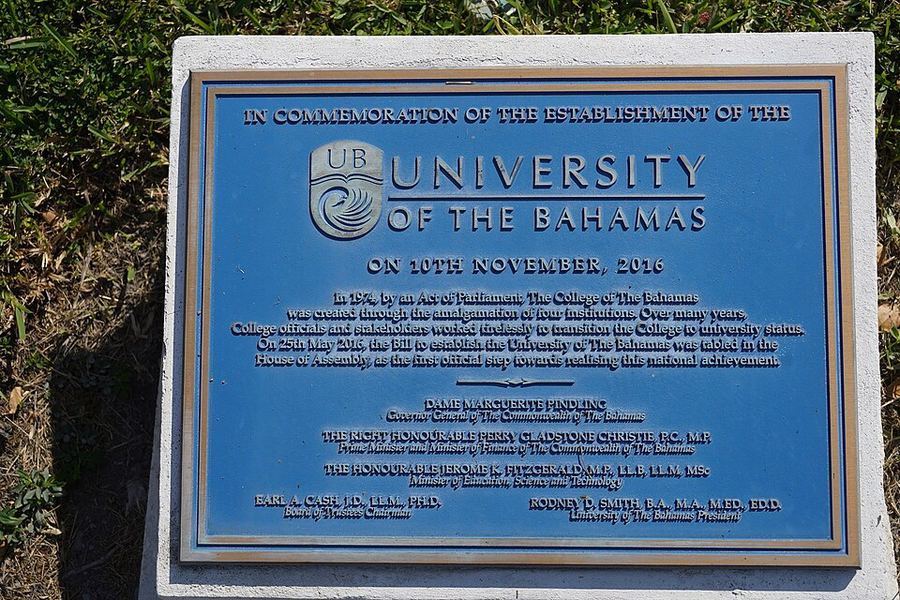
Education is free in government schools and compulsory between the ages of five and sixteen, and adult literacy is high, in the mid-nineties as a percentage. Delivering it across an archipelago is the central problem: many Family Island settlements support only small all-age schools, and secondary pupils frequently board or move to New Providence, so distance learning and inter-island transport are permanent policy questions. Pupils sit the Bahamas Junior Certificate and then the Bahamas General Certificate of Secondary Education, a national examination system introduced in the 1990s to replace British qualifications. The College of the Bahamas, founded in 1974, was elevated to the University of The Bahamas in 2016 and remains the principal national institution, with campuses in Nassau and Freeport and a research centre in Andros; the Bahamas Technical and Vocational Institute provides trades training, and the LJM Maritime Academy in Nassau trains merchant marine officers, a natural fit for a country with one of the world's largest ship registries. Government scholarships have long sent students to universities in the United States, Canada and the United Kingdom, and returning graduates staff much of the public service. Persistent weaknesses are boys' underachievement and low national examination pass rates.
Notable Educational Programs, Bahamas
Bluerasberry / CC BY 4.0

Wars & Conflicts

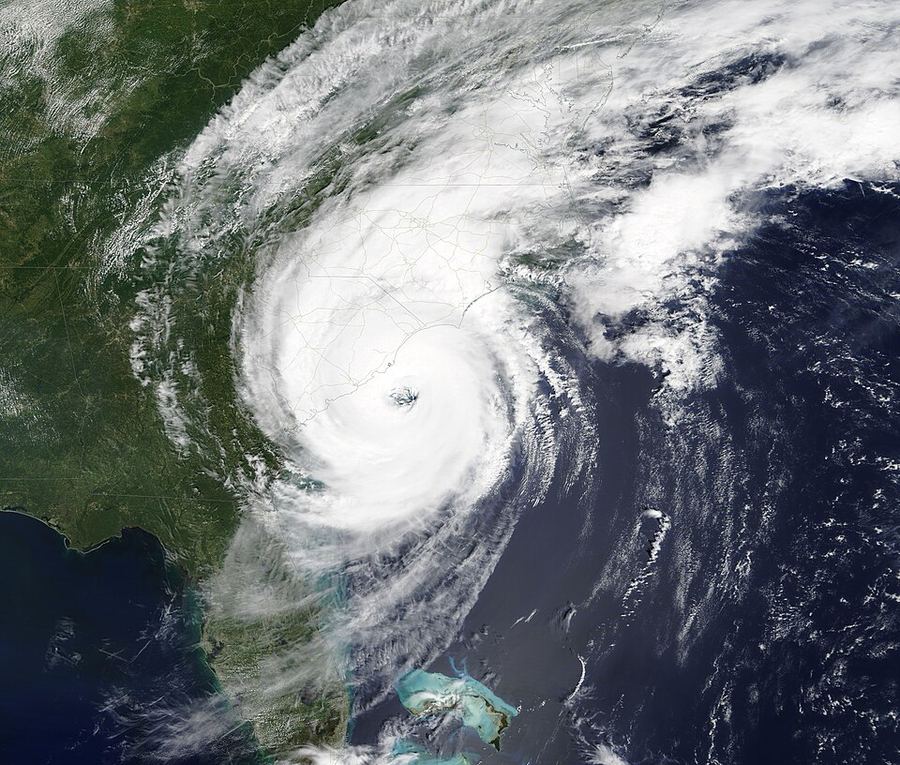
The Bahamas has no history of armed conflict since independence, no army in the conventional sense beyond the Royal Bahamas Defence Force, which is essentially a coastguard, and no involvement in foreign wars. Its security concerns are maritime and environmental. The archipelago sits directly on the route between South America and the United States, making drug and firearms trafficking through the cays a persistent problem addressed jointly with United States agencies under the long-running Operation Bahamas, Turks and Caicos arrangement. Irregular migration by sea, mainly Haitian and to a lesser degree Cuban, has been a continuous political and humanitarian issue for decades, and interdictions, detention at the Carmichael Road centre and repatriations have drawn criticism from human rights organisations, while the status of Bahamian-born people of Haitian descent under the citizenship provisions of the constitution remains legally contested. The most damaging event of recent decades was not conflict but weather: Hurricane Dorian stalled over Abaco and Grand Bahama on 1 to 3 September 2019 as a category five storm with sustained winds around 300 kilometres per hour, killing at least 74 people, leaving hundreds unaccounted for and destroying much of Marsh Harbour.
UNHCRHuman Rights WatchReutersUNUCDP
Current as of 2026-08-06
Wars & Conflicts, Bahamas
MODIS Land Rapid Response Team, NASA GSFC / Public domain

Land & Border Disputes

The Bahamas has no land borders and therefore no territorial disputes in the ordinary sense; every boundary question it has is maritime. Its claimed exclusive economic zone is very large relative to its land area and overlaps in places with those of the United States to the northwest, Cuba to the south and the Turks and Caicos Islands to the southeast, and delimitation with the United States in particular has been the subject of long-running negotiation rather than complete final agreement. The southern cays, including the isolated Cay Sal Bank lying much closer to Cuba than to any populated Bahamian island, are Bahamian territory but sit awkwardly within Cuban and American maritime space and are used heavily by traffickers and by migrant vessels. Fisheries enforcement against foreign poaching of spiny lobster and conch on the banks is a recurring friction, and the Royal Bahamas Defence Force devotes much of its capacity to it. The Bahamas has also been in periodic dispute with international bodies rather than states, having been listed and delisted by the OECD and the European Union over tax transparency and by the Financial Action Task Force over anti-money-laundering standards, each time responding with legislative change.
Land & Border Disputes, Bahamas
Larry Syverson from Richmond, VA, USA / CC BY-SA 2.0
Land, Life & Legacy

Land & Climate

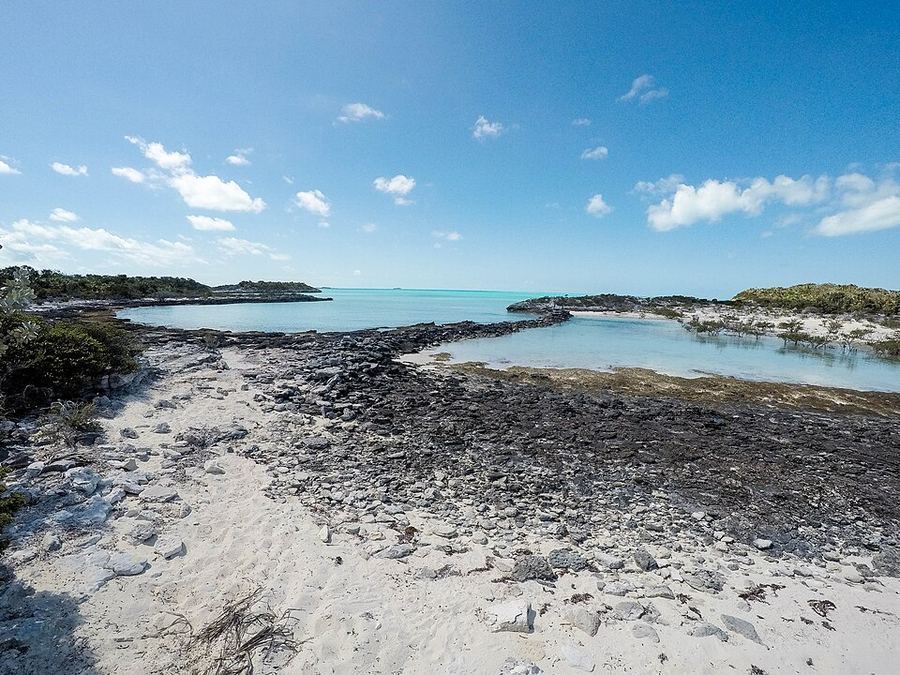
The Bahamas is not a volcanic island chain but the exposed high ground of two vast shallow carbonate platforms, the Little and Great Bahama Banks, built up from the accumulated skeletons of marine organisms. The land is consequently limestone, flat and extremely low: the highest point, Mount Alvernia on Cat Island, reaches only about 63 metres, and much of the country lies within a metre or two of sea level, which makes it one of the states most exposed to sea-level rise anywhere. The platforms are cut by deep channels, the largest being the Tongue of the Ocean between Andros and New Providence, which plunges to more than 1,800 metres. Dissolution of the limestone has produced spectacular karst features: Andros holds the world's greatest concentration of blue holes, and Dean's Blue Hole off Long Island is among the deepest known. There are no rivers; fresh water comes from thin lenses floating on saltwater within the rock, supplemented by desalination. The climate is tropical marine, warmed in winter by the Gulf Stream, with a wet season from May to October. Hurricanes are the dominant hazard: Dorian, which stalled over Abaco and Grand Bahama in September 2019 as a category five storm, was the most destructive on record here.
Land & Climate, Bahamas
Ton Engwirda / CC BY-SA 3.0 nl

Entertainment

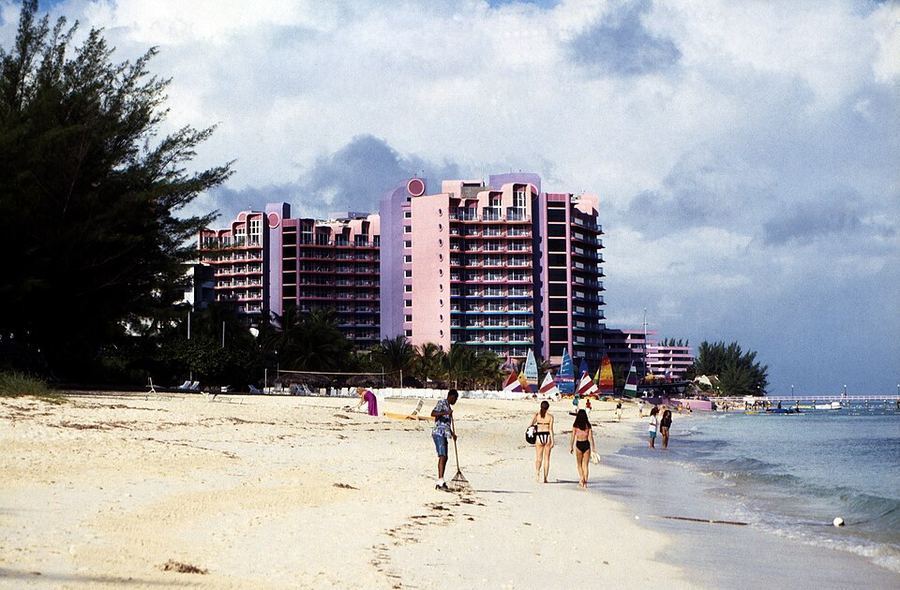
Life turns toward the water. Boating, snorkelling, spearfishing and above all bonefishing on the Andros and Abaco flats are ordinary weekend activities as well as a tourist industry, and the shallow banks make small-boat cruising unusually safe. Sailing regattas in traditional Bahamian sloops, single-masted wooden boats with enormous sail area and hiking boards for crew ballast, are the great Family Island events; the National Family Island Regatta at George Town in Exuma has run since 1954 and draws the diaspora home, with the All Abaco and Long Island regattas close behind. Junkanoo practice sessions in the shack, where groups build costumes and rehearse for months, are a social world in themselves. Softball and basketball are the participation sports of the neighbourhoods, dominoes are played competitively on porches and at bars, and church activities occupy much of Sunday and several weekday evenings. Beaches are a daily amenity rather than a holiday, with Cable Beach and Cabbage Beach near Nassau and the pink sand of Harbour Island the best known. Eating out means the fish fry, and gambling in the casinos is restricted to non-residents, so Bahamians play the licensed local number houses instead.
Entertainment, Bahamas
Rüdiger Stehn from Kiel, Deutschland / CC BY-SA 2.0

Art & Museums

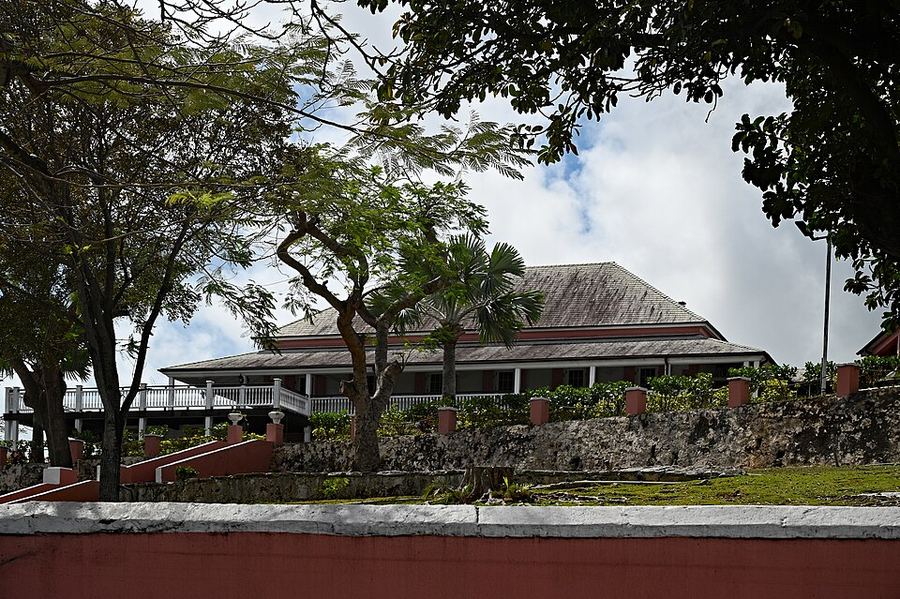
Bahamian visual art is dominated by two poles: the intuitive tradition and a trained contemporary scene, both of which the National Art Gallery of The Bahamas, opened in 2003 in the restored colonial Villa Doyle in Nassau, sets out to hold together. The outstanding intuitive painter was Amos Ferguson, a house painter from Exuma who worked in enamel on cardboard, signing his pictures with the phrase match me if you can, and whose flattened, brilliantly coloured scenes of biblical stories, Junkanoo and Bahamian folklore were exhibited internationally from the 1980s. Brent Malone, Max Taylor, Kendal Hanna and Antonius Roberts, whose carved standing figures in dead casuarina trunks mark shoreline sites, established the modern professional scene, and the artist-run Popopstudios in Nassau has sustained a younger generation. Janine Antoni, born in Freeport, became a major figure in international contemporary art with process-based sculpture and performance. Craft traditions carry equal weight: Junkanoo costume construction is an applied art of considerable sophistication, Androsia batik is designed and printed on Andros, and the coiled palm-top basketry of Red Bays descends directly from Seminole technique. Wood carving, shell work and boat building complete the picture.
Art & Museums, Bahamas
RealJunkanoo / CC BY-SA 3.0

Notable People

Sidney Poitier, whose parents were Cat Island tomato farmers and who spent his childhood in the Bahamas, became in 1964 the first Black man to win the Academy Award for best actor and later served as Bahamian ambassador to Japan. Sir Lynden Pindling led the country to majority rule in 1967 and independence in 1973 and is called the father of the nation; Sir Milo Butler became the first Bahamian governor-general. In music, the Andros guitarist Joseph Spence is the most influential figure abroad, and Ronnie Butler and the Baha Men the best known at home. Amos Ferguson is the country's signature painter and Janine Antoni its most prominent contemporary artist. Sport supplies most of the modern names: Sir Durward Knowles won the country's first Olympic gold in Star class sailing at Tokyo in 1964 and competed at eight Games; Pauline Davis-Thompson, Chandra Sturrup, Debbie Ferguson-McKenzie, Savatheda Fynes and Eldece Clarke won the 4x100 metres relay at Sydney in 2000 as the Golden Girls; Tonique Williams-Darling, Shaunae Miller-Uibo and Steven Gardiner have all won Olympic 400 metres titles. In basketball, Mychal Thompson and Deandre Ayton were both first overall picks in the NBA draft, and Buddy Hield has had a long NBA career.
Notable People, Bahamas
Unknown photographer / Public domain

Inventions & Breakthroughs

The Bahamas has contributed institutional and design innovations rather than devices. The most significant is conservation: the Exuma Cays Land and Sea Park, declared in 1958, was the first protected area anywhere to be conceived as a single unit of land and sea, and its conversion into a fully no-take reserve in 1986 provided one of the earliest and best-studied demonstrations that closed areas replenish adjacent fisheries, evidence that shaped marine reserve policy internationally. The pairing of that park with the Bahamas National Trust, a statutory body created by parliament in 1959 to manage the whole national park system, remains an unusual governance model. In finance, the Central Bank of the Bahamas launched the Sand Dollar in October 2020, the first central bank digital currency to be rolled out nationwide anywhere in the world, designed to serve scattered island settlements that commercial banks had withdrawn from. In design, the Bahamian sloop, a shallow-draft working sailboat carrying an oversized mainsail and crewed from hiking boards, was developed locally for sponging and fishing on the banks and survives as a strictly regulated racing class. Androsia batik, created on Andros in 1973, established a domestic textile design industry from nothing.
Inventions & Breakthroughs, Bahamas
Craig Stanfill / CC BY-SA 2.0

Science & Technology

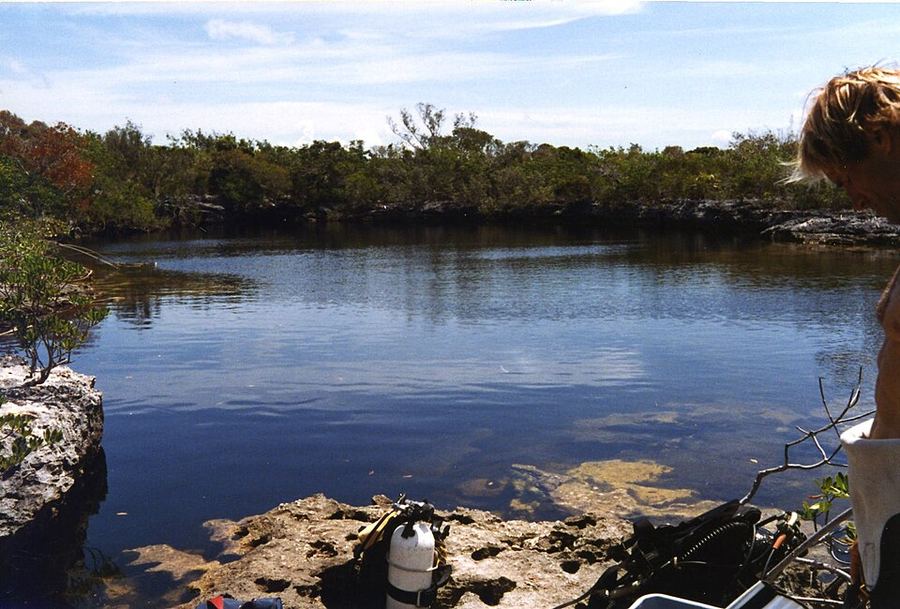
Bahamian science is overwhelmingly marine. The Tongue of the Ocean, a deep trench with exceptionally quiet acoustic conditions, hosts the Atlantic Undersea Test and Evaluation Center on Andros, a United States Navy facility operating there since the 1960s and one of the world's principal deep-water acoustic and sonar test ranges. The blue holes of Andros and Abaco have become internationally important research sites: their stratified anoxic waters preserve microbial communities of interest to astrobiologists, and cave diving in Sawmill Sink on Abaco has recovered exceptional fossil material, including remains of Cuban crocodiles and tortoises and Lucayan human remains, that has rewritten the islands' ecological history. The Perry Institute for Marine Science and the Cape Eleuthera Institute run long-term coral reef, shark and fisheries research, and the Bahamas has been a testing ground for marine reserve science since the Exuma park closures. In technology, the Central Bank's Sand Dollar made the country the first in the world to deploy a retail central bank digital currency nationally in 2020. Climate adaptation research, particularly on sea level rise and hurricane resilience, is a national priority given the country's extreme low elevation.
NatureScienceIMFIPCC
Science & Technology, Bahamas
R Pollack at English Wikipedia / Public domain
On The World Stage
Champions of Bahamas

Champions & Defining Moments

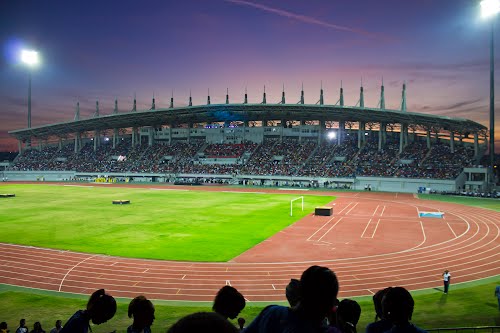
For its size the Bahamas is among the most successful Olympic nations in the world, with almost all of its medals coming from sprinting and relays. Sir Durward Knowles and Cecil Cooke won Star class sailing gold at Tokyo in 1964, the country's first title. At Sydney in 2000 the women's 4x100 metres relay team known as the Golden Girls won gold, and Pauline Davis-Thompson took the 200 metres. Tonique Williams-Darling won the 400 metres at Athens in 2004, Shaunae Miller-Uibo won it at Rio in 2016 with a dive across the line and again at Tokyo in 2021, and Steven Gardiner won the men's 400 metres at Tokyo after taking the world title in Doha in 2019. The country has also won world championship medals in the men's and women's relays. Nassau's Thomas A. Robinson Stadium hosted the World Athletics Relays in 2014, 2015, 2017 and 2024, giving the Bahamas a permanent event on the global athletics calendar. In basketball, Mychal Thompson in 1978 and Deandre Ayton in 2018 were selected first overall in the NBA draft, Thompson being the first foreign-born player taken at number one.

OlympediaWorld AthleticsIOC
filip bossuyt / CC BY 2.0
Government & Leadership

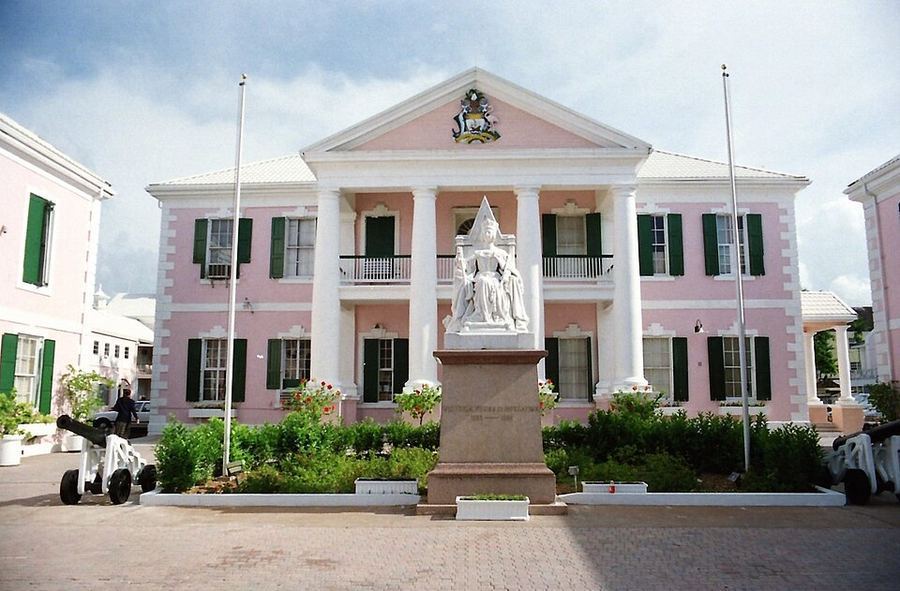
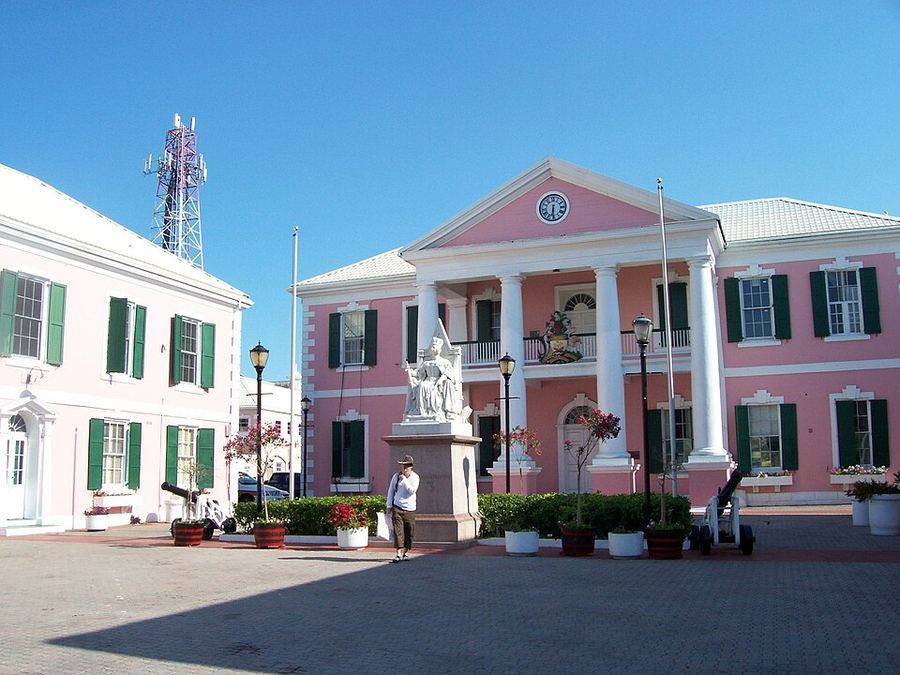
Parliamentary democracy under a constitutional monarchy; a Commonwealth realm

Seat of the executive

Executive

Charles III — King

In office since 8 September 2022

Philip Edward Davis — Prime Minister

P. Hughes / CC BY 4.0
The legislature

Parliament

Bicameral

Senate — 16 seats

Last election 10/6/2021 · 31.3% women

House of Assembly — PLP majority

PLP 32 · FNM 7

Last election 9/16/2021 · 17.9% women

The highest court
The highest court — Roger W / CC BY-SA 2.0

Court of Appeal

consists of the court president and 6 justices, organized in 3-member panels); Supreme Court (consists of the chief justice and 19 justices

Economy, Trade & Government

Currency & GDP

Bahamian Dollar — BSD ($)

GDP (PPP): $14.544 billion (2024 est.)

Per capita: $36,200 (2024 est.)

Exports

$6.771 billion (2024 est.)

refined petroleum, ships, aluminum, shellfish, plastics (2023)

Partners: USA 36%, Zimbabwe 16%, Cote d'Ivoire 14%, Germany 8%, Guyana 8% (2023)

Imports

$7.069 billion (2024 est.)

refined petroleum, ships, aircraft, cars, crude petroleum (2023)

Partners: USA 60%, Germany 13%, China 5%, Japan 3%, Brazil 2% (2023)

Government

Type: parliamentary democracy under a constitutional monarchy; a Commonwealth realm

Independence: 10 July 1973 (from the UK)

Terrain → Where People Live

How mountains, coasts, and rivers shape settlement (LandScan).

Coming — data

Migration & Ethnic Settlement

Where groups settled and how people move (GeoEPR + UNHCR).

Coming — data

Universities

Notable institutions, mappable as points.

Coming — data
Economy & government facts: CIA World Factbook (public domain), via OpenFactBook / factbook.json.
Every fact and narrative claim will carry a visible source citation. Data-driven sections light up automatically wherever HERA has coverage.