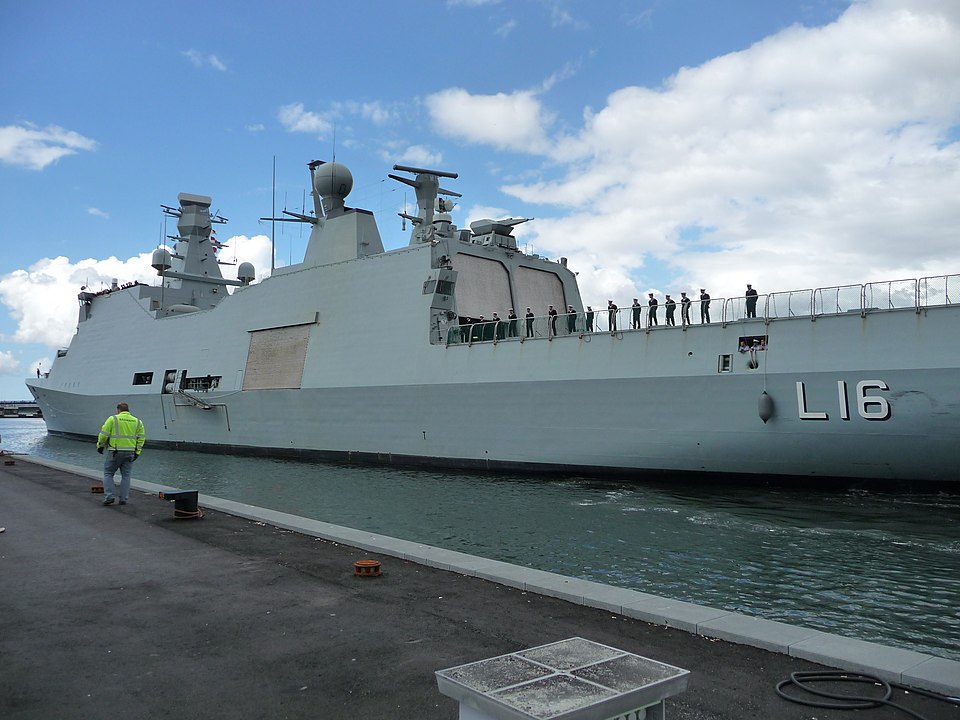
Denmark is not a party to any armed conflict, but the week to 21 September 2026 brought the sharpest direct military encounter with Russia in years and what may be the resolution of the Greenland sovereignty crisis with the United States. On Monday 14 September, the Danish Armed Forces said a Russian frigate fired two flares at a Royal Danish Air Force Fennec helicopter that had been sent to photograph the ship in international waters south of Gedser, in the Baltic Sea; one flare passed within 'a matter of metres' of the aircraft, with no warning or radio contact beforehand, Defense Minister Jeppe Bruus told Reuters. No one was hurt and the helicopter broke off and returned to base (Reuters via U.S. News, 15 September 2026; Euronews, 15 September 2026; Bloomberg, 15 September 2026). Prime Minister Mette Frederiksen called it 'reckless action from Russia towards Danish military during a routine overflight' and said Russia 'wants to sow fear and discord'; Foreign Minister Lars Løkke Rasmussen said 'Russia is gradually shifting the boundary for what they consider acceptable behaviour' and summoned Russia's ambassador, Vladimir Barbin. Barbin gave the opposite account: he blamed 'dangerous manoeuvres' and 'provocative actions' by the Danish aircraft near the vessel, delivered a formal note demanding steps to prevent a repeat, and said Moscow would investigate (Al Jazeera, 15 September 2026; Euronews, 15 September 2026). Russia's Defense Ministry has not publicly identified the frigate. Copenhagen's response was to bring forward its 31st military aid package for Ukraine, 1.8 billion kroner (about $275 million) directed mainly at air defense ahead of the autumn-winter period, with contents undisclosed for security reasons; Bruus said 'if the Russians think they can intimidate us, our response is to increase support for Ukraine even faster than we planned' (Bloomberg, 18 September 2026; Reuters, 18 September 2026; Ukrinform, 19 September 2026). The incident came after Denmark's Security and Intelligence Service (PET) warned on 3 September that Russian intelligence services are 'actively preparing acts of sabotage targeting the defence industry in Denmark', recruiting ordinary Danes through social media to photograph companies with ties to Ukraine (Reuters and Euronews, 3 September 2026); PET has named no company and no attack on Danish soil has been publicly attributed. On 16 September a drone sighted near Bruus's home in Gladsaxe triggered a police cordon and a bomb-disposal callout before being identified as a hobby drone with no hostile intent (Dronewatch Europe, September 2026). On Greenland, President Trump announced on Truth Social on Friday 18 September that the United States had 'entered into an Agreement with The Kingdom of Denmark, and Greenland, that gives the United States permanent control over security, and all other needs, in Greenland', that Washington would 'immediately begin the process of developing a large Military presence in the appropriate part of Greenland', and that no U.S. adversary could have a base, military presence or sensitive investment there without express written U.S. approval (CNN, 18 September 2026; NBC News, 18 September 2026; CNBC, 18 September 2026). Reporting on the text, which has not been made public, says it recognises the Kingdom's sovereignty and territorial integrity and Greenlanders' right to self-determination, bars any non-NATO base or troop presence, and adds investment screening aimed at Russia and China (Al Jazeera, 18 September 2026; NPR, 19 September 2026). Frederiksen and Greenlandic Premier Jens-Frederik Nielsen both welcomed the deal but neither described it as a transfer of control: Frederiksen said it 'strengthens our common security in the Arctic and the North Atlantic area' and 'recognises the sovereignty and territorial integrity of the Kingdom and the Greenlandic people's right to self-determination', and Nielsen said it would 'ensure and strengthen the security of Greenland, the Kingdom of Denmark, the United States, and the Western Alliance' (AP via ABC News, 19 September 2026; PolitiFact, 19 September 2026). Rasmussen said on 21 September that responsibility for Arctic security under the agreement 'is not only Danish or American' and that 'to a large extent it would be NATO that looks after the Arctic' (Reuters via Defense News, 21 September 2026). The three governments are expected to sign in New York on Tuesday 22 September during the UN General Assembly, after which the deal must pass parliamentary procedures to enter into force; it grew out of the U.S.-Danish-Greenlandic working group formed in January 2026, and while CBS News described the Danish and Greenlandic leaders as 'cautiously optimistic', some commentators have called it 'largely a rebranding of the status quo to claim a win' (CNN, 18 September 2026; CBS News, September 2026; Common Dreams, 21 September 2026). Meanwhile NATO's Military Committee met at chiefs-of-defense level in Copenhagen on 18-19 September, chaired by Admiral Giuseppe Cavo Dragone with all 32 allied chiefs plus SACEUR General Alexus Grynkewich and SACT Admiral Pierre Vandier; it followed up the Ankara summit on deterrence, readiness, innovation and support for Ukraine, told industry that 'Allies are ready to buy at scale', and elected Germany's General Carsten Breuer as the next Chair. Denmark's Chief of Defense, General Michael Wiggers Hyldgaard, said allies 'once again show their commitments to strengthening the Alliance ... and our support for Ukraine' (NATO, 19 September 2026). The Danish-led exercise Arctic Shield concluded on 18 September after just under two weeks in southern Greenland and near Kangerlussuaq, with about 400 soldiers from 11 allied nations (Danish Armed Forces, September 2026; High North News, September 2026). On the eastern flank, 200-300 troops from Denmark's roughly 800-strong battalion at Camp Valdemar, Latvia, continue in Latvia's Namejs 2026 exercise (2 September-8 October) in the country's northeast near the Russian border, playing the opposing force (LSM, 2 September 2026; Danish Armed Forces, September 2026).
Last reviewed 2026-09-21 · 2 weeks ago