HERA · Human Entity Reference Atlas by Masego Inc

← Kyrgyzstan 🌐 3D View
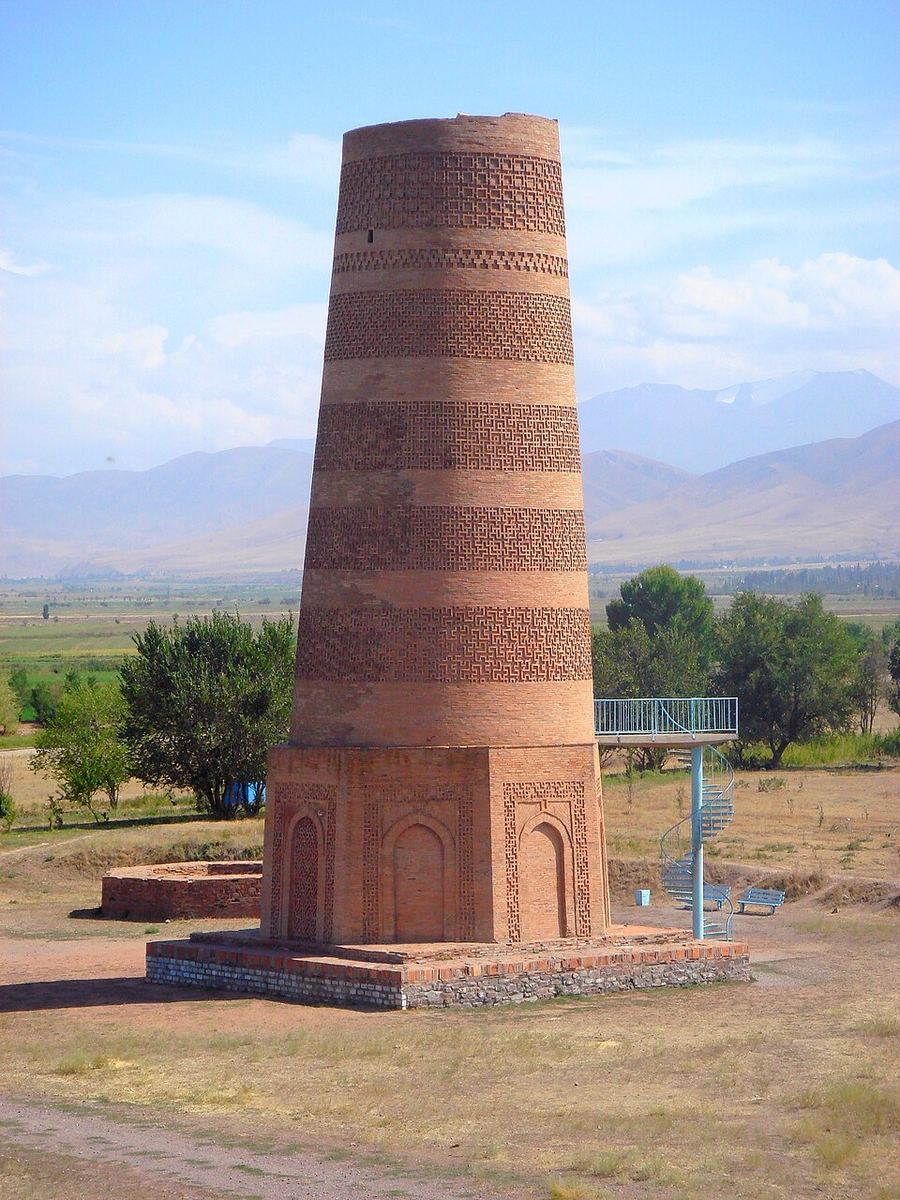
Burana Tower, Kyrgyzstan 01, Kyrgyzstan
Kyrgyzstan KGZ
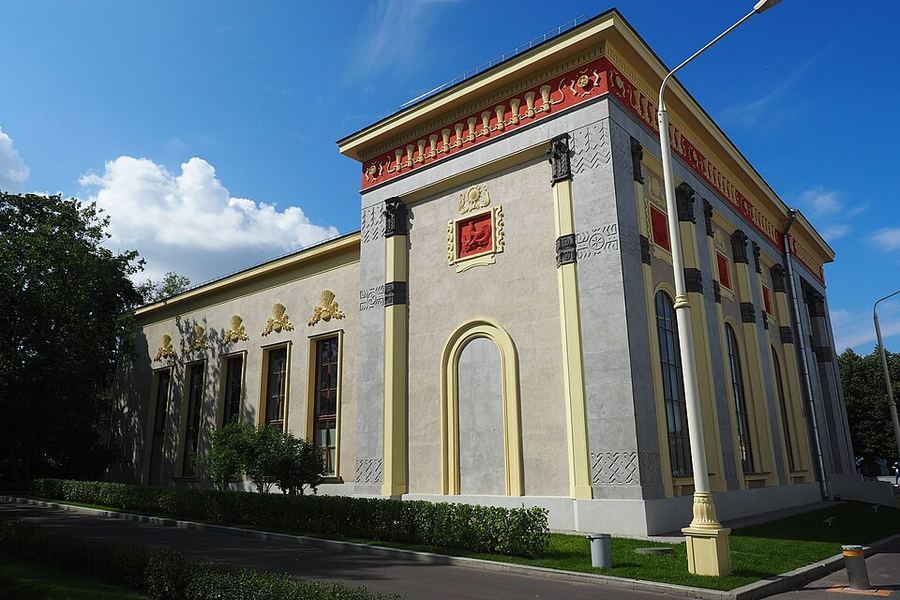
Burana Tower, Kyrgyzstan 01 — Photo: Bgag / CC0 via Wikimedia Commons
Did You Know The tunduk — the wooden crown wheel at the apex of a Kyrgyz yurt — is the emblem at the centre of the national flag. — Encyclopaedia Britannica

Kyrgyzstan is a mountainous Central Asian republic of roughly 6.2 million people, wedged between Kazakhstan, China, Tajikistan and Uzbekistan, in which more than nine-tenths of the territory lies above 1,500 metres and the Tien Shan and Pamir-Alay ranges occupy nearly the whole country. Bishkek, on the northern plain below the Kyrgyz Ala-Too, is the capital and largest city; Osh, in the Fergana Valley, is the southern centre and one of the oldest continuously inhabited towns in Central Asia. Independence from the Soviet Union came on 31 August 1991. Kyrgyz make up about 74 percent of the population, with a substantial Uzbek community of nearly 15 percent concentrated in the south and a Russian minority of around 5 percent, alongside Dungan, Uyghur, Tajik, Tatar and Korean communities. Kyrgyz is the state language and Russian holds official status, a rare formal arrangement in the region. Around 90 percent of the population is Muslim, predominantly Sunni, with a Russian Orthodox minority. The economy is small and open, dependent on gold from the Kumtor mine, on hydroelectricity, on re-export trade with China and above all on remittances from Kyrgyz working abroad, chiefly in Russia — among the highest such shares of national income anywhere.

CIA World FactbookEncyclopaedia BritannicaWorld Bank
Population
6,219,751
Capital
Bishkek
Currency
None KGS
Time zones
Largest city
Bishkek
Human Geography Themes
Loading national figures…
Largest Cities
Bishkek1,428,079
Osh481,389
Jalal-Abad122,863
Özgön86,254
Nookat63,786
Kara-Balta62,858
Suzak57,880
Ak-Bulun55,512
In Perspective

Bishkek's urban core is home to about 1,428,079 people.

That's bigger than Amsterdam — each a great world city in its own right.

Bishkek1,428,079
Amsterdam1,223,407

Among the world's megacities, though, it's one of many — the giants of Asia and Latin America run larger still:

Bishkek1,428,079
Jakarta40,545,126
Dhaka37,307,160
Tokyo33,244,670
Shanghai30,678,616
Cairo25,230,325
The Country & Its People

History

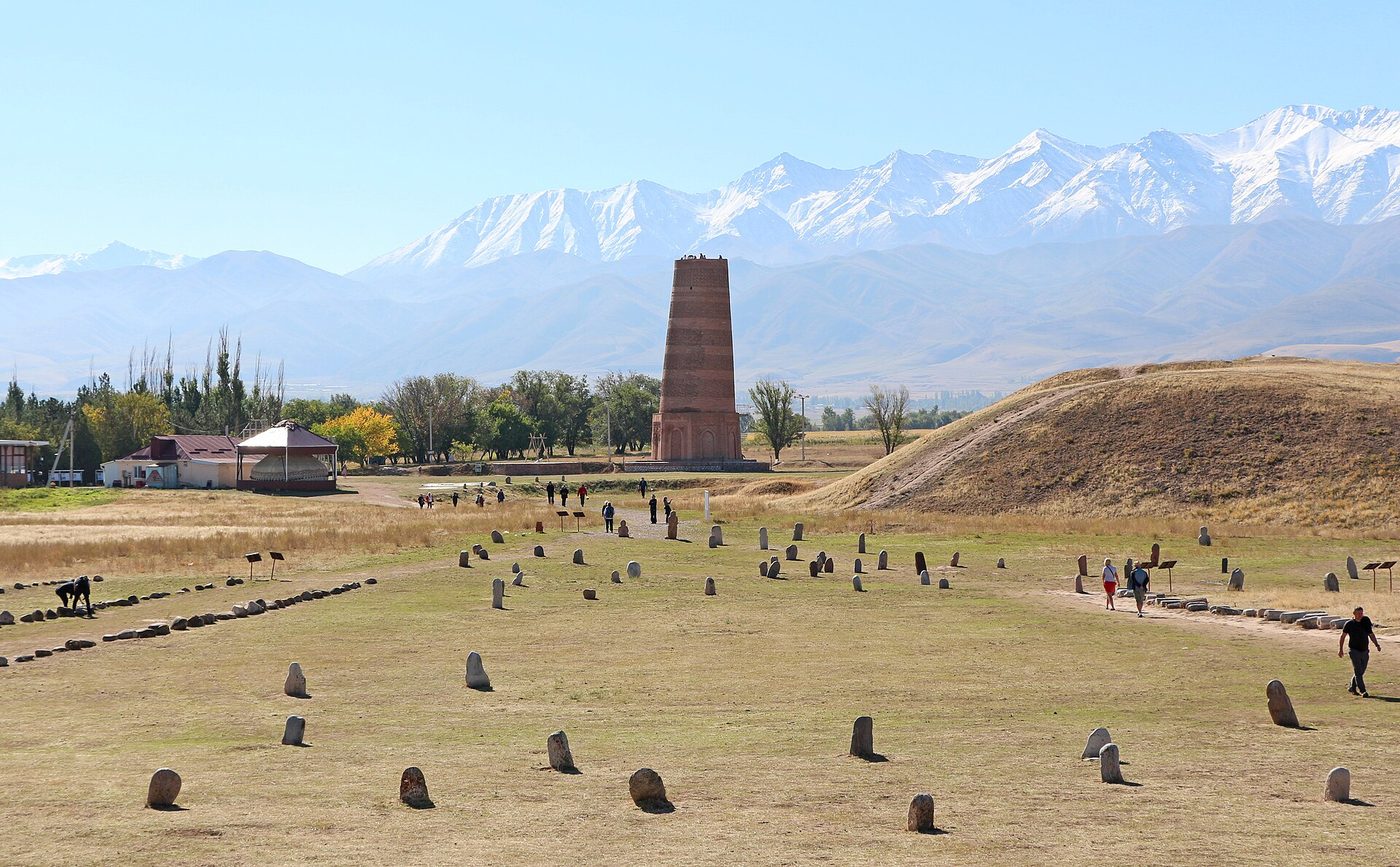
The Kyrgyz trace their origins to Turkic-speaking peoples of the Yenisei region in southern Siberia, who from the ninth century built a khaganate there before migrating south into the Tien Shan over subsequent centuries; the Manas epic preserves the memory of that movement and of the struggle to hold territory. The high valleys and the Fergana rim were crossed by the Silk Road, and Osh, Uzgen and the Chuy valley carried caravan traffic between China and the Islamic world, with the Burana tower near Tokmok surviving from the eleventh-century Karakhanid capital of Balasagun. Mongol conquest and later Oirat pressure reshaped the region, and in the eighteenth and nineteenth centuries the Kyrgyz fell under the Khanate of Kokand before Russian imperial forces annexed the territory in the 1860s and 1870s. The 1916 Urkun revolt against wartime conscription was suppressed with great loss of life and drove thousands of Kyrgyz across the mountains into China. Soviet rule brought the Kyrgyz Autonomous Oblast, then a union republic in 1936, along with mass literacy, forced settlement of nomads and collectivisation. Independence followed in August 1991 under Askar Akayev, and the country has since removed two presidents by popular uprising, in 2005 and 2010, and a third in unrest in 2020.
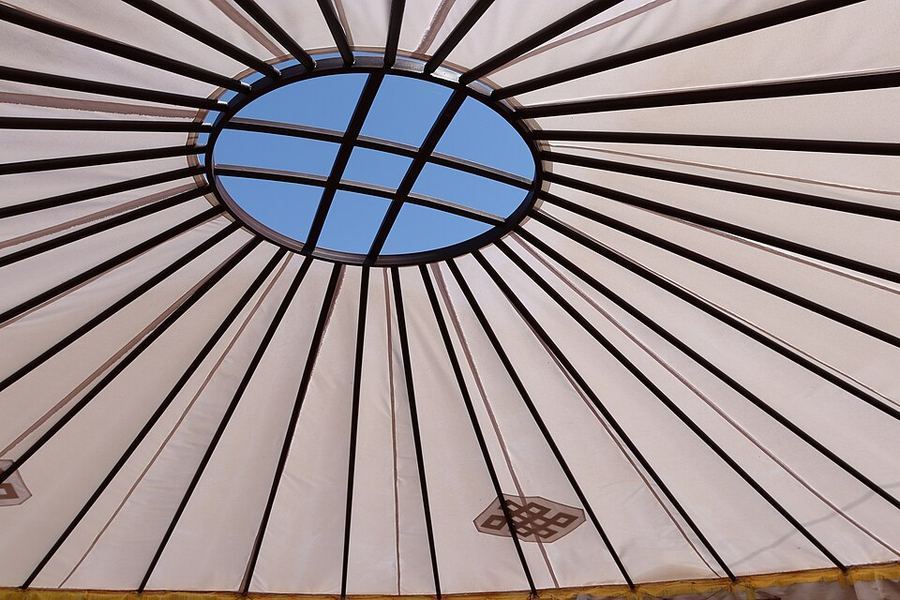
Culture

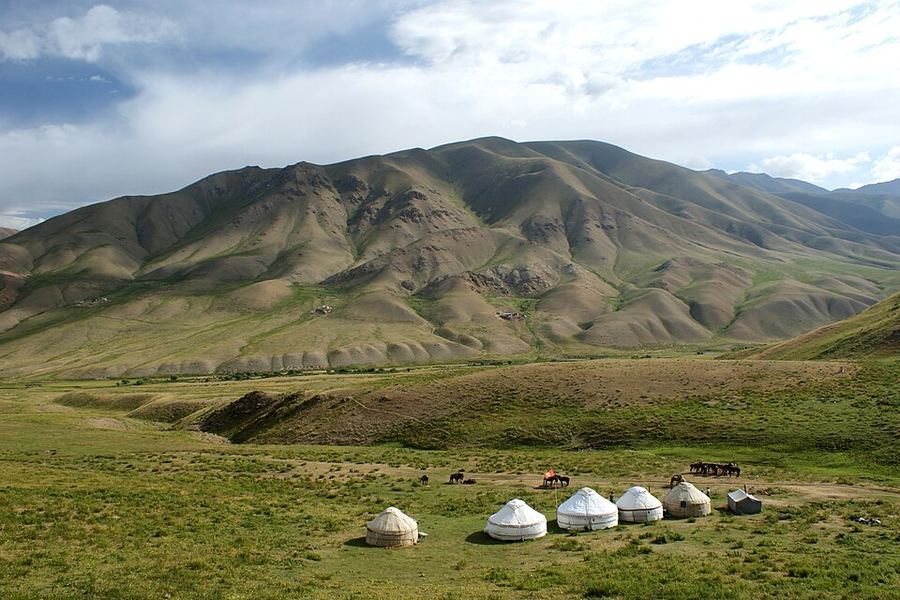
Kyrgyz culture is a mountain variant of the Central Asian nomadic tradition, and it has held on to its material forms unusually well. The boz uy, the Kyrgyz yurt, is central: its wooden frame, felt covering and tunduk crown wheel are still made by hand, still used on summer pastures, and the tunduk itself sits at the centre of the national flag. Transhumance is a live practice rather than a memory — families still move flocks to the high jailoo pastures each summer, and much of rural income depends on it. Hospitality is obligatory and elaborate, with bread never placed upside down, the guest seated at the head of the dastorkon and the sheep's head offered to the most senior person present. Islam, adopted gradually from the Karakhanid period onward, is practised in a form that retains pre-Islamic Tengri elements, including reverence for ancestors and for natural sites; the sacred mountain Sulaiman-Too above Osh is the clearest expression of that layering. Kinship is reckoned through the seven-fathers rule, by which a Kyrgyz should be able to name seven generations of paternal ancestors, and clan and regional identity, particularly the north-south division, remains politically significant.

Points Of Pride

The Epic of Manas is the country's supreme cultural possession: a sung oral poem about the hero who united the Kyrgyz tribes, whose fullest recorded versions run to hundreds of thousands of lines, making it one of the longest epics known anywhere and many times the length of the Iliad and Odyssey combined. It is performed by specialist reciters called manaschi, without instruments, from memory, and UNESCO has inscribed the Kyrgyz epic trilogy of Manas, Semetey and Seytek on its intangible heritage lists. Sulaiman-Too Sacred Mountain, rising above Osh and used as a place of pilgrimage for a millennium and a half, was the country's first World Heritage site, joined by the Silk Roads Chang'an–Tianshan corridor and the Western Tien-Shan. Lake Issyk-Kul, the second-largest mountain lake in the world by volume and saline enough not to freeze at 1,600 metres, is a biosphere reserve and the centre of domestic tourism. Kyrgyzstan is also proud of its yurt-making and felt-carpet traditions, both UNESCO-recognised, and of the World Nomad Games, which it created in 2014 to give traditional Central Asian sports an international competition.

Cultural Fusion

Kyrgyzstan sits where the Turkic steppe meets the settled Persianate oasis world, and the seam runs through the country geographically. The north, opening onto the Kazakh plain and shaped by Russian settlement, railway towns and Soviet industry, is more Russian-speaking and more secular in habit; the south, in and around the Fergana Valley, is more densely populated, more religiously observant and home to the large Uzbek community whose towns, mosques and mahalla neighbourhood structures belong to the sedentary Central Asian tradition. Soviet-era deportation and migration added Volga Germans, Koreans and Chechens, while the Dungan — Chinese-speaking Muslims who fled Qing reprisals in the 1870s — established villages in the Chuy valley and gave the country a distinctive cuisine of hand-pulled noodles and vinegar-sharp salads. Uyghur communities connect the country to Xinjiang across the Torugart and Irkeshtam passes. Russian remains an official language and the medium of much higher education, media and labour migration, so many Kyrgyz function in two languages daily, and the returning migrant economy carries Russian habits and money back into mountain villages.

Music & Dance

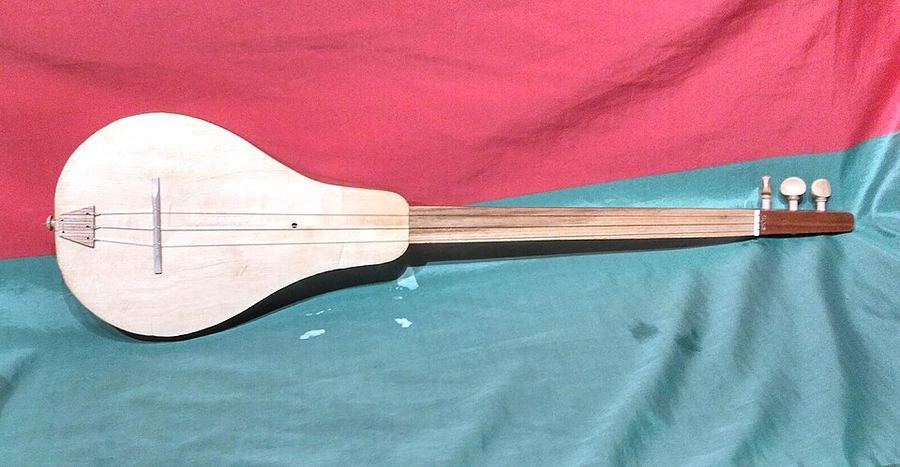
The komuz, a three-stringed fretless lute carved from a single piece of apricot or juniper wood, is the emblematic Kyrgyz instrument, played with a percussive, tumbling right hand and often accompanied by a performer's own theatrics, the instrument tossed and caught mid-phrase. The kyl kyyak, a two-stringed horsehair fiddle, and the temir komuz, a metal jaw harp associated with women's playing, complete the core ensemble, and UNESCO recognises the craftsmanship and performance art of these instruments. The dominant vocal tradition is narrative rather than lyrical: the manaschi recites the Manas epic in a driving chant, sometimes for hours, entering a heightened state that performers describe as receiving the story rather than remembering it. Alongside it stand the akyn, improvising poets who compete in aitysh, sung verse duels also inscribed by UNESCO. Toktogul Satylganov, the early twentieth-century akyn, is the canonical figure and lends his name to a region, a reservoir and countless institutions. Soviet conservatory training added opera, choral work and a national orchestra of folk instruments in Bishkek, and contemporary Kyrgyz pop and rock frequently return to komuz motifs.

Cuisine & Misattributed Foods

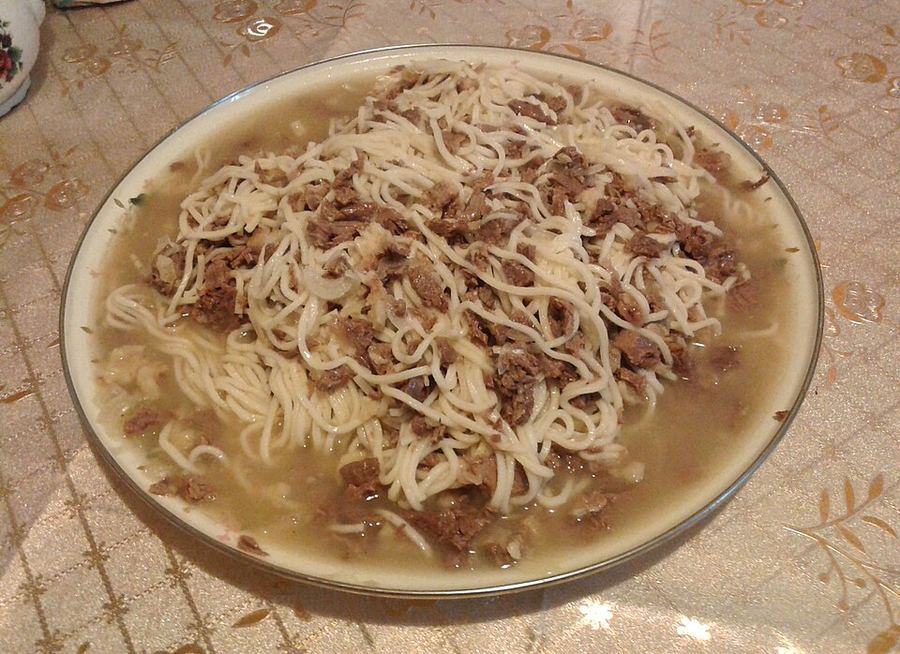
Kyrgyz cooking follows the herds: mutton, horse, dairy and wheat, prepared plainly and eaten in quantity. Beshbarmak, boiled meat served over broad squares of noodle with onion broth, is the national dish and the centrepiece of any celebration, carved and distributed by the host according to seniority. Kuurdak is fried offal and meat with onion and potato; shorpo is the broth drunk alongside; and lagman, hand-pulled noodles with a stir-fried vegetable and meat sauce, arrived from the Uyghur and Dungan communities and is now everyday food. Manty, steamed dumplings of chopped mutton and onion, and samsa baked against the wall of a tandyr oven are staples of every bazaar. Dairy is fermented: kymyz from mare's milk, drunk in quantity in early summer when mares are foaling and regarded as restorative, and kurut, hard salted curd balls that keep indefinitely on the pasture. Bread is treated with reverence, torn rather than cut, and boorsok — small squares of fried dough — is set out at every table. Tea, usually green in the south and black in the north, is served continuously in small bowls throughout a meal.

National Dress

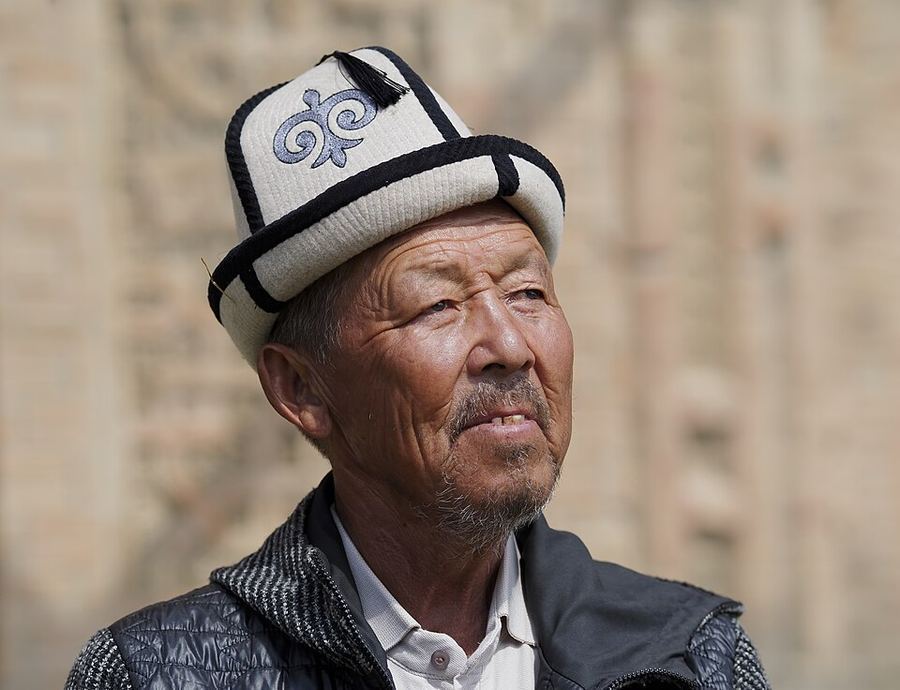
The single most recognisable item of Kyrgyz dress is the ak-kalpak, a tall white hat of four wedge-shaped panels made from felted sheep's wool, its brim turned up and often edged in black. It is worn across generations and regions, is protected by a national holiday on 5 March, and functions as a marker of Kyrgyz identity in a way few garments do anywhere. Men also wear the chapan, a quilted coat tied with a sash, and the sheepskin tebetey in winter. Women's dress historically centred on the beldemchi, a wrapped and often richly embroidered skirt worn over a dress after marriage, with the elechek — a long white cloth wound into a substantial turban — marking married status; the elechek is now largely ceremonial but appears at weddings and festivals. Silver jewellery, coral and coin ornament, and embroidered velvet waistcoats complete formal dress. The decorative vocabulary is shared with felt-making: the shyrdak and ala-kiyiz carpets, whose cut-and-inlay and rolled-felt techniques UNESCO lists as heritage in need of safeguarding, use the same curling horn and plant motifs that appear on clothing and yurt bands.

Sports & Inspiring Athletes

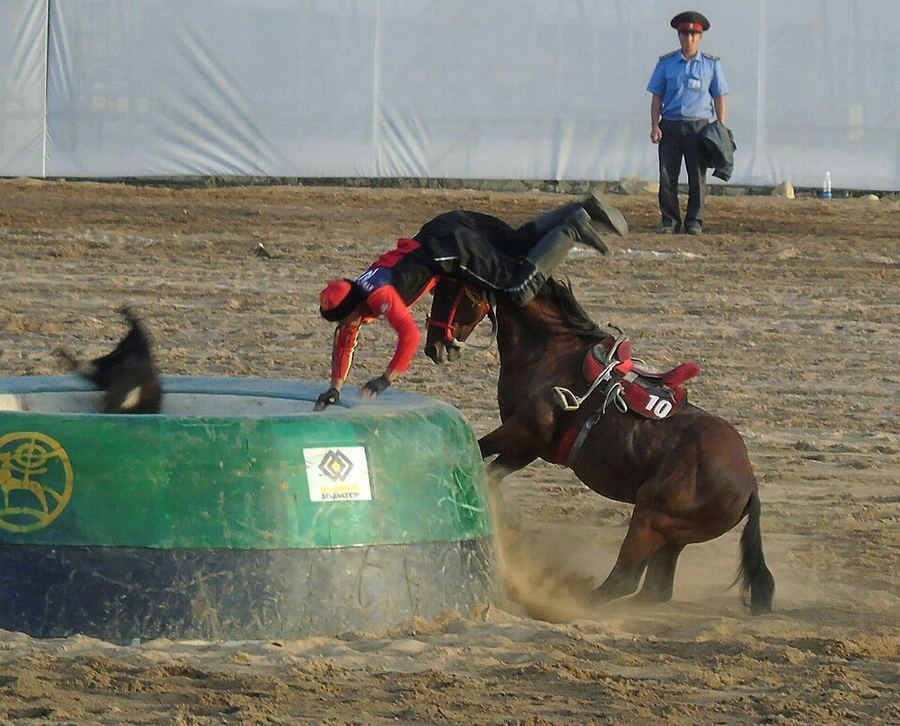
Horseback games are the Kyrgyz national sport in the fullest sense. Kok-boru, in which two mounted teams contest a goat carcass and try to drop it into a raised clay goal called a tai kazan, is played competitively with codified rules, televised nationally and inscribed by UNESCO as intangible heritage; at-chabysh long-distance racing, oodarysh wrestling on horseback and kyz kuumai, a chase between a man and a woman on horseback, belong to the same repertoire. Kurosh-style belt wrestling and the board game toguz korgool are also organised as sports with national federations. From the Soviet period the country inherited strength in wrestling, judo, weightlifting and boxing, which remain its most productive Olympic disciplines. Football is the most-played modern sport, governed by the Kyrgyz Football Union under the Asian confederation, with the national team having reached the AFC Asian Cup finals for the first time in 2019 and advanced to the knockout round. Bandy, ice hockey and alpine skiing have small followings supported by the climate, and Bishkek's Spartak Stadium and Dolen Omurzakov Stadium are the main venues.

Notable Educational Programs

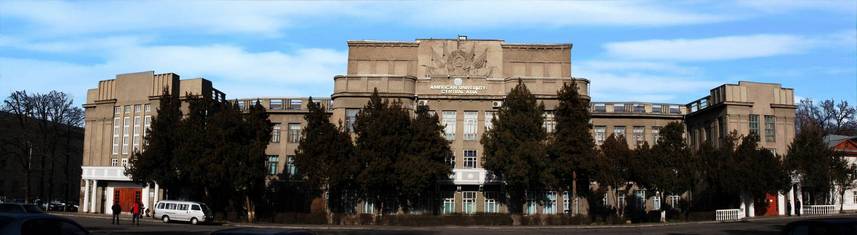
Kyrgyzstan inherited near-universal literacy and a dense school network from the Soviet system and has maintained high enrolment despite severe fiscal constraints since independence. Schooling is compulsory for nine years, with instruction available in Kyrgyz, Russian, Uzbek and Tajik, a genuinely multilingual arrangement that reflects the country's demography but complicates textbook supply and teacher training. Higher education expanded rapidly in the 1990s, and the country now has an unusually international university sector for its size: the American University of Central Asia in Bishkek, founded in 1993 and teaching in English on a United States liberal-arts model, the Kyrgyz-Russian Slavic University, the Kyrgyz-Turkish Manas University and the OSCE Academy in Bishkek all draw students from across the region. The Kyrgyz National University traces its origins to 1925 and remains the largest domestic institution, and Bishkek's medical schools attract a substantial number of fee-paying students from South Asia. Kyrgyzstan has taken part in the OECD's PISA assessments, whose results prompted a national reform effort focused on reading and mathematics, and rural school funding and teacher retention remain the system's principal weaknesses.

Wars & Conflicts

Kyrgyzstan's instability has been internal and, at the border, episodic. Three presidents have been removed by street protest: Askar Akayev in the Tulip Revolution of March 2005, Kurmanbek Bakiyev in April 2010 after clashes in Bishkek that killed dozens, and Sooronbay Jeenbekov in October 2020 following disputed parliamentary elections. The gravest episode was the ethnic violence of June 2010 in Osh and Jalal-Abad, when fighting between Kyrgyz and Uzbek communities killed several hundred people, destroyed thousands of homes and displaced hundreds of thousands, many across the Uzbek border; international investigations criticised the response and the subsequent prosecutions as disproportionately targeting Uzbeks. Externally, the unresolved and enclave-riddled border with Tajikistan in the Batken region has produced repeated armed clashes between border forces and villagers over water, roads and pasture, most seriously in April and May 2021 and again in September 2022, when scores were killed and tens of thousands evacuated on both sides. A comprehensive delimitation agreement between the two states was concluded in 2025, and the frontier has since been calmer.
Current as of 2026-08-07

Land & Border Disputes

The most difficult of Kyrgyzstan's boundary questions has been with Tajikistan, where the Soviet-era administrative line through the Fergana rim left a tangle of enclaves — Tajikistan's Vorukh sits entirely within Kyrgyz Batken province — and where roads, irrigation canals and pastures cross the frontier repeatedly. Large stretches went undelimited for three decades and were the site of recurrent violence, until the two governments completed delimitation and signed a border treaty in 2025 that also addressed access to water infrastructure and the enclave road links. The border with Uzbekistan, similarly complicated by the enclaves of Sokh and Shohimardon, was the subject of a long negotiation concluded in 2022 with an agreement covering the remaining disputed sections and the shared Kempir-Abad reservoir, a deal that prompted domestic protest and arrests in Kyrgyzstan. The frontier with China, inherited from imperial-era treaties, was settled by agreements in the late 1990s. Beyond boundaries, the central regional dispute concerns water: Kyrgyzstan controls the Naryn headwaters of the Syr Darya and wants to release water for winter power generation, while downstream Uzbekistan and Kazakhstan need it for summer irrigation.
Land, Life & Legacy

Land & Climate

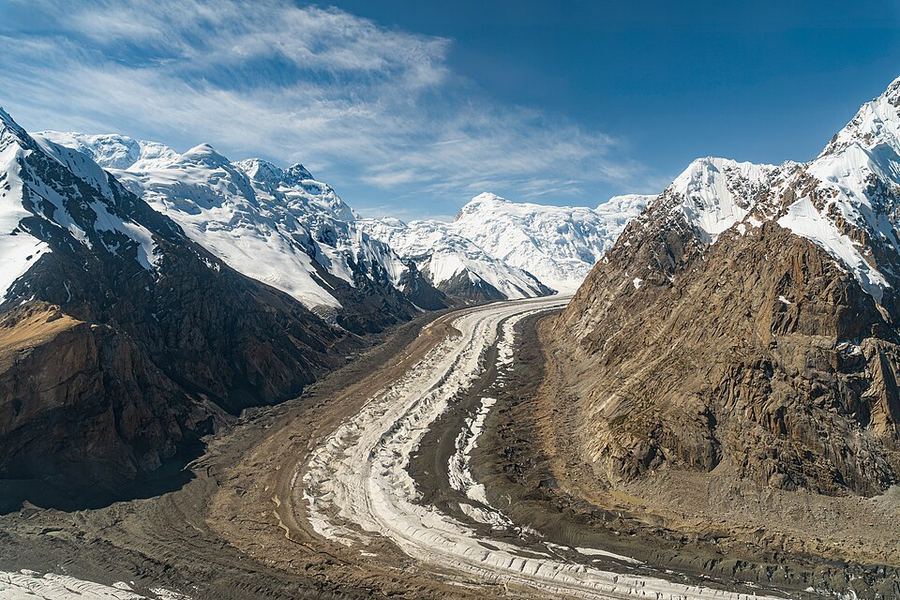
Kyrgyzstan is one of the most mountainous countries on earth: about 94 percent of its territory is mountain, the average elevation is close to 2,750 metres, and the highest point, Jengish Chokusu on the Chinese border, reaches 7,439 metres, the northernmost seven-thousander in the world. The Tien Shan dominates the north and east and the Pamir-Alay the south-west, separated by the Fergana range, and the country's habitable lowlands are confined to the Chuy valley in the north, the Talas valley and the Kyrgyz rim of the Fergana Valley. Lake Issyk-Kul occupies a closed basin at about 1,600 metres, is roughly 668 metres deep, and its slight salinity and volume keep it ice-free through the winter, which gives it its name, meaning warm lake. The Inylchek and other glaciers of the central Tien Shan feed the Naryn, the headwater of the Syr Darya, making Kyrgyzstan an upstream water power for the whole Aral basin. The climate is continental and highly variable with altitude, from hot Fergana summers to permanent snow above 3,500 metres, and the country is seismically active and prone to landslides and glacial-lake outburst floods.

Entertainment

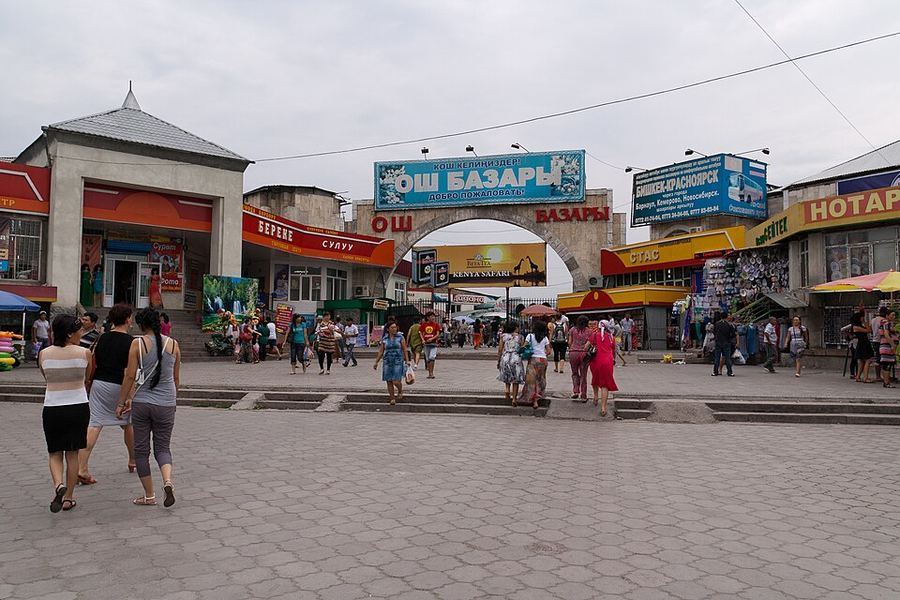
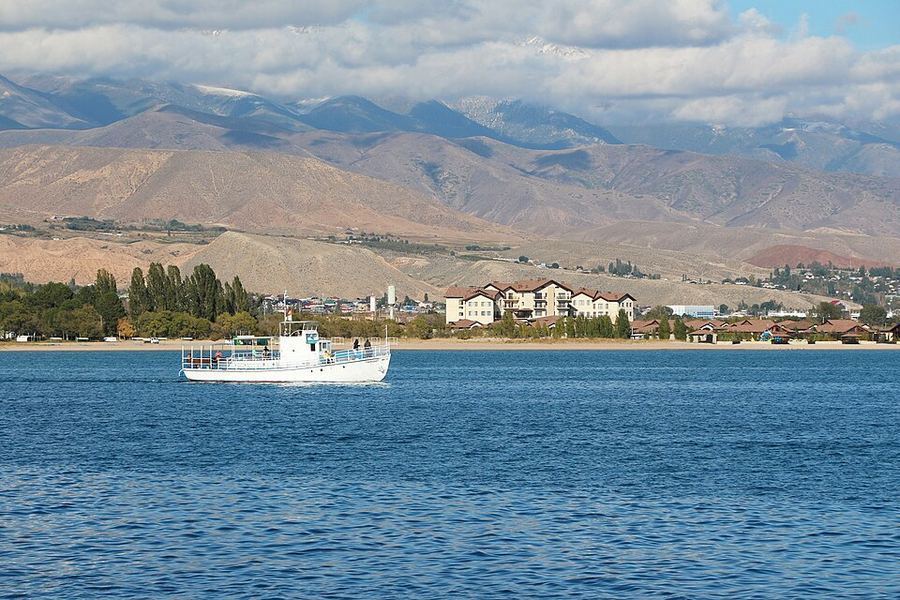
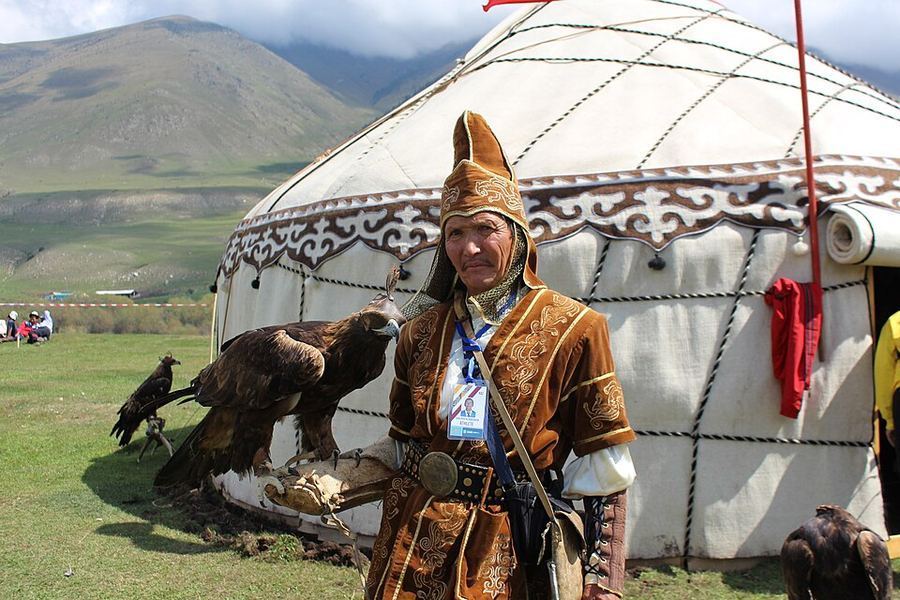
Summer in Kyrgyzstan means the jailoo. Families with rural ties spend part of the season at high pasture, and the same landscape supports the country's tourism: yurt camps at Song-Kol and Tash Rabat, horse treks over the passes, and trekking in the Ala-Archa gorge an hour from Bishkek. Lake Issyk-Kul's northern shore at Cholpon-Ata is the national holiday coast, busy from June to August with Kyrgyz and Kazakh visitors, while the southern shore is quieter and more traditional. Skiing at Karakol and at resorts near Bishkek has grown, and the country's mountaineering circuit around Khan Tengri and Lenin Peak draws climbers from abroad. Everyday leisure is more domestic: the banya, tea houses, the Osh bazaar in Bishkek, chess and the board game toguz korgool, played on a nine-pit board and taken seriously enough to have its own championships. Falconry with golden eagles and with hunting hawks is practised and demonstrated at festivals in the Issyk-Kul region, and Kyrgyz falconry is part of the multinational UNESCO inscription for the practice.

Art & Museums

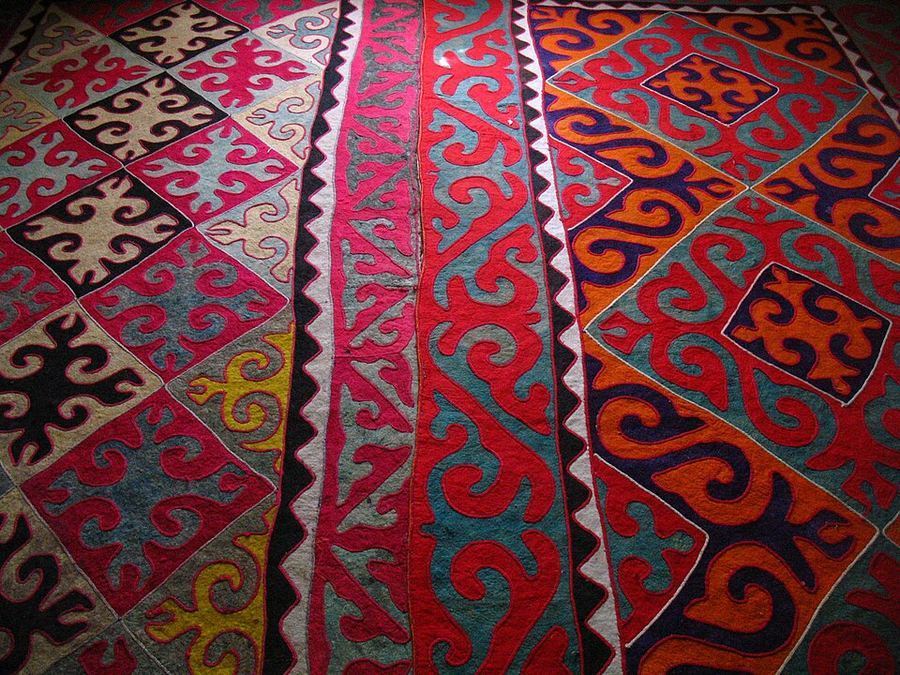
Kyrgyz visual tradition is overwhelmingly textile. The shyrdak, a felt carpet made by stitching together contrasting cut-out layers so that positive and negative forms mirror each other, and the ala-kiyiz, in which dyed wool is rolled directly into the felt, are the two great forms, both listed by UNESCO as intangible heritage in urgent need of safeguarding. Their motifs — the curling ram's horn, the running dog, plant and antler forms — recur in embroidery, in the woven bands that bind a yurt frame, and in silverwork. Applied ornament extends to carved wooden chests, leather vessels for kymyz and chased silver jewellery. Easel painting arrived with the Soviet period; Semyon Chuikov, born in Pishpek, is the best-known painter of the republic's mid-century school, and the Kyrgyz National Museum of Fine Arts in Bishkek holds the principal collection alongside a large body of applied art. Bishkek's Soviet-era monumental architecture, Ala-Too Square and the Philharmonic Hall define the capital's civic centre. In literature, Chinghiz Aitmatov is the overwhelming presence, and his novels are the main channel through which Kyrgyz life reached a world readership.

Notable People

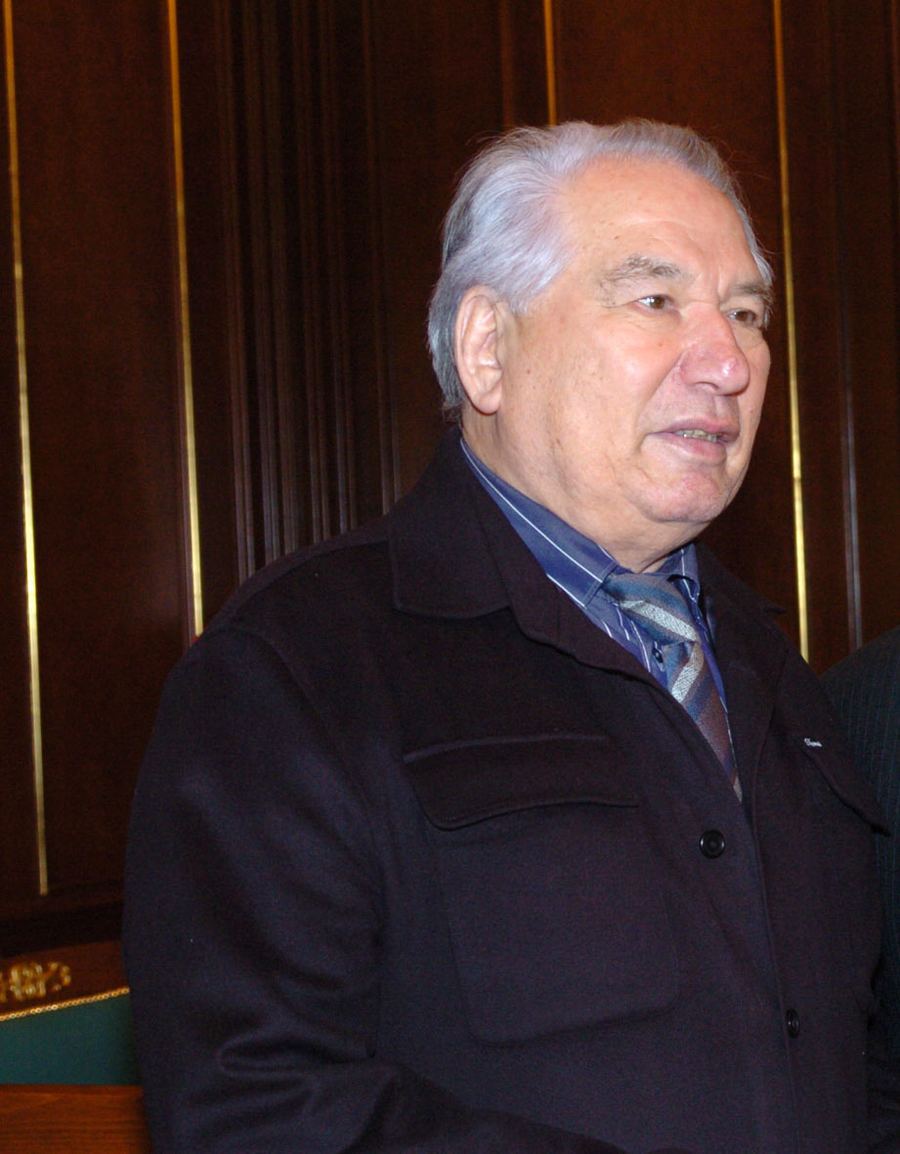
Chinghiz Aitmatov, born in 1928 in the Talas valley, is the country's defining cultural figure — a novelist writing in both Kyrgyz and Russian whose works, including Jamila, Farewell, Gulsary!, The Day Lasts More Than a Hundred Years and The White Steamship, were translated into dozens of languages and made him one of the most widely read Soviet authors; he later served as an ambassador and remains on Kyrgyz banknotes and in the name of institutions across the country. Toktogul Satylganov, the akyn and composer who died in 1933, is the canonical figure of the oral tradition. Kurmanjan Datka, the nineteenth-century Alai ruler known as the Queen of the South, negotiated with both Kokand and Russian authorities and is a national symbol of stateswomanship. In politics, Askar Akayev led the country from independence until his removal in 2005, followed by Kurmanbek Bakiyev, Roza Otunbayeva — the first woman to serve as head of state in Central Asia — Almazbek Atambayev, Sooronbay Jeenbekov and Sadyr Japarov. In sport, the wrestler Aisuluu Tynybekova has won world titles and an Olympic medal for Kyrgyzstan.

Inventions & Breakthroughs

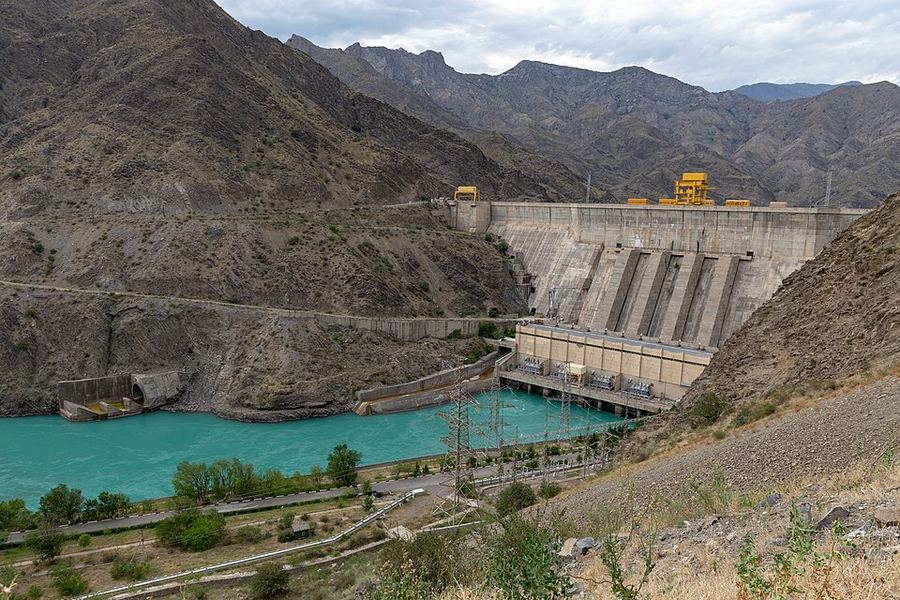
Kyrgyzstan's contributions are pastoral technologies rather than laboratory inventions, but they are consequential ones. The boz uy is a piece of precision engineering: a demountable dwelling of steam-bent willow lattice, radial roof poles and a compression-ring crown that can be raised in about an hour, withstands mountain wind, and packs onto a few animals — a design so effective that it has changed little in centuries and is inscribed by UNESCO. Felt-making itself, the oldest known method of producing fabric without spinning or weaving, is practised here in two elaborated forms, ala-kiyiz and shyrdak, whose inlay technique produces a reversible double carpet from a single cutting. Kymyz, fermented mare's milk, represents an indigenous solution to preserving and making digestible a milk that is otherwise unusable in quantity, and kurut does the same for surplus summer dairy on pastures without refrigeration. The Kyrgyz also refined high-altitude transhumance itself — a calendar of seasonal pasture rotation that sustains livestock on terrain too steep and too cold for cultivation. In the modern era the country's engineering achievement is hydroelectric, above all the Toktogul dam on the Naryn.

Science & Technology

Kyrgyzstan's research base is small and concentrated in Bishkek, organised around the National Academy of Sciences, which was founded in 1954 and retains institutes in geology, seismology, biology and mathematics. Two fields have unusual international standing because of the country's terrain. The first is glaciology and mountain hydrology: the glaciers of the central Tien Shan feed the Syr Darya and are retreating measurably, which makes Kyrgyz field stations important to regional water forecasting and to climate assessment work; the country hosts the Central Asian Institute for Applied Geosciences and collaborates with the mountain research programme coordinated by the United Nations. The second is seismology, driven by necessity in one of the most earthquake-prone parts of Eurasia. Energy is the applied technology that matters most: hydropower on the Naryn cascade, anchored by the Toktogul reservoir, supplies the large majority of domestic electricity, and the long-stalled Kambarata-1 project and the CASA-1000 transmission line to South Asia are the country's principal infrastructure ambitions. Research and development spending is very low as a share of national income, and the sector depends heavily on donor and regional partnerships.
World BankUNIEANatureIPCC
On The World Stage

Champions & Defining Moments

Kyrgyzstan first competed as an independent nation at the 1994 Winter and 1996 Summer Olympic Games and has taken part in every edition since, winning its medals in wrestling, judo and weightlifting. Freestyle and Greco-Roman wrestling is the country's strongest global discipline, and Aisuluu Tynybekova became world champion and an Olympic medallist in women's freestyle, the most prominent Kyrgyz athlete of her generation. The country's most distinctive contribution to international sport, however, is institutional: Kyrgyzstan created the World Nomad Games, first staged at Cholpon-Ata on Lake Issyk-Kul in 2014 and repeated biennially, gathering competitors from dozens of countries for kok-boru, horse racing, belt wrestling, archery, eagle hunting and traditional board games. The event has since travelled to Turkey and Kazakhstan and has done more than anything else to give Central Asian traditional sport an international stage. In football, the national team's qualification for the 2019 AFC Asian Cup and its progress to the round of sixteen was the country's best result, and Kyrgyz clubs compete in the AFC Cup.

IOCOlympediaFIFAUNESCO
Economy, Trade & Government

Currency & GDP

Som — KGS (None)

GDP (PPP): $50.907 billion (2024 est.)

Per capita: $7,000 (2024 est.)

Exports

$3.628 billion (2022 est.)

gold, coal, precious metal ore, refined petroleum, garments (2023)

Partners: Switzerland 30%, Russia 19%, Kazakhstan 14%, UAE 10%, Turkey 8% (2023)

Imports

$10.655 billion (2022 est.)

cars, garments, refined petroleum, fabric, footwear (2023)

Partners: China 44%, Russia 12%, Kazakhstan 6%, Turkey 6%, Uzbekistan 4% (2023)

Government

Type: parliamentary republic

Independence: 31 August 1991 (from the Soviet Union)

Terrain → Where People Live

How mountains, coasts, and rivers shape settlement (LandScan).

Coming — data

Migration & Ethnic Settlement

Where groups settled and how people move (GeoEPR + UNHCR).

Coming — data

Universities

Notable institutions, mappable as points.

Coming — data
Economy & government facts: CIA World Factbook (public domain), via OpenFactBook / factbook.json.
Every fact and narrative claim will carry a visible source citation. Data-driven sections light up automatically wherever HERA has coverage.