HERA · Human Entity Reference Atlas by Masego Inc

← Libya 🌐 3D View
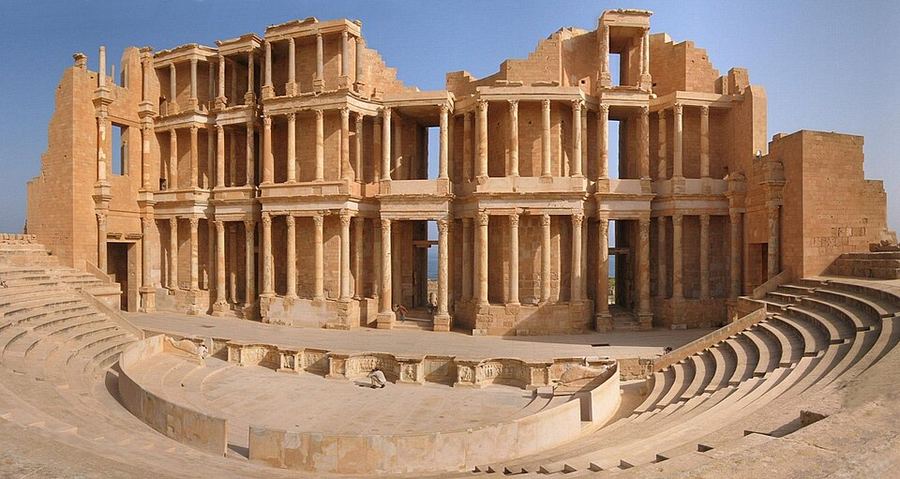
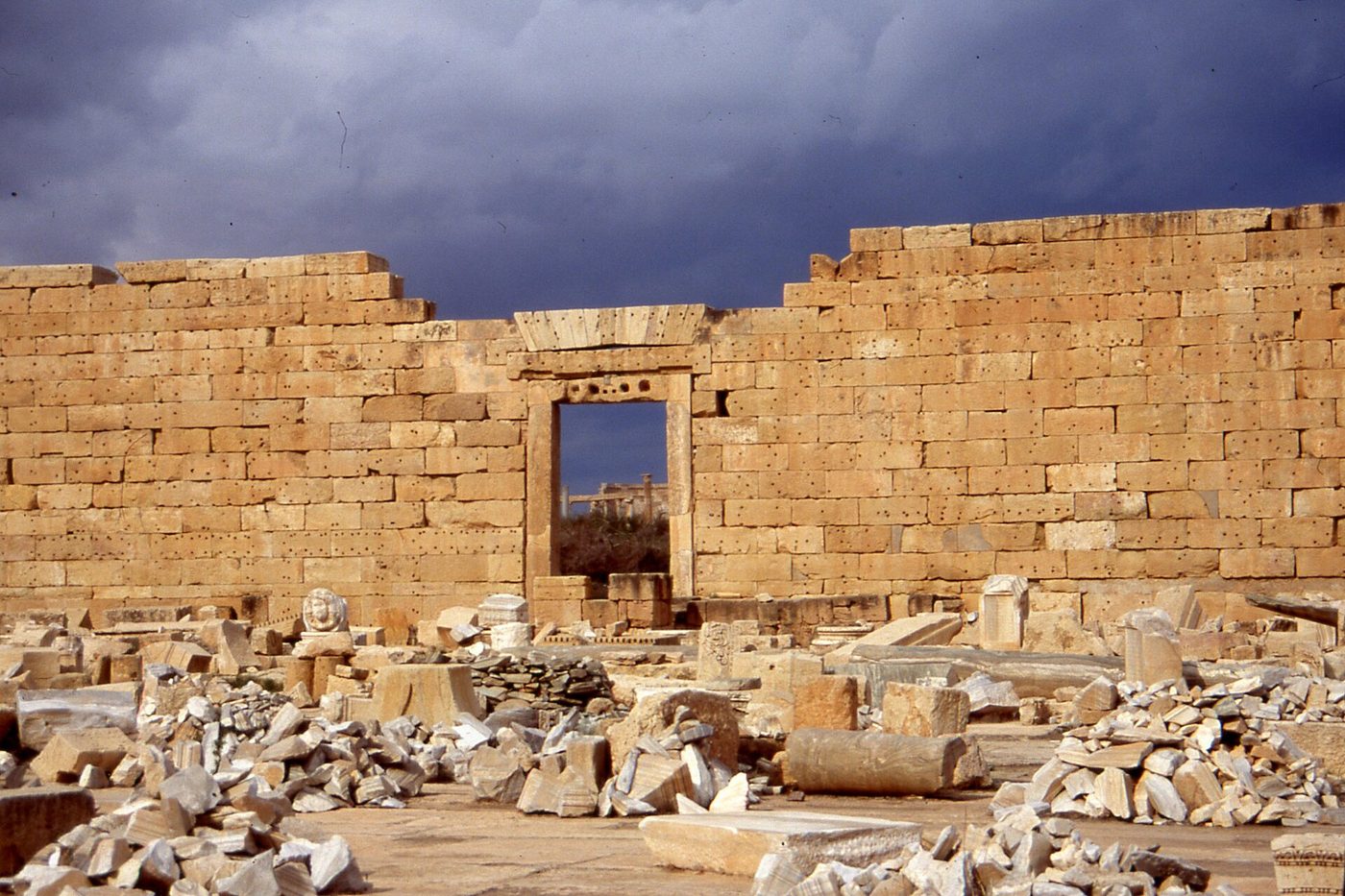
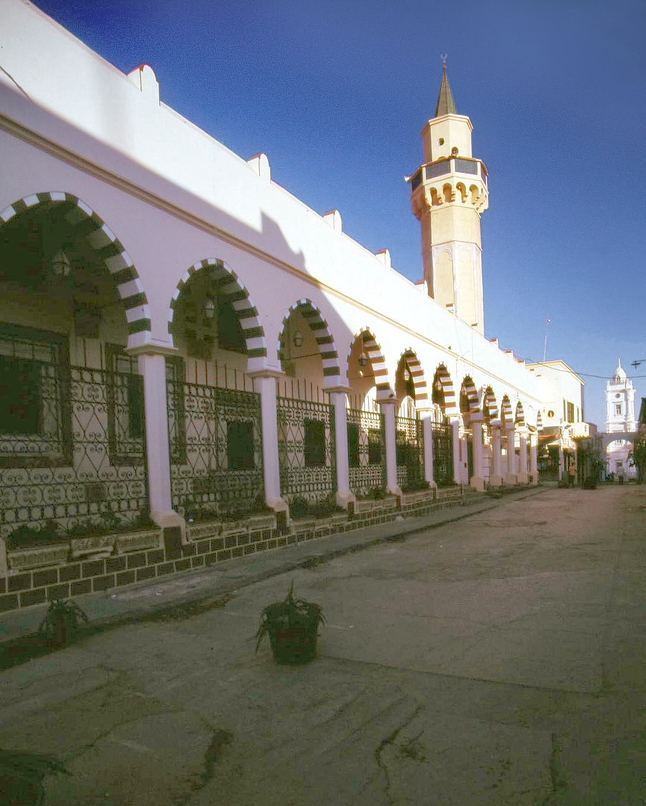
Leptis Magna - Labdah, Libya November 2004 (6769449483), Libya
Libya LBY
Leptis Magna - Labdah, Libya November 2004 (6769449483) — Photo: Sludge G / CC BY-SA 2.0 via Wikimedia Commons
Did You Know All five of Libya's UNESCO World Heritage sites — Leptis Magna, Sabratha, Cyrene, Ghadames and the Tadrart Acacus rock art — are currently listed as in danger. — UNESCO World Heritage Centre

Libya is the fourth-largest country in Africa, occupying roughly 1.76 million square kilometres of North Africa between Egypt, Sudan, Chad, Niger, Algeria and Tunisia, with about 1,770 kilometres of Mediterranean coastline. More than nine-tenths of that territory is Saharan desert, and the great majority of its 7.4 million people live in a narrow coastal belt, above all in Tripoli in the north-west and Benghazi in the east. The country is composed historically of three distinct regions — Tripolitania on the western coast, Cyrenaica in the east and Fezzan in the south-west — a division that has structured its politics from Ottoman times to the present. Independence came on 24 December 1951, when Libya became the first state to gain sovereignty through the United Nations, initially as a monarchy under King Idris. Muammar Gaddafi ruled from a 1969 coup until his overthrow and killing in 2011, and the state has been in contested transition since, with rival administrations in the west and east. The population is overwhelmingly Arab and Amazigh and almost entirely Sunni Muslim, with Arabic official and Tamazight varieties spoken in the Nafusa mountains, Ghadames, Awjila and among the Tuareg. Libya holds the largest proven crude oil reserves in Africa, and petroleum accounts for nearly all export earnings.

CIA World FactbookEncyclopaedia BritannicaWorld BankUN
Population
7,361,263
Capital
Tripoli (Tarabulus)
Currency
None LYD
Time zones
Largest city
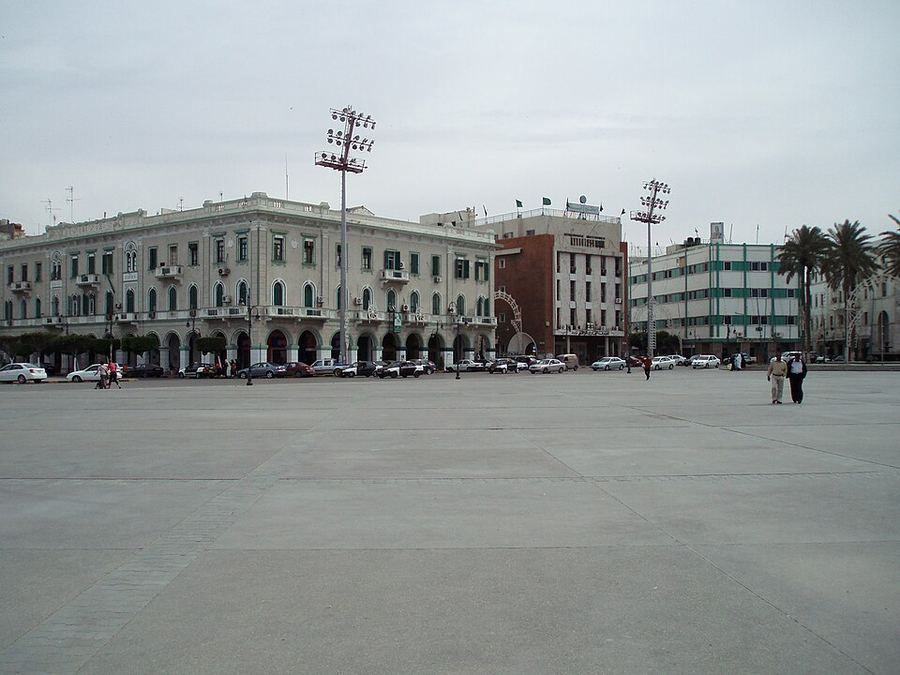
Tripoli
Human Geography Themes
Loading national figures…
Largest Cities
Tripoli1,248,354
Benghazi599,691
Misrata361,980
Al Zawiyah210,857
Bayda202,068
Marj124,834
Sabha118,712
Tubruq115,429
In Perspective

Tripoli's urban core is home to about 1,248,354 people.

That's bigger than Amsterdam — each a great world city in its own right.

Tripoli1,248,354
Amsterdam1,223,407

Among the world's megacities, though, it's one of many — the giants of Asia and Latin America run larger still:

Tripoli1,248,354
Jakarta40,545,126
Dhaka37,307,160
Tokyo33,244,670
Shanghai30,678,616
Cairo25,230,325
The Country & Its People

History

The Libyan coast carries some of the finest classical remains in the Mediterranean. Phoenicians founded the three cities of Tripolitania — Oea, Sabratha and Leptis Magna — while Greeks from Thera settled Cyrene in Cyrenaica around 631 BC; Rome absorbed both, and Leptis Magna, birthplace of the emperor Septimius Severus, became one of the great cities of the empire. Vandal and Byzantine rule gave way to the Arab conquest of the seventh century, which brought Islam and Arabic, and to the migration of the Banu Hilal in the eleventh century that Arabised the interior. Ottoman authority from 1551 was exercised loosely, with the Karamanli dynasty ruling from Tripoli in the eighteenth century and the Sanusi religious order building a network of lodges across Cyrenaica in the nineteenth. Italy invaded in 1911 and imposed a brutal colonisation, met by two decades of resistance led in the east by Omar al-Mukhtar, executed in 1931, during which a large share of the Cyrenaican population died in Italian concentration camps. The Second World War swept the coast, and on 24 December 1951 Libya became independent under King Idris. Oil was found in 1959. Gaddafi seized power in September 1969 and governed until the uprising of February 2011.
Culture

Libyan society is organised around family, tribe and region to an unusual degree, and the tribal networks of Tripolitania, Cyrenaica and Fezzan have been a durable structure of authority through Ottoman, Italian, monarchical and revolutionary periods alike, filling gaps left by weak or contested central government and mediating disputes, blood money and local security. Islam is universally observed and Sunni practice predominates, with the Maliki school and, historically, the influence of the Sanusi Sufi order in the east, whose lodges combined religious teaching, trade and political organisation. Hospitality is expansive and obligatory, and the serving of green and mint tea in three rounds — the last with roasted peanuts or almonds — is a defining social ritual. Ramadan and the two Eids anchor the year, and weddings run for several days with separate celebrations for men and women. Amazigh communities in the Nafusa mountains, Zuwara, Ghadames and Awjila maintain distinct languages, calendars and traditions that were actively suppressed under Gaddafi, when their language could not be taught or printed, and which have been publicly revived since 2011. Tuareg and Tebu communities in the south have their own social structures and cross-border kinship.

Points Of Pride

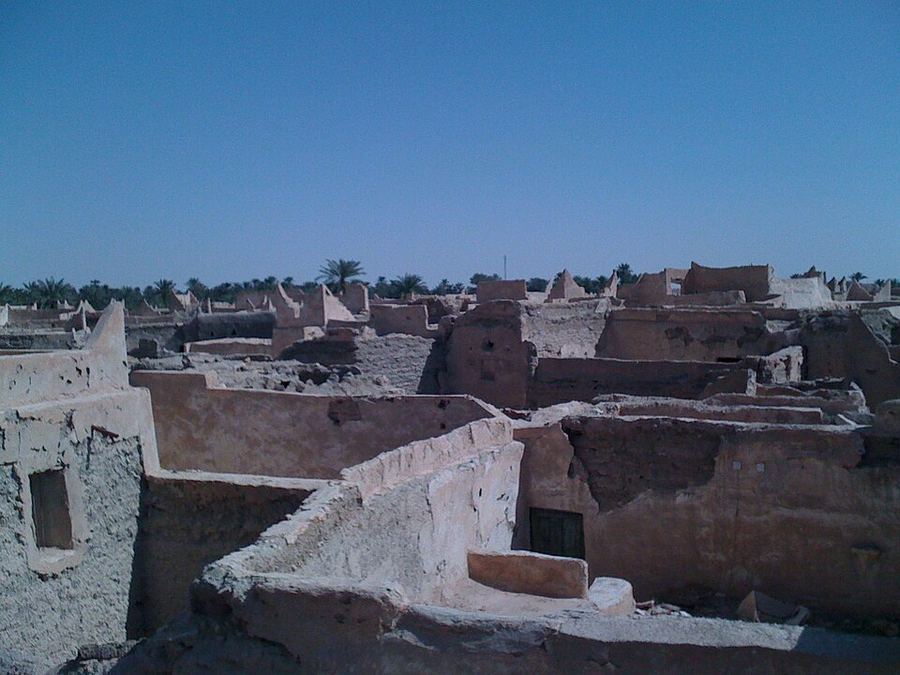
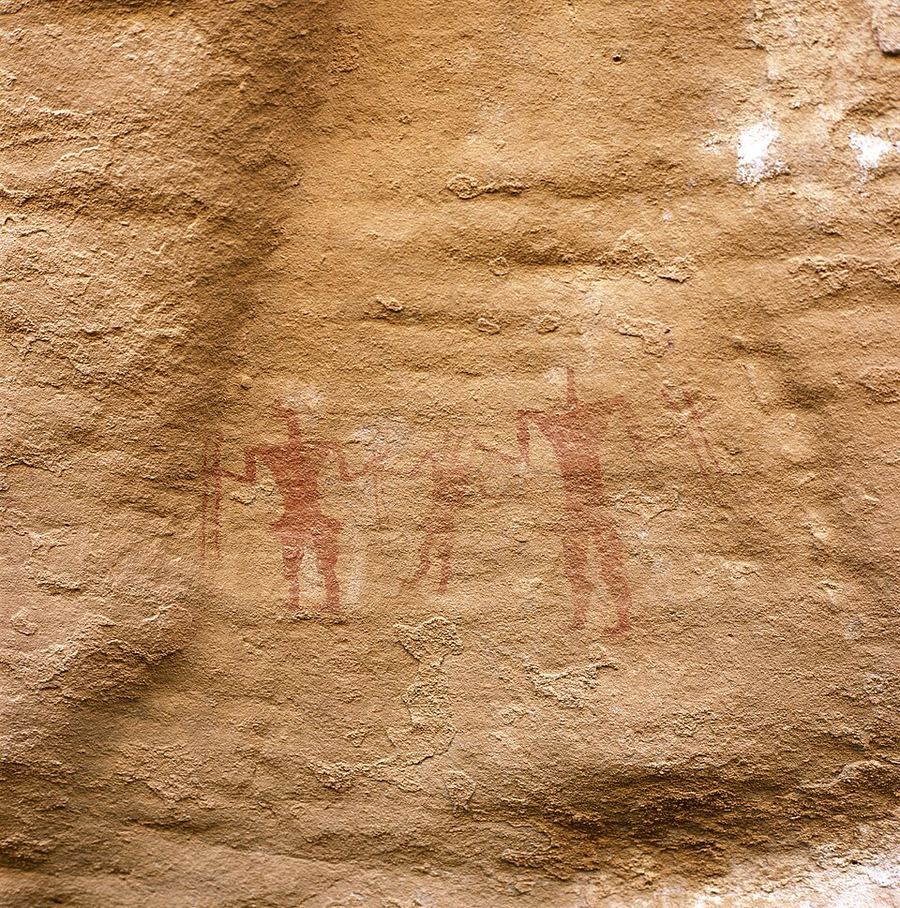
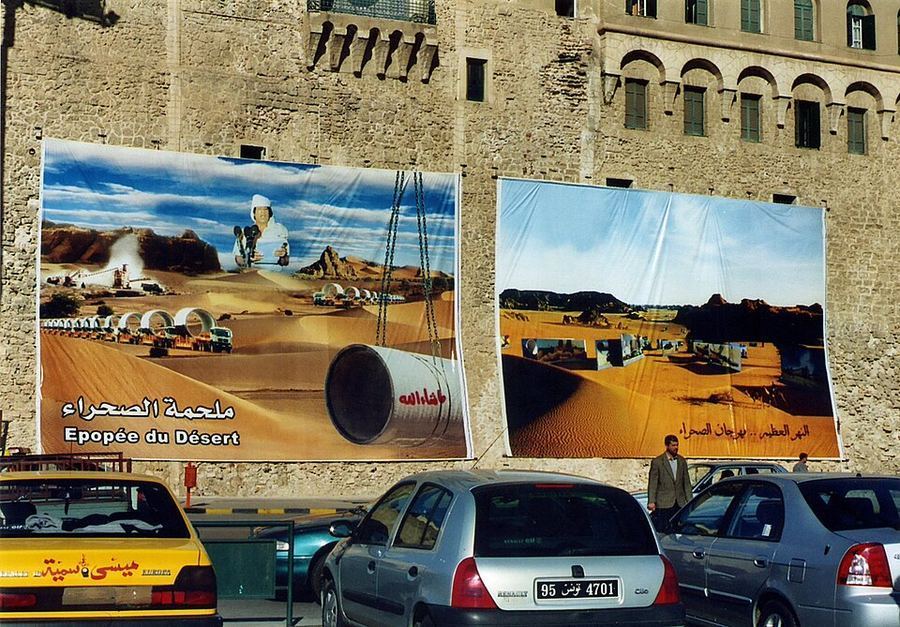
Libya holds five UNESCO World Heritage sites, an extraordinary concentration and all of them currently listed as in danger because of conflict. Leptis Magna, near Khoms, is among the most complete and least disturbed Roman cities anywhere, with its forum, basilica, arch of Septimius Severus, theatre and harbour works standing in sand that preserved them for centuries. Sabratha retains a spectacular three-storey theatre facing the sea. Cyrene, founded by Greek colonists in the seventh century BC, was one of the principal cities of the Hellenic world and the home of the philosopher Aristippus and the geographer Eratosthenes. Ghadames, the oasis town on the Algerian border, is an intact example of pre-Saharan vernacular architecture, its covered alleys and stacked mud-brick houses designed so that men and women moved through separate levels of the town. The rock art of the Tadrart Acacus in the Fezzan records six thousand years of Saharan life, including the giraffes, cattle and elephants of a green Sahara. Libyans also take pride in the resistance of Omar al-Mukhtar and in the Great Man-Made River, the vast fossil-water pipeline system that supplies the coastal cities.

Cultural Fusion

Libya sits where the Mediterranean meets the Sahara, and its population reflects both. The Arab and Amazigh inheritance is the foundation: Amazigh peoples are the region's indigenous population, and Arabisation proceeded through conquest, religion and the Bedouin migrations, producing a country that is today largely Arabic-speaking but in which Amazigh identity has reasserted itself strongly since 2011, with Tamazight now taught, broadcast and written in Tifinagh in Nafusa and Zuwara. In the south, Tuareg communities extend across the borders into Algeria, Niger and Mali, and Tebu communities into Chad and Niger, with kinship, trade and pastoral routes that predate the frontiers and complicate their control. Trans-Saharan caravan trade brought sub-Saharan African populations north for centuries, including through the slave trade, and left communities in the Fezzan oases. Italian colonisation left architecture in Tripoli and Benghazi, coffee culture, pasta as a Libyan staple and Italian loanwords still in daily speech. Since the 1960s oil wealth drew large migrant workforces from Egypt, Tunisia, Sudan and West Africa; the country is now also a major transit point for migration toward Europe, with a large and vulnerable foreign population.

Music & Dance

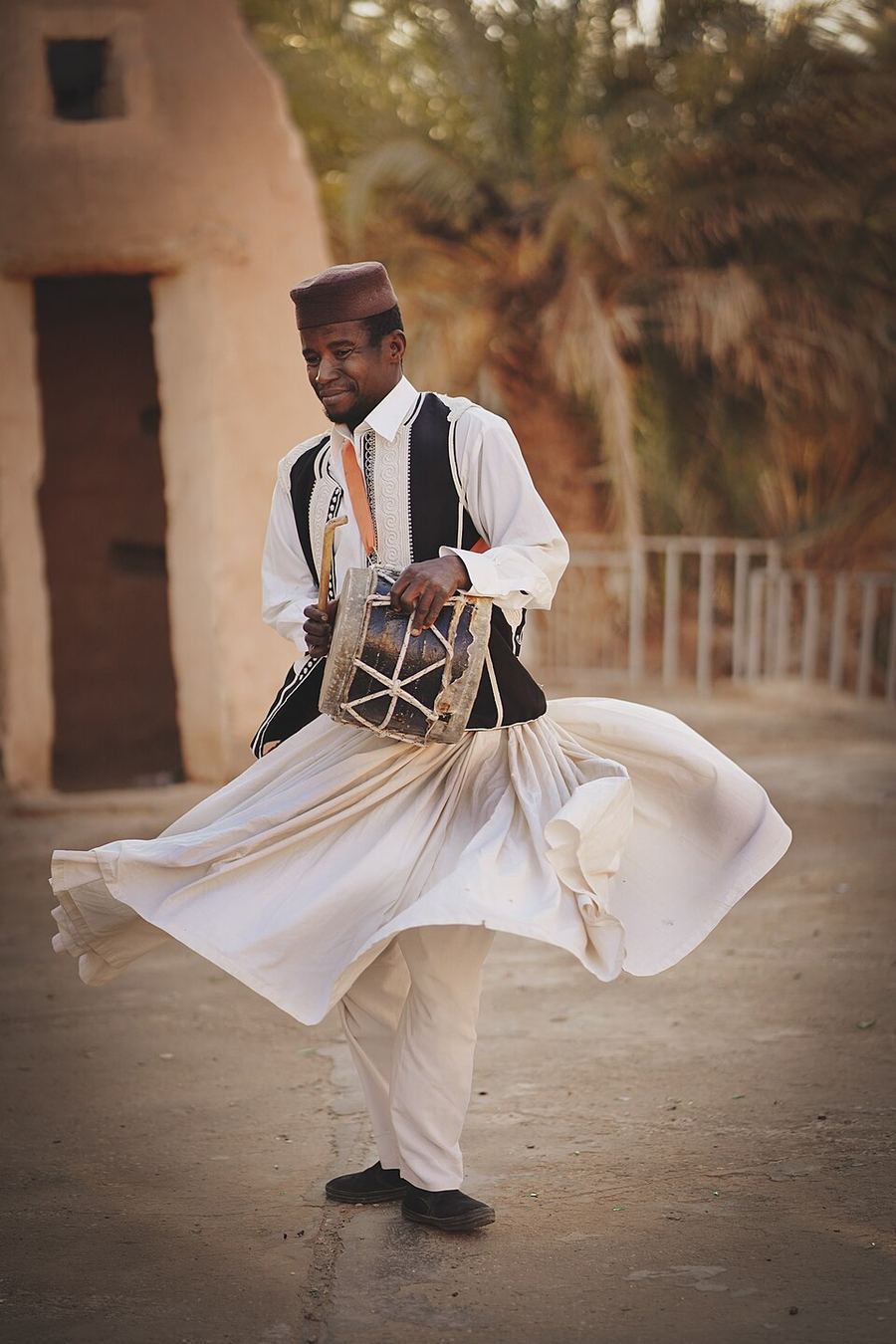
Libyan music divides between the urban Andalusian-derived tradition of the coast and the Bedouin and Saharan traditions of the interior. Maluf, the North African art music descended from the courtly repertoire of Muslim Spain and carried west by exiles after the reconquest, is performed in Tripoli and Benghazi in suites of instrumental and vocal movements with oud, violin, qanun and percussion, and Libya shares the tradition with Tunisia and Algeria in a distinct local form. Bedouin poetry sung to the simple accompaniment of a frame drum, and the chanted verse contests of the desert, carry the older layer. The characteristic communal dance is a line or circle form performed by men with sticks or swords to drum and zukra — the Libyan bagpipe, a reed instrument with a goatskin bag whose piercing sound is inseparable from Libyan weddings — with the tabl drum driving the rhythm. Women's celebration music centres on hand drums and ululation. Tuareg music in the Fezzan uses the imzad single-string fiddle and the tende drum, a tradition inscribed by UNESCO through neighbouring states. Since 2011 a young Libyan rap and rock scene has emerged from Tripoli, Benghazi and the diaspora.

Cuisine & Misattributed Foods

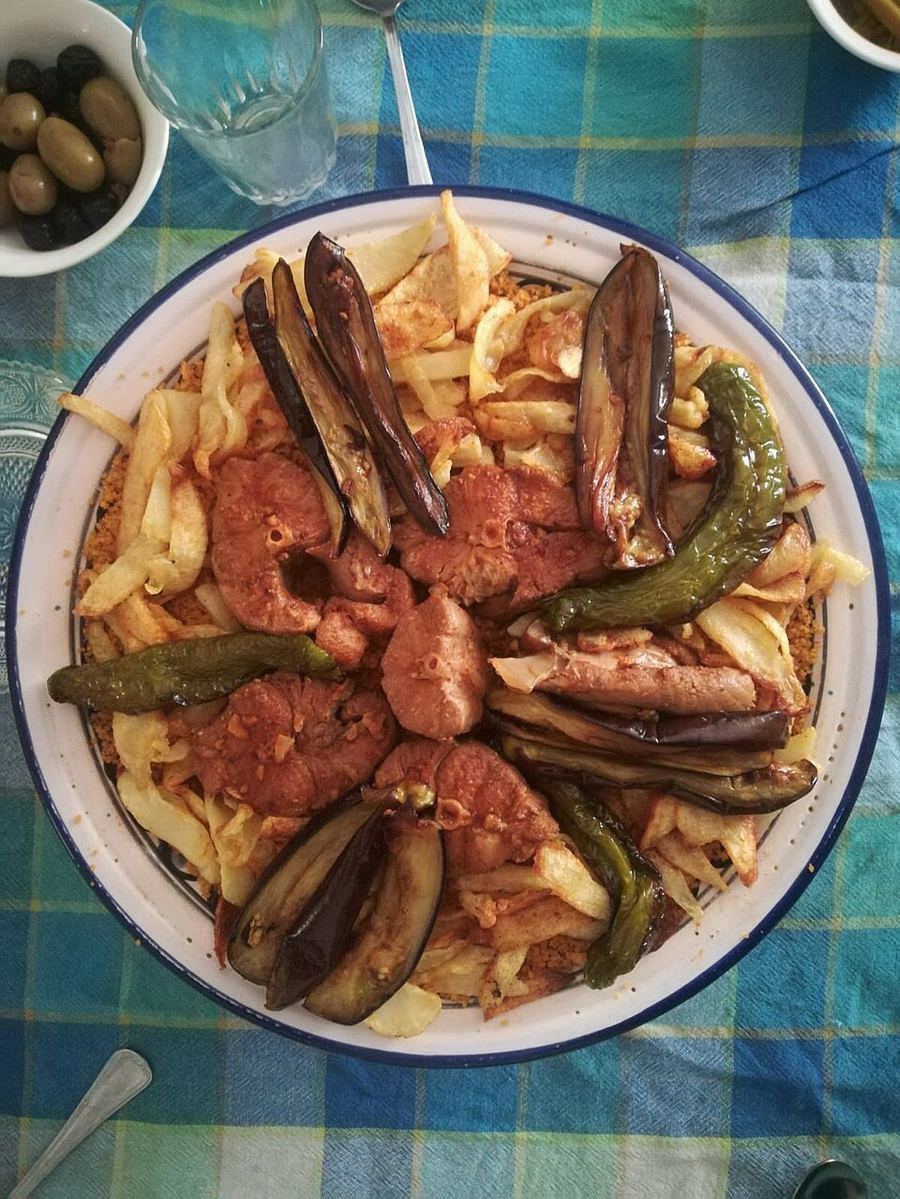
Libyan cooking sits at the meeting point of the Maghreb, the Levant and Italy. The national dish is bazin, a firm dome of unleavened barley dough boiled and worked to a dense paste, set in the middle of a shared platter and surrounded by a spiced tomato and lamb stew with eggs and potatoes, torn off by hand from the diner's own segment of the dish. Couscous, steamed and served with lamb, chickpeas and vegetables, is the Friday and celebration food. Sharba libiya, a lamb and tomato soup thickened with orzo and heavily flavoured with mint and dried herbs, is the standard opening of the Ramadan iftar. Italian rule left a permanent taste for pasta, and mbakbaka — macaroni cooked directly in a spiced lamb and tomato sauce — is now thoroughly Libyan, as are the country's tomato-based flavour base and its coffee habits. Street food centres on the fried potato and tuna pastry known as burek, on shakshuka and on lamb grilled over charcoal. Dates from the oases are eaten daily and traded in dozens of varieties, and asida, a semolina or wheat porridge served with date syrup and butter, marks births and the Prophet's birthday. Tea is drunk very strong, in small glasses, in three successive rounds.

National Dress

The distinctive item of Libyan men's dress is the jard, a large rectangle of fine white or cream wool draped and wrapped around the body over a long shirt and wide trousers, worn with an embroidered waistcoat, the sidriya, and topped by the rimless red felt cap known locally as the shanna or by a wound turban. The jard is the formal national dress, worn at weddings, on public occasions and on Independence Day, and its draping is a matter of some skill. The everyday alternative is the jalabiya or a long shirt with the wide-legged sirwal. Libyan women's traditional celebration dress is the holi or farashiya, a long length of silk wrapped around the body and drawn over the head, historically in white or in richly coloured patterned silk, worn with substantial gold jewellery: heavy bracelets, headpieces and the elaborate necklaces given at marriage, which represent a family's stored wealth. Bridal costume, particularly in Tripoli, is spectacular, involving several changes of dress across successive days and extensive gold. Amazigh and Tuareg dress is distinct: indigo cloth, silver jewellery and, among Tuareg men, the tagelmust veil covering the face.

Sports & Inspiring Athletes

Football is by an enormous margin the dominant sport in Libya, and club loyalties — above all to Al-Ahly and Al-Ittihad in Tripoli and Al-Ahly and Al-Nasr in Benghazi — run deep enough that they have at times carried political weight; a 1996 riot at a Tripoli match involving Gaddafi's son ended in deaths and became a notorious episode of the era. The Libyan Premier League has been repeatedly suspended, relocated or played abroad because of the conflict, and the national team, the Mediterranean Knights, has played many home fixtures in neighbouring countries. Handball, basketball and volleyball have organised leagues and reasonable followings, and athletics, judo, taekwondo and weightlifting supply most of the country's international competitors. Traditional and desert sports remain significant: horse racing with Arabian and Barb horses, particularly in Cyrenaica and the Fezzan, camel racing, falconry with sakers and peregrines, and equestrian display at weddings and festivals. Chess and dominoes are staples of café life. Sporting infrastructure has been damaged by more than a decade of instability, and many facilities built during the oil boom years are in poor repair or have been used for other purposes.

Notable Educational Programs

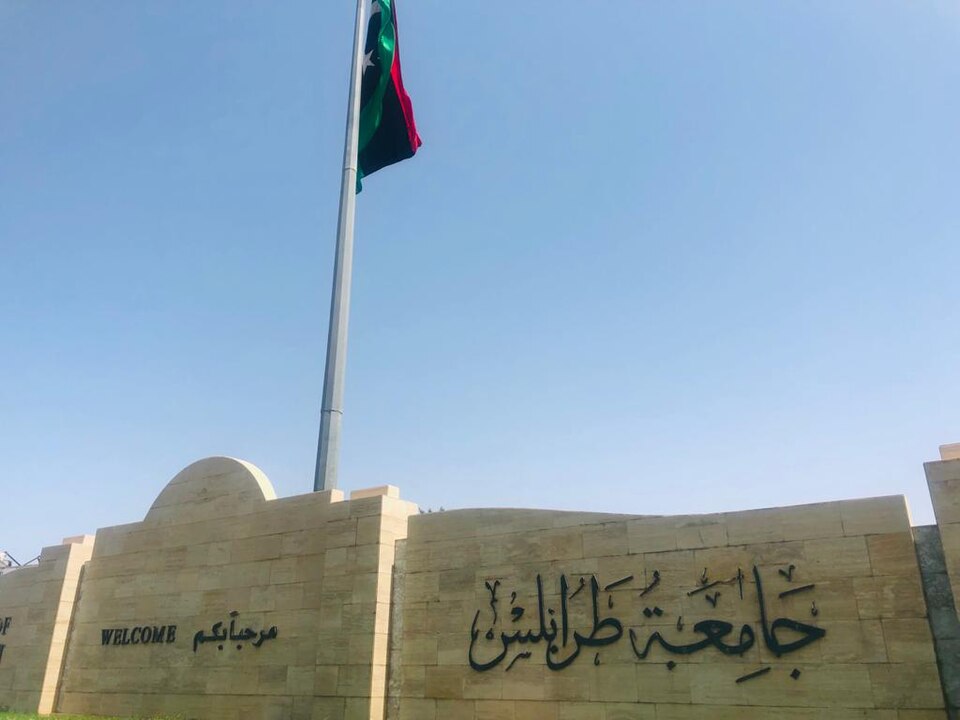
Libya achieved near-universal literacy and high enrolment during the oil-funded decades, and adult literacy remains among the highest in North Africa, with women well represented in secondary and higher education. Schooling is free and compulsory through the basic stage, and instruction is in Arabic; since 2011 Tamazight has been introduced in some Amazigh areas after decades in which its teaching was prohibited. The University of Libya was founded in Benghazi in 1955 and later split into the University of Benghazi and the University of Tripoli, which remain the two principal institutions, joined by universities at Sabha, Misrata, Sirte and elsewhere and by a substantial network of technical and vocational colleges. The system's problems are now those of a state in conflict: schools damaged or occupied, teachers unpaid through liquidity crises, curricula contested between rival administrations, large numbers of internally displaced students, and the interruption of the government scholarship programmes that once sent thousands of Libyans abroad each year. UNICEF and UNESCO have documented significant learning loss and out-of-school populations, particularly among displaced families and migrant children, and reconstruction of education infrastructure is contingent on a durable political settlement.

Wars & Conflicts

Libya has been in conflict or contested transition since February 2011, when protests in Benghazi against Gaddafi's rule escalated into armed uprising. The United Nations Security Council authorised measures to protect civilians in resolution 1973, and a NATO air campaign followed; Gaddafi was captured and killed near Sirte in October 2011 after forty-two years in power. The revolutionary coalition fragmented, and by 2014 the country had two rival parliaments and governments, in Tripoli and in the east, each backed by shifting armed groups and by competing foreign states. The Islamic State seized Sirte in 2015 and was expelled the following year at heavy cost. Khalifa Haftar's Libyan National Army, based in the east, launched an offensive on Tripoli in April 2019 that was repelled in 2020, after which a United Nations-brokered ceasefire and a Government of National Unity were established, though elections scheduled for December 2021 were not held and the political division persists. Migrant detention, trafficking and abuse have been documented extensively by United Nations investigators. In September 2023 Storm Daniel caused the collapse of two dams above Derna, destroying much of the city and killing thousands.
Current as of 2026-08-07

Land & Border Disputes

Libya's most significant territorial dispute was over the Aouzou Strip, a band of territory roughly a hundred kilometres deep along the border with Chad which Libya occupied from 1973 and formally annexed, precipitating a long war with Chad in the 1980s that ended in Libyan defeat. Both states referred the question to the International Court of Justice, which ruled in February 1994 that the boundary was fixed by a 1955 treaty between Libya and France and that the strip belonged to Chad; Libya withdrew, and the ruling stands as a notable case of a state accepting an adverse judgment on territory. Libya's other boundaries with Egypt, Sudan, Niger, Algeria and Tunisia are settled in law, though the southern frontiers run through desert that no administration effectively controls, and Tebu and Tuareg communities, smuggling networks and armed groups move across them freely. Offshore, the maritime boundary with Tunisia in the Gulf of Gabès was delimited following an International Court of Justice judgment in 1982 on the continental shelf. The internationally consequential dispute today is not over borders but over which authority legitimately governs Libya and controls its oil revenues and central bank.
Land, Life & Legacy

Land & Climate

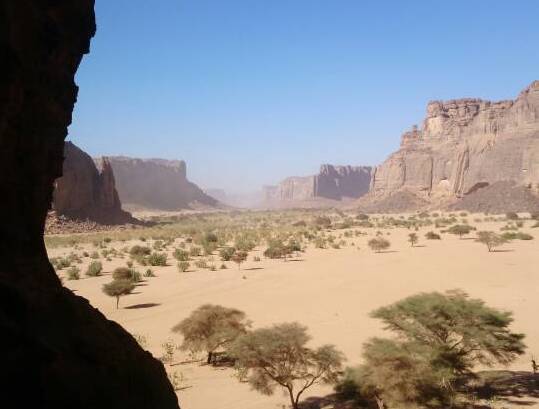
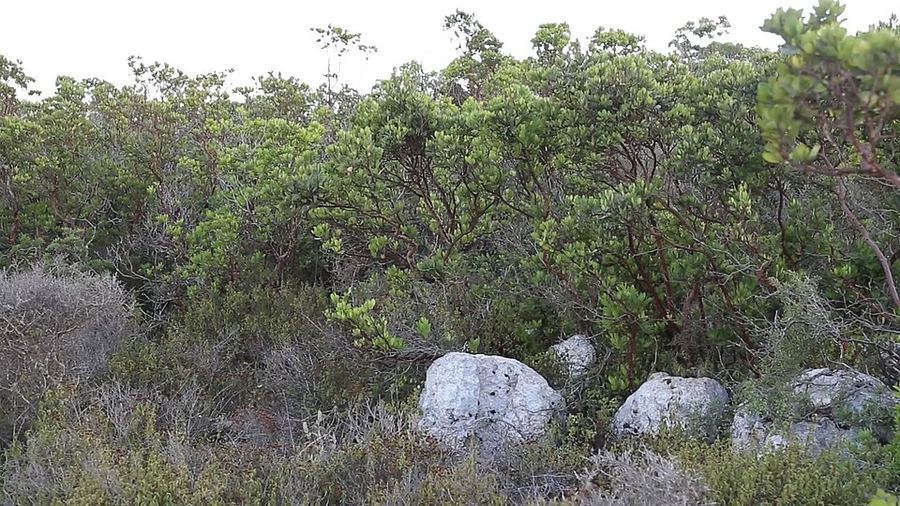
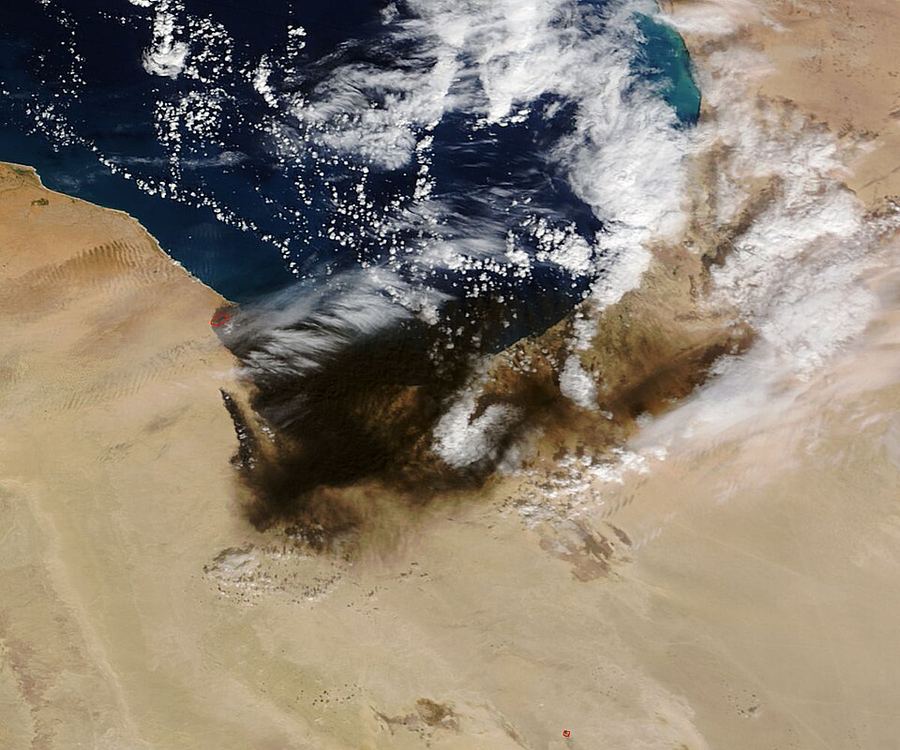
Libya is overwhelmingly desert. The Sahara covers around ninety percent of the country, from the sand seas of the Rabyanah and Murzuq ergs to the stony hammada plateaus and the volcanic Tibesti foothills in the far south, where Bikku Bitti reaches the country's highest elevation near the Chadian border. The habitable land is the Mediterranean fringe: the Jefara plain behind Tripoli, the Nafusa mountains rising inland from it, and the Jebel Akhdar, the Green Mountain of Cyrenaica behind Benghazi, whose higher rainfall supports forest and orchards and which is the greenest part of the country. Between them the Gulf of Sirte brings the desert almost to the sea. There are no permanent rivers at all; water comes from coastal aquifers and, above all, from the immense fossil aquifers beneath the Sahara, tapped by the Great Man-Made River. The climate is Mediterranean on the coast and hyper-arid inland, with the ghibli, a hot dry southerly wind, raising dust and temperatures sharply in spring and autumn. Al-Aziziya was long cited as holding the record for the highest air temperature ever measured, a claim the World Meteorological Organization formally rejected in 2012 after review.

Entertainment

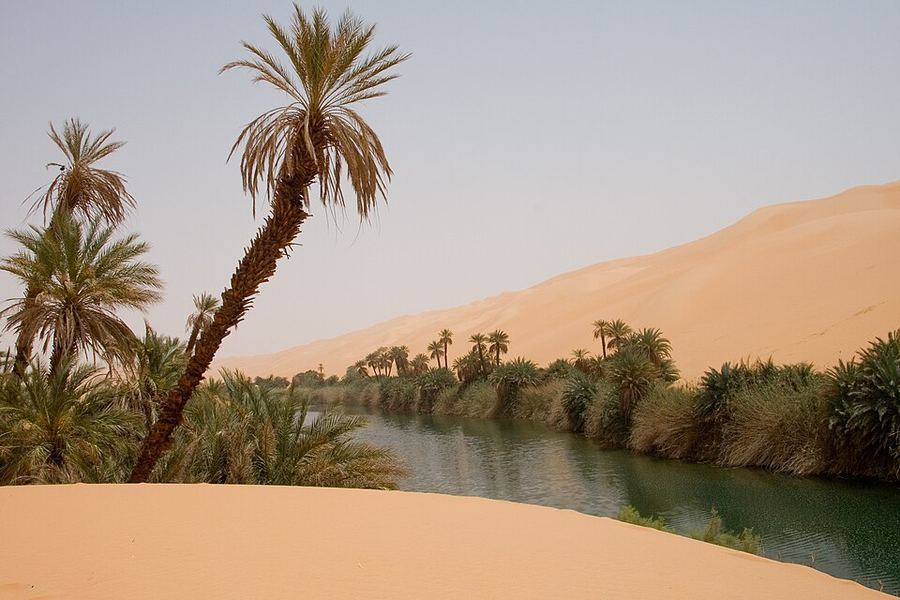
Libyan leisure is family-centred and, because of the climate, heavily nocturnal in summer. Extended family visiting is the principal social activity, particularly through Ramadan, when the hours after iftar become the busiest of the day and cafés, sweet shops and markets stay open until dawn. Men gather in cafés over strong coffee, tea and shisha to watch football and talk politics. The Mediterranean coast supplies the country's recreation in the hot months, with beaches west of Tripoli and around Benghazi busy with families, and fishing is both livelihood and pastime along the whole shore. Weekend excursions run to the Roman sites at Leptis Magna and Sabratha, to the Jebel Akhdar for its cooler air and orchards, and, for those with the means and the security to do so, into the desert to the Ubari lakes, the Acacus rock art and the oasis towns. Falconry and saluki coursing survive among enthusiasts, and horse and camel racing draw crowds in some regions. Since 2011, insecurity, fuel shortages and periodic fighting have curtailed much of this, and cinema and theatre, which had a lively presence before the 1980s, have not fully recovered.

Art & Museums

Libya's most significant art is ancient and lies in the ground and on the rock. The classical cities of the coast hold mosaics, sculpture and architecture of the first rank, including the Severan basilica and arch at Leptis Magna and the theatre facade at Sabratha, while Cyrene's sanctuary of Apollo and its necropolis represent Greek civic art at its most complete outside Greece; the archaeological museums of Tripoli and Shahat hold much of the moveable material, some of which has been looted or endangered since 2011. Older still is the rock art of the Tadrart Acacus and the Messak plateau, engraved and painted over six millennia and recording the wildlife and pastoral life of a wetter Sahara — one of the world's great prehistoric art assemblages, and one now damaged by vandalism and unmanaged access. Living craft traditions include silverwork and gold jewellery, particularly bridal pieces, leatherwork, copper and brass in the Tripoli medina, and weaving of wool cloaks and carpets. Ghadames houses, painted inside in red, white and geometric black patterns, are a domestic art form in themselves. Modern Libyan painting and calligraphy developed from the mid-twentieth century, and post-2011 street art in Tripoli and Benghazi became a widespread form of political expression.

Notable People

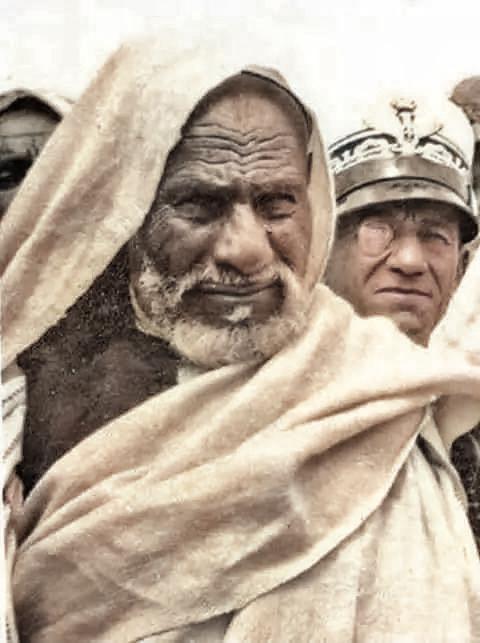
Omar al-Mukhtar, the Quranic teacher from Cyrenaica who led two decades of guerrilla resistance to the Italian occupation until his capture and public hanging in 1931 at the age of about seventy, is the undisputed national hero, appearing on currency and in the name of streets and institutions across the country and beyond. King Idris al-Sanusi, head of the Sanusi order, led Libya to independence in 1951 and reigned until 1969. Muammar Gaddafi, who seized power in a bloodless coup in September 1969 at twenty-seven and ruled for forty-two years through his idiosyncratic Third Universal Theory and the Green Book, is the dominant figure of modern Libyan history and one of the most internationally consequential, and was killed near Sirte in October 2011. In antiquity, the emperor Septimius Severus was born at Leptis Magna in 145, and Eratosthenes, who calculated the circumference of the earth with remarkable accuracy in the third century BC, and the philosopher Aristippus both came from Cyrene. The novelist Ibrahim al-Koni, writing in Arabic on Tuareg and Saharan themes, and Hisham Matar, whose memoir The Return won the Pulitzer Prize, are the country's best-known contemporary writers.

Inventions & Breakthroughs

The most consequential idea to come out of Libyan territory is a measurement. Eratosthenes, born in Cyrene around 276 BC and later chief librarian at Alexandria, calculated the circumference of the earth by comparing the angle of the noon sun at two locations a known distance apart, arriving at a figure within a few percent of the true value — the first serious quantitative determination of the size of the planet — and he also devised the sieve that bears his name for finding prime numbers and coined the term geography. In the modern era Libya's signature engineering achievement is the Great Man-Made River, begun in 1984, a network of more than 2,800 kilometres of buried four-metre pipe carrying fossil groundwater from the Nubian Sandstone Aquifer beneath the Sahara to Tripoli, Benghazi, Sirte and the coastal farms — by most measures the largest irrigation and water-supply project ever built, and one that made large-scale settlement of the coast possible while drawing on a resource that does not recharge. Older indigenous technologies include the foggara underground irrigation channels of the oases and the stacked, thermally efficient mud architecture of Ghadames.

Science & Technology

Libya's applied technology is dominated by two things: hydrocarbons and water. The country holds the largest proven crude oil reserves in Africa, and its petroleum engineering capacity, concentrated in the National Oil Corporation and the Sirte, Murzuq and Ghadames basin operations, is the sector in which Libyan technical expertise is deepest; production has repeatedly been halted by blockades of terminals and fields, making the industry's technical continuity a political question. The Great Man-Made River is the country's other major engineering system, drawing fossil water from the Nubian Sandstone Aquifer through thousands of kilometres of buried pipe to supply the coastal cities and agriculture, and its maintenance and protection have become urgent since 2011, with sections damaged and pumping stations looted. Desalination supplements coastal supply. Research capacity, once supported by substantial oil revenue and by scholarships that sent Libyans to universities abroad, has been badly eroded by conflict and brain drain, and universities in Benghazi and Tripoli have struggled to sustain laboratories and funding. The Derna dam collapse of 2023 has focused attention on dam safety, hydrological monitoring and the maintenance of civil infrastructure across the country.
World BankIEAUNNatureIPCC
On The World Stage

Champions & Defining Moments

Libya's greatest international sporting achievements have come in football. The national team hosted and reached the final of the Africa Cup of Nations in 1982, losing to Ghana on penalties in Tripoli — still the country's best result — and it returned to the finals in 2006 and 2012. In 2014 Libya won the African Nations Championship, the tournament restricted to players based in domestic leagues, beating Ghana on penalties in Cape Town, a victory that came in the middle of the country's descent into renewed conflict and was received at home as a rare unifying moment. At club level Al-Ittihad and Al-Ahly Tripoli have competed in African continental competition. Libya first appeared at the Olympic Games in Rome in 1960 and has taken part intermittently since, boycotting several editions for political reasons; it has never won an Olympic medal, and its athletes compete mainly in athletics, judo, taekwondo and swimming. Libya hosted the 2009 Mediterranean Games bid unsuccessfully and was stripped of hosting the 2013 Africa Cup of Nations because of the security situation. Ongoing instability has severely constrained the country's participation in international competition.

FIFAIOCOlympedia
Economy, Trade & Government

Currency & GDP

Libyan Dinar — LYD (None)

GDP (PPP): $90.609 billion (2024 est.)

Per capita: $12,300 (2024 est.)

Exports

$37.753 billion (2023 est.)

crude petroleum, natural gas, refined petroleum, gold, scrap iron (2023)

Partners: Italy 23%, Germany 15%, Spain 9%, France 7%, China 6% (2023)

Imports

$33.284 billion (2023 est.)

refined petroleum, broadcasting equipment, tobacco, garments, cars (2023)

Partners: China 17%, Turkey 15%, Italy 8%, UAE 8%, Egypt 8% (2023)

Government

Type: in transition

Independence: 24 December 1951 (from UN trusteeship)

Terrain → Where People Live

How mountains, coasts, and rivers shape settlement (LandScan).

Coming — data

Migration & Ethnic Settlement

Where groups settled and how people move (GeoEPR + UNHCR).

Coming — data

Universities

Notable institutions, mappable as points.

Coming — data
Economy & government facts: CIA World Factbook (public domain), via OpenFactBook / factbook.json.
Every fact and narrative claim will carry a visible source citation. Data-driven sections light up automatically wherever HERA has coverage.