HERA · Human Entity Reference Atlas by Masego Inc

← Palau 🌐 3D View
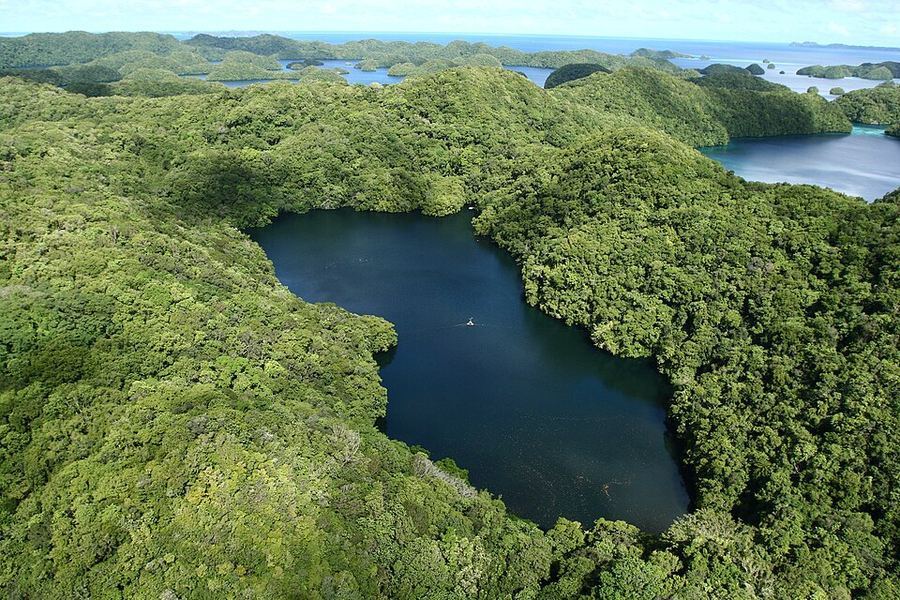
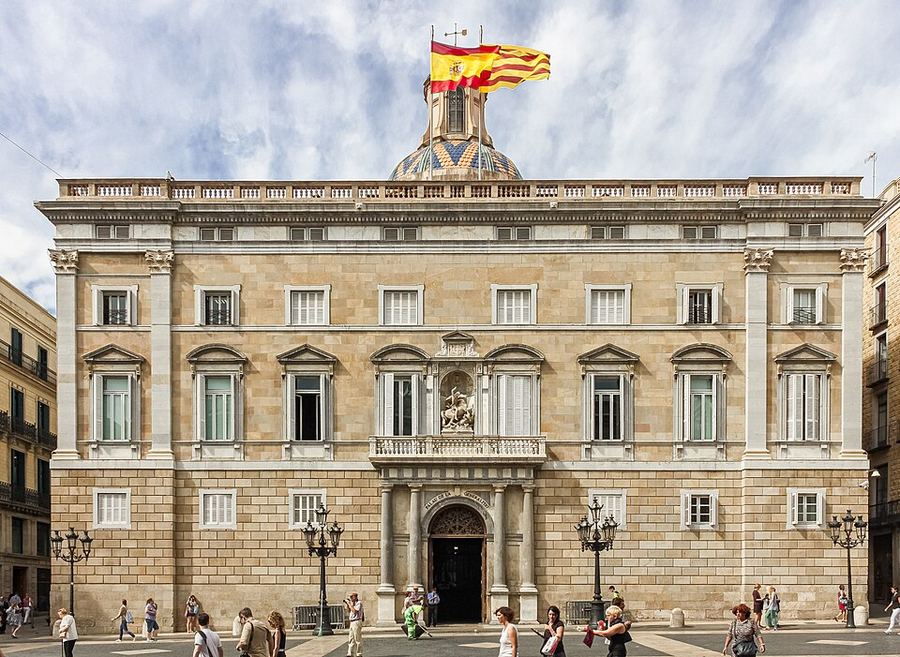
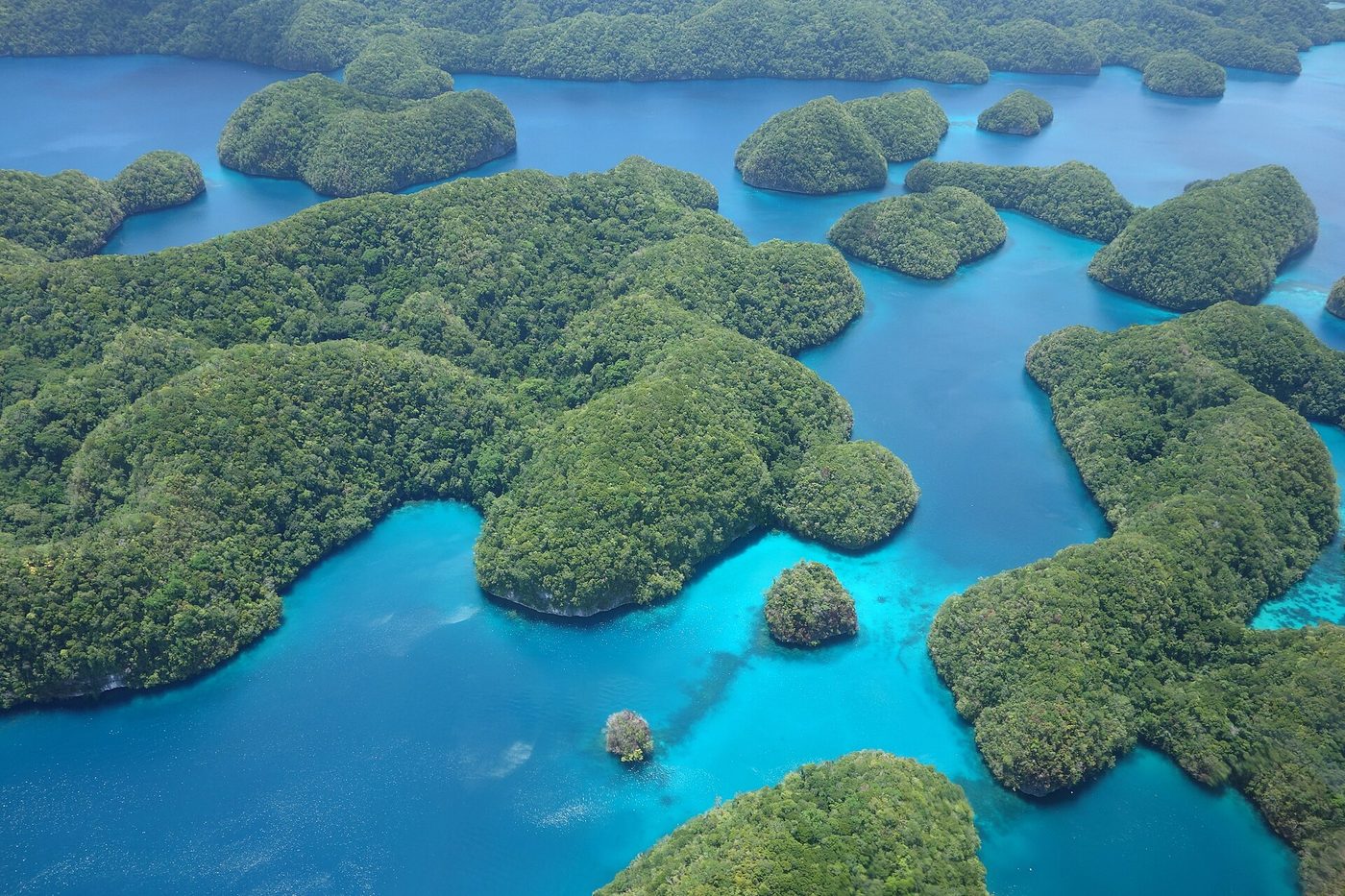
Rock-Islands-Palau-1-2016-aerial-view-Luka-Peternel, Palau
Palau PLW
Rock-Islands-Palau-1-2016-aerial-view-Luka-Peternel — Photo: Luka Peternel / CC BY-SA 4.0 via Wikimedia Commons
Did You Know Jellyfish Lake in the Rock Islands holds a landlocked population of golden jellyfish that has lost most of its sting and migrates across the lake each day, following the sun. — Science

Palau is a presidential republic of about 22,000 people in the western Pacific, an archipelago of more than 300 islands at the far western end of the Caroline chain, roughly 900 kilometres east of the Philippines. It is one of the world's smallest sovereign states by population and one of the largest by the ocean it governs: its exclusive economic zone covers some 600,000 square kilometres, and in 2015 it declared a national marine sanctuary closing the great majority of that water to commercial fishing. Independence came on 1 October 1994, at the end of the United Nations trusteeship the United States had administered since the Second World War, under a Compact of Free Association that gives the United States defence responsibility and Palauans the right to live and work there. The capital moved in 2006 from Koror, still the commercial centre and home to most of the population, to Ngerulmud on the larger island of Babeldaob. Palauans make up 70.6% of residents and Asian workers, largely Filipino, about a quarter. Palauan and English are official, Catholicism is the largest denomination, and the indigenous Modekngei faith persists. Tourism, built on diving, and fishing licences dominate an economy of about $280 million.

CIA World FactbookEncyclopaedia BritannicaUN
Population
21,947
Capital
Ngerulmud
Currency
Time zones
Largest city
Human Geography Themes
Loading national figures…
The Country & Its People

History

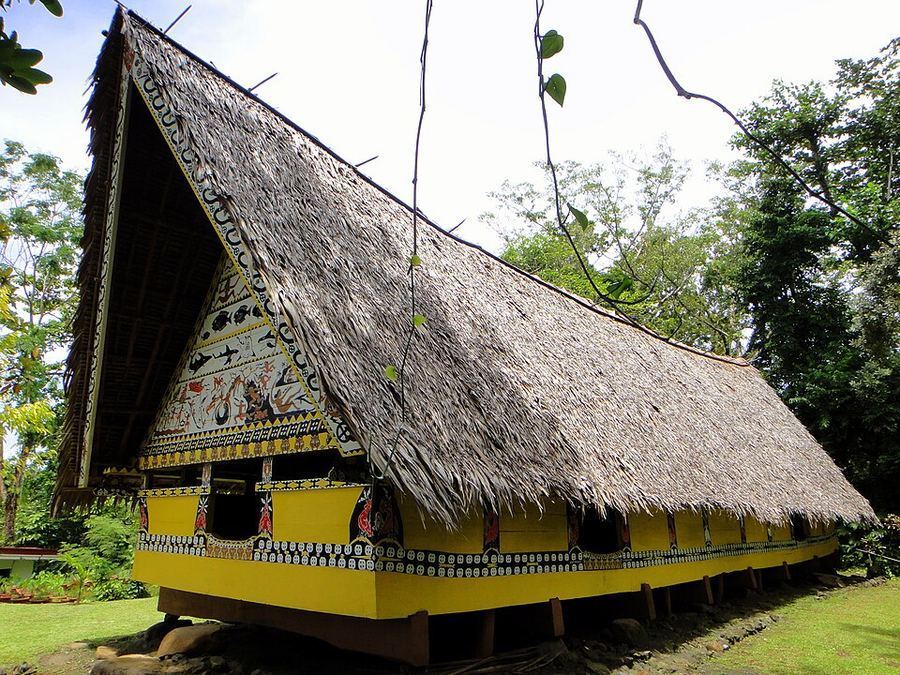
Palau was settled from island Southeast Asia several thousand years ago, and the archaeological record on Babeldaob includes extensive terraced hillsides and, in the Rock Islands, cave burials and the remains of villages abandoned before European contact. Society was organised into competing village polities governed by chiefly councils and by matrilineal clans, with the bai — a high-gabled men's meeting house — as the political centre of each village. Europeans arrived properly in 1783 when the East India Company packet Antelope wrecked on a reef and its crew was sheltered by the high chief of Koror, whose son Lebuu returned with them to England and died there of smallpox. Spain claimed the islands as part of the Caroline group in the nineteenth century, sold them to Germany in 1899 after losing the Spanish–American War, and Japan took them in 1914 and administered them under a League of Nations mandate, developing Koror into a substantial colonial town and settling thousands of Japanese and Okinawan migrants. The Second World War brought the battle of Peleliu in 1944, one of the costliest of the Pacific campaign. The islands then entered the United States-administered Trust Territory of the Pacific Islands, and after a long constitutional argument over nuclear provisions, became independent in 1994.
Culture

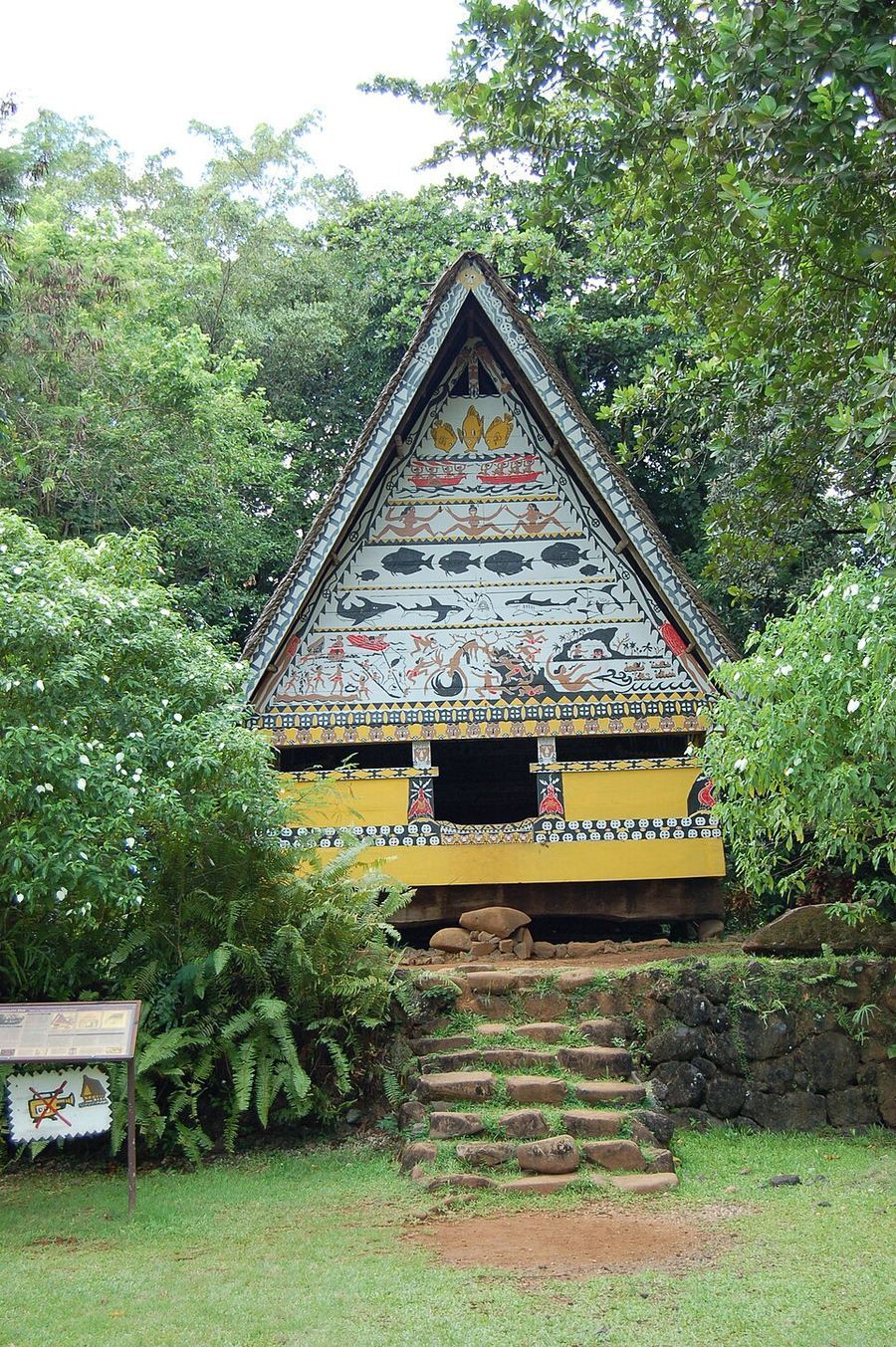
Palauan society is matrilineal: clan membership, land rights and the selection of chiefly titles descend through women, and senior women of a clan choose and can remove the men who hold its titles. That structure survives alongside an elected presidential government, and the constitution recognises traditional leaders, with a Council of Chiefs advising the president. The village bai, its gables painted with narrative storyboards recording clan histories and legends, was the meeting house of the men's council and remains the emblem of Palauan political culture. Custom governs exchange as much as authority: money made from shell and glass beads, and later Palauan customary currency, circulates in ceremonial obligation at funerals, first-birth ceremonies and house-buildings rather than in commerce, and the ocheraol, a fundraising feast for a family building a house, is a living institution. The ngasech, celebrating a woman's first child, involves ritual bathing in herbal medicine and ginger and a public appearance in traditional adornment. Catholicism, brought by Spanish and later German missionaries, is the largest denomination, but Modekngei — a syncretic faith that emerged in the early twentieth century, blending Christian and indigenous belief and once suppressed by the Japanese administration — is still practised.

Points Of Pride

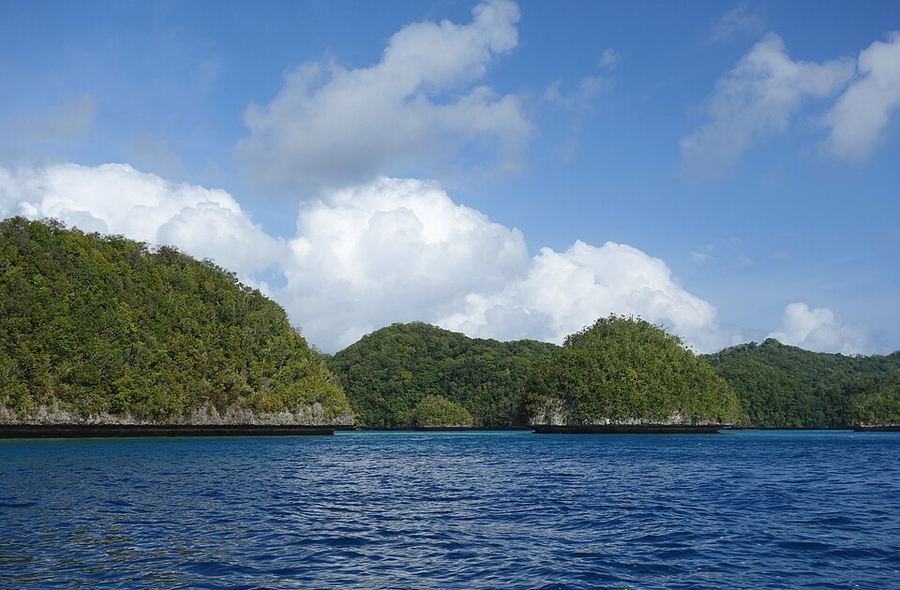
Palau's international reputation rests on ocean conservation, and the country has cultivated it deliberately. In 2009 it declared the world's first shark sanctuary, banning commercial shark fishing throughout its waters; in 2015 it legislated the Palau National Marine Sanctuary, closing about 80% of its exclusive economic zone to commercial extraction and reserving the remainder for domestic fishing — a commitment of ocean space unmatched by any comparable state. In 2017 it introduced the Palau Pledge, a conservation undertaking stamped into every visitor's passport and signed on arrival, and it has banned sunscreens containing reef-toxic compounds. The Rock Islands Southern Lagoon, an archipelago of forested limestone knobs undercut by the sea and enclosing marine lakes, is inscribed by UNESCO as a mixed World Heritage site for both its natural values and the archaeological record of abandoned villages within it. Jellyfish Lake, where a landlocked population of golden jellyfish has lost most of its sting and migrates daily across the lake, is one of very few such places on earth. Palauans also take pride in the survival of matrilineal custom and chiefly authority alongside a modern constitutional state.

Cultural Fusion

Four colonial administrations in a century left visible sediment. Spanish rule brought Catholicism, which remains the largest religion, and Spanish given names. German administration was brief and mainly extractive, focused on phosphate. The Japanese period from 1914 to 1945 was the most transformative: Koror became the capital of Japan's South Seas Mandate, Japanese settlers at times outnumbered Palauans, and the language absorbed a large stock of Japanese loanwords — Palauan speakers still use them for everyday introduced objects, and some Japanese words entered Palauan with meanings that have since drifted from the original. American administration after 1945 brought English, the constitutional order, basketball and baseball, and a pattern of migration to Guam, Hawaii and the United States mainland that now sees a substantial Palauan population living abroad. The most recent layer is contemporary labour migration: about a quarter of residents are Asian, predominantly Filipino workers in construction, tourism and services, alongside Chinese, Bangladeshi and Nepali communities, and Filipino food and language are now part of daily life in Koror. Carolinian settlers from the atolls to the east form a small long-established minority with their own language.

Music & Dance

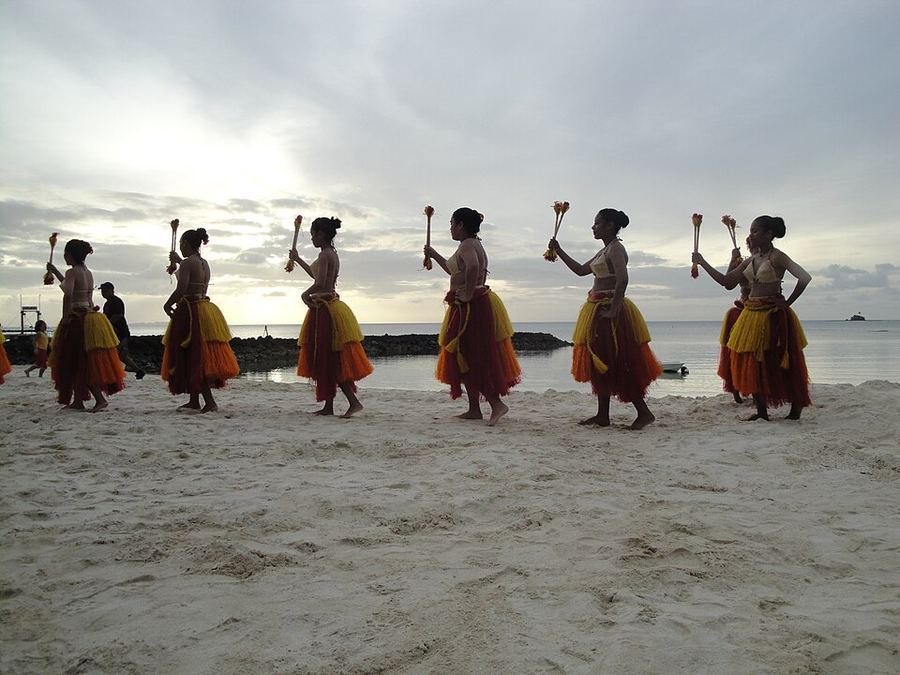
Traditional Palauan performance is centred on chant rather than melody-driven song. The chesols is a sitting chant, sung by seated performers who mark rhythm with hand movements and the beating of the body or of fans, and it carries narrative — clan history, legend, the recording of events — in a way that made it a form of archive as much as entertainment. The ruk is a standing dance, and the men's and women's dances differ sharply in movement and costume; performances at a bai, or at a house-building feast, were part of the formal exchange between villages rather than a separate entertainment. Instruments were few: the human voice, body percussion, and the conch and bamboo used to signal. Japanese rule introduced Western scales, brass and the popular song form, and a number of Japanese-era songs survive with Palauan lyrics — a repertoire sometimes called derebechesiil, sung at gatherings by older generations. Since American administration, church choir singing has become a major musical activity, and contemporary Palauan popular music draws on Pacific reggae and island string-band styles heard across Micronesia. Traditional dance is performed at national events, at the annual independence celebrations and for visitors.

Cuisine & Misattributed Foods

Palauan food is built from the reef, the lagoon and the taro patch. Taro is the staple and the ceremonial food, grown by women in irrigated patches that are themselves clan property, and served boiled or as the base of dishes at every important occasion; cassava, introduced later, has partly replaced it in daily use, and breadfruit, yam and sweet potato fill out the starch. Fish is the constant: reef fish grilled whole, tuna and mackerel from the deeper water, and raw preparations in coconut milk and lime. The mangrove crab, chemadch, is the prestige dish, steamed and served whole. Fruit bat soup, made with the whole animal simmered in coconut milk and ginger, is the island speciality most remarked on by outsiders and is genuinely eaten, though less commonly than its reputation suggests. Coconut appears as milk, cream, meat and as the sap fermented into a mild toddy. Japanese influence is heavy and permanent — sashimi, tempura, bento and Japanese seasonings are ordinary rather than exotic — and Filipino cooking has become equally familiar through the resident workforce. Betel nut, chewed with lime and pepper leaf, is close to universal.

National Dress

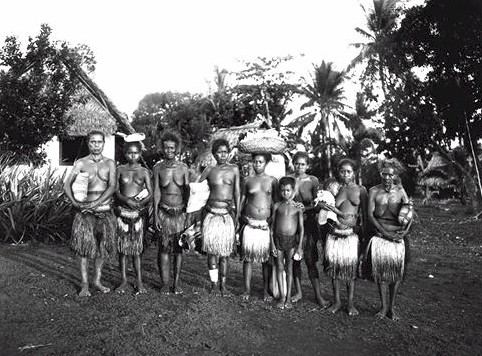
Palauan traditional dress is worn now for ceremony rather than daily life, but the ceremonies are frequent enough that it remains familiar. Women's traditional dress is the grass skirt, made from shredded and dried hibiscus or coconut fibre or from young banana and pandanus leaf, layered and tied at the waist, worn with the upper body bare or covered depending on occasion and era, and completed by turmeric applied to the skin, floral leis and hair ornaments of woven fibre and flowers. The ngasech ceremony for a woman's first child is the setting where the fullest version appears: the mother is bathed in herbal preparations, coated in turmeric and coconut oil, and presented wearing customary money and beads that signify her clan's standing. Men's traditional dress is a loincloth of woven fibre or bark, with a chief's status marked by ornament rather than by cut. The most valuable objects are not garments but the beads and shell pieces of Palauan customary money, worn as necklaces and passed down within clans, whose individual pieces are named and whose ownership is a matter of record. Everyday clothing is otherwise Western, with the island shirt standard for men at formal occasions.

Sports & Inspiring Athletes

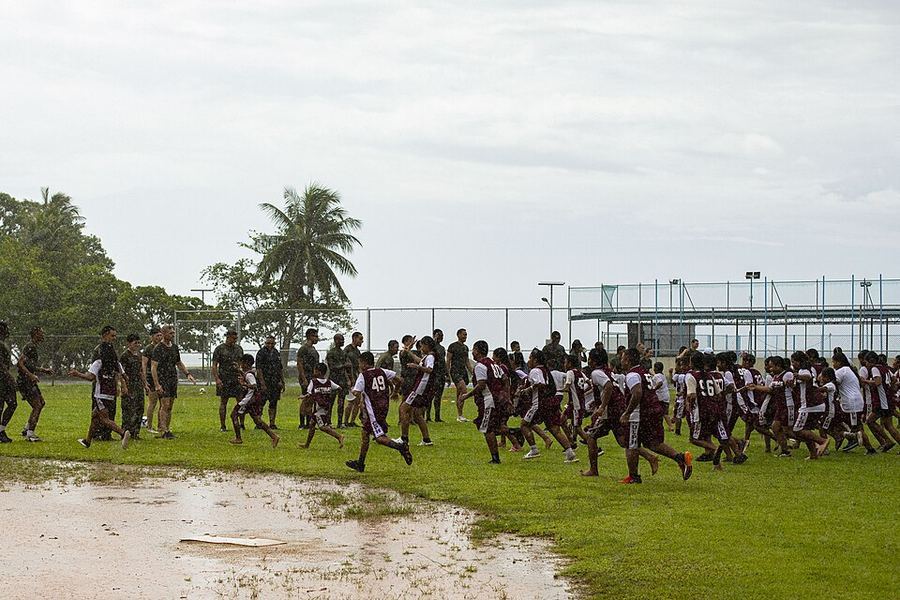
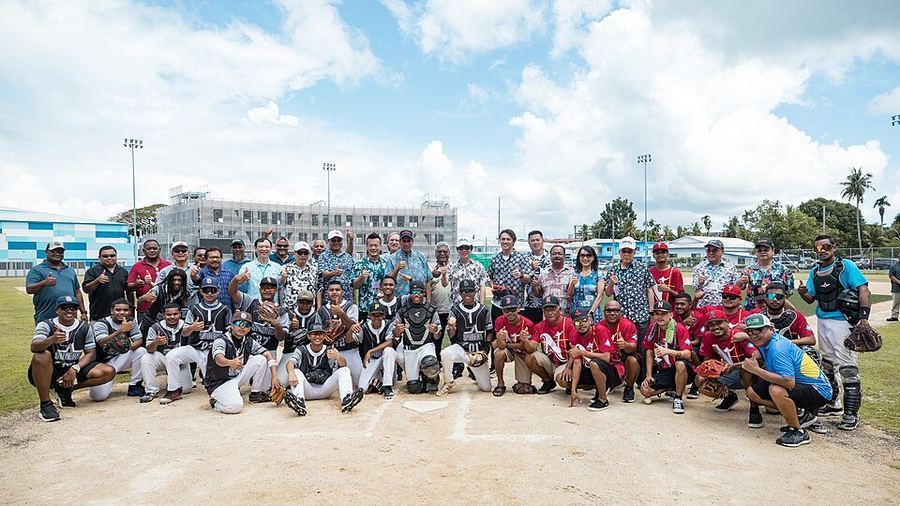
Baseball and basketball are the sports Palauans play most, in a sequence that reflects the country's colonial history: baseball arrived with the Japanese administration before the Second World War and took hold thoroughly, and basketball came with the Americans afterwards. Both are organised into village and state leagues, and the Palau Major League baseball competition is a significant part of the social calendar. Softball is widely played by women and men. Traditional canoe racing survives and has been revived as a competitive and cultural event. Given a population of about 22,000, Palau's competitive base is necessarily small, and its athletes compete internationally chiefly in swimming, athletics, weightlifting, judo, wrestling and baseball. The country's strongest regional showings have come in the Micronesian Games and the Pacific Games, where Palauan teams compete against comparably sized neighbours in baseball, basketball, athletics and swimming and where the national side has won medals across several editions. Fishing and spearfishing, though not organised as sport in the Western sense, involve competitive village events. Palau has no professional sports sector, and its best athletes typically train abroad, most often in Guam, Hawaii or the United States mainland.

Notable Educational Programs

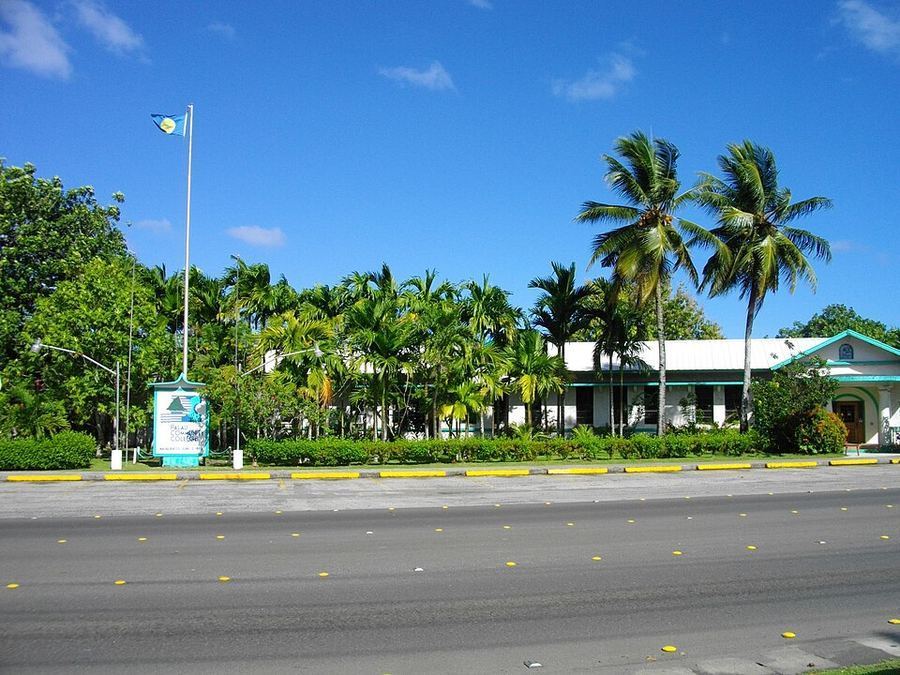
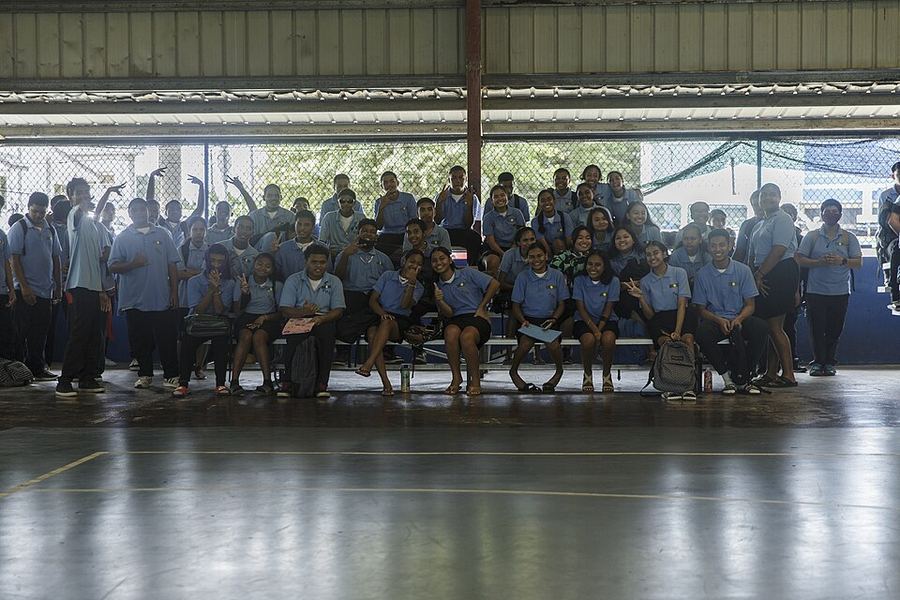
Education in Palau is free and compulsory, and adult literacy is high. The system is modelled on the American pattern inherited from the trusteeship period, with elementary schools distributed across the sixteen states and Palau High School in Koror as the principal public secondary institution, alongside Catholic and other mission schools including Mindszenty High School. Palau Community College, also in Koror, is the country's only tertiary institution; it is accredited by a United States regional accrediting body, offers associate degrees and vocational qualifications in fields including marine science, nursing, construction and business, and serves students from elsewhere in Micronesia as well as Palauans. Because the college does not award bachelor's degrees, students seeking them go abroad — most often to Guam, Hawaii or the United States mainland, a route made straightforward by the Compact of Free Association, and to a lesser extent to the Philippines, Japan and Taiwan. Retaining graduates afterwards is a recognised national difficulty. Palauan language instruction is part of the curriculum, and considerable effort goes into documenting and teaching the language, which has relatively few speakers. Marine and environmental education is emphasised, reflecting national conservation policy.

Wars & Conflicts

Palau has no armed forces and is not party to any armed conflict; under the Compact of Free Association the United States is responsible for its defence and has the right to operate militarily in and around its territory. The country's experience of war is historical and severe. The battle of Peleliu, fought from September to November 1944 between United States Marines and Army units and the Japanese garrison, was among the bloodiest engagements of the Pacific war; the fighting lasted far longer than the few days predicted, casualties on both sides were heavy, the Japanese garrison was almost entirely destroyed, and Palauan civilians were displaced. The island still holds wreckage, caves, unexploded ordnance and war memorials, and Japanese and American veterans' delegations have visited for decades. Palau's independence itself was delayed by conflict of a different kind: the constitution's ban on nuclear weapons and materials clashed with the terms of the Compact, and the question required repeated referendums across the 1980s, a period that included political violence and the assassination of the first president, before the Compact took effect in 1994. Contemporary security concerns are maritime — illegal fishing and surveillance of a very large ocean area.
Current as of 2026-08-07

Land & Border Disputes

Palau has no land boundaries and no outstanding territorial disputes. Its external boundaries are maritime, and it has negotiated delimitation of its exclusive economic zone with neighbours including the Federated States of Micronesia, Indonesia and the Philippines; a maritime boundary treaty with Indonesia was concluded in the 2010s, and discussions with the Philippines have concerned the waters between Palau and the southern Philippine islands. The practical problem in Palau's waters is not a contested line but enforcement: policing an exclusive economic zone of roughly 600,000 square kilometres with very limited assets is a permanent challenge, and illegal, unreported and unregulated fishing by distant-water fleets has been documented and prosecuted, with Palau at times seizing and destroying vessels. Palau's most consequential external relationships are diplomatic rather than territorial: it is one of a small number of states maintaining formal relations with Taiwan rather than the People's Republic of China, a position that carries economic consequences for tourism arrivals, and it hosts United States military infrastructure under the Compact, including radar installations, which places it within wider regional strategic competition.
Land, Life & Legacy

Land & Climate

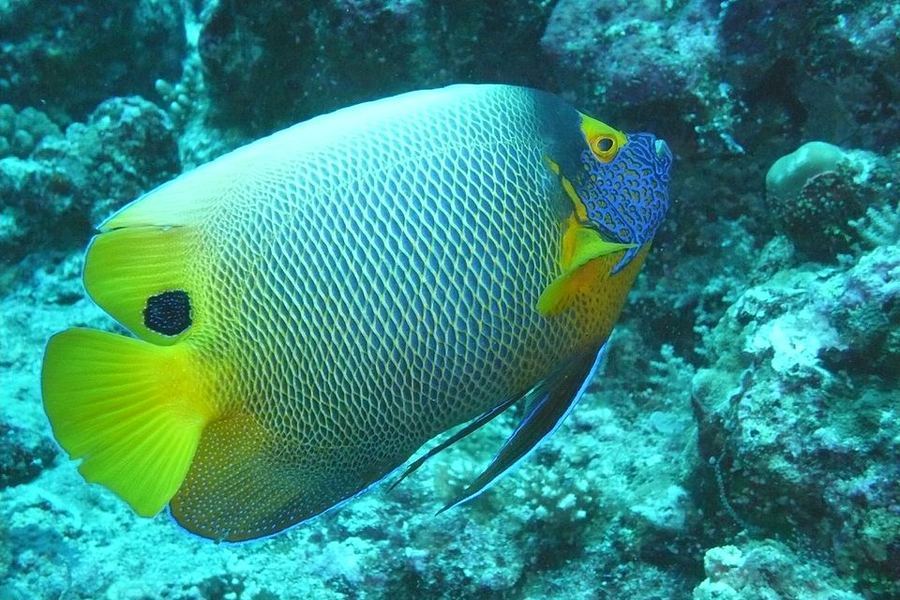
Palau lies at the western end of the Caroline Islands, north of the equator and east of the Philippines, and comprises more than 300 islands of which only a handful are permanently inhabited. Babeldaob, the largest, is a volcanic island of rolling hills, savanna and mangrove covering most of the nation's land area but holding a minority of its people; Koror, small and adjacent, holds most of the population. To the south of Koror lie the Rock Islands — several hundred forested limestone mushrooms undercut at the waterline by erosion, riddled with caves and enclosing dozens of isolated marine lakes. Peleliu and Angaur sit beyond them, and the remote Southwest Islands lie hundreds of kilometres away. Total land area is only about 460 square kilometres, but the surrounding exclusive economic zone is vast. The barrier reef enclosing much of the group creates the lagoon conditions that make the diving world-famous, including the Blue Corner and the German Channel cut through the reef in the colonial period. The climate is tropical, hot and humid year-round, with a wetter season from roughly May to November. Typhoons pass mostly to the north, but Typhoon Bopha in 2012 and Haiyan in 2013 both caused damage, and sea-level rise and coral bleaching are the principal long-term threats.

Entertainment

The water is both livelihood and leisure. Fishing — by line, spear and net — is a normal weekend activity as well as a food source, and boats are the ordinary means of moving between islands. Diving and snorkelling structure the visitor economy and are also enjoyed locally: the Blue Corner, where a reef wall meets open ocean and pelagic fish gather in the current, the German Channel with its manta rays, and the wrecks of Japanese ships sunk in the lagoon in 1944 are the best-known sites. Jellyfish Lake, reached by a short walk over a limestone ridge on one of the Rock Islands, allows swimming among millions of jellyfish whose sting is too weak to affect people. Kayaking through the Rock Islands' hidden lagoons and caves is popular. On land, basketball is played in every village, and baseball and softball leagues are followed closely — both American inheritances layered onto an earlier Japanese enthusiasm for baseball. Village feasts, church gatherings and the customary ceremonies around births, funerals and house-building account for a large share of social time, and betel nut chewing accompanies most of it.

Art & Museums

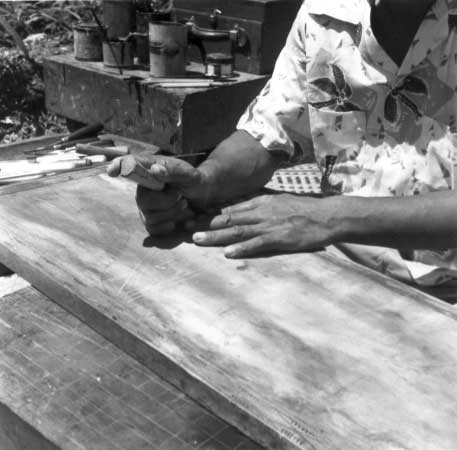
The central Palauan art form is the storyboard, and it descends directly from architecture. The bai, the village men's meeting house, carried carved and painted narrative panels across its gable ends and interior beams, recording clan legends, historical events and moral tales in a sequence of figures that a knowledgeable viewer could read. During the Japanese administration in the 1930s the artist Hisakatsu Hijikata encouraged Palauan carvers to transfer these narratives onto free-standing wooden boards for sale, and the storyboard became the country's signature craft — still carved in mahogany and other hardwoods, still telling identifiable stories, and still sold and commissioned. Palauan carving also produced canoe prows, dance paddles and the dilukai, a female figure traditionally mounted on the gable of a bai. Beadwork and the working of customary money pieces are the other traditional arts, and their value is genealogical as much as aesthetic. Weaving in pandanus and coconut fibre produces mats, baskets and the fibre used in dress. The Belau National Museum in Koror, founded in 1955 and among the oldest museums in the Pacific islands, holds the principal collection and has a reconstructed bai on its grounds.

Notable People

Lebuu, son of the high chief Ibedul of Koror, sailed to England with the survivors of the wrecked Antelope in 1784 and died of smallpox at Rotherhithe the following year; the account of the shipwreck and of his stay was a bestseller in Britain and is the earliest sustained European description of Palau. Haruo Remeliik, elected in 1980 as the first president of the Republic of Palau, was assassinated in 1985, an unresolved episode of the difficult transition period. Kuniwo Nakamura, president from 1993 to 2001, led the country into independence and into the United Nations. Tommy Remengesau Jr., president across several terms in the 2000s and 2010s, was the architect of Palau's conservation policy, including the shark sanctuary and the national marine sanctuary, and became one of the most recognised Pacific voices in international climate negotiations. Surangel Whipps Jr. was elected president in 2020. In sport, swimmer Alwyn Nakamura and the small team Palau sends to each Olympic Games carry the flag; Palau has competed at every Summer Games since Sydney in 2000. The country's traditional chiefs, the Ibedul of Koror and the Reklai of Melekeok, remain nationally significant figures.

Inventions & Breakthroughs

Palau's distinctive contributions are institutional and navigational rather than mechanical. The clearest is the bul — a traditional conservation moratorium declared by chiefs, closing a reef or a species to harvest for a period so that stocks can recover, enforced by customary authority rather than by statute. The bul is centuries old, is documented in the ethnographic record, and has been explicitly cited as the cultural precedent for Palau's modern marine legislation; the country's national marine sanctuary is, in effect, a bul at the scale of an exclusive economic zone, and the concept has been discussed internationally as a model for community-based fisheries management. Palauan customary money constitutes a second institution of unusual sophistication: a finite stock of named glass and ceramic beads of foreign origin, non-reproducible, valued by individual identity rather than denomination, and used exclusively for social obligation rather than trade — a currency that cannot be inflated. In material culture, Palauan canoe design and the associated knowledge of reef passages, currents and stars belong to the wider Micronesian navigational tradition, and the storyboard is a genuine artistic innovation of the twentieth century.

Science & Technology

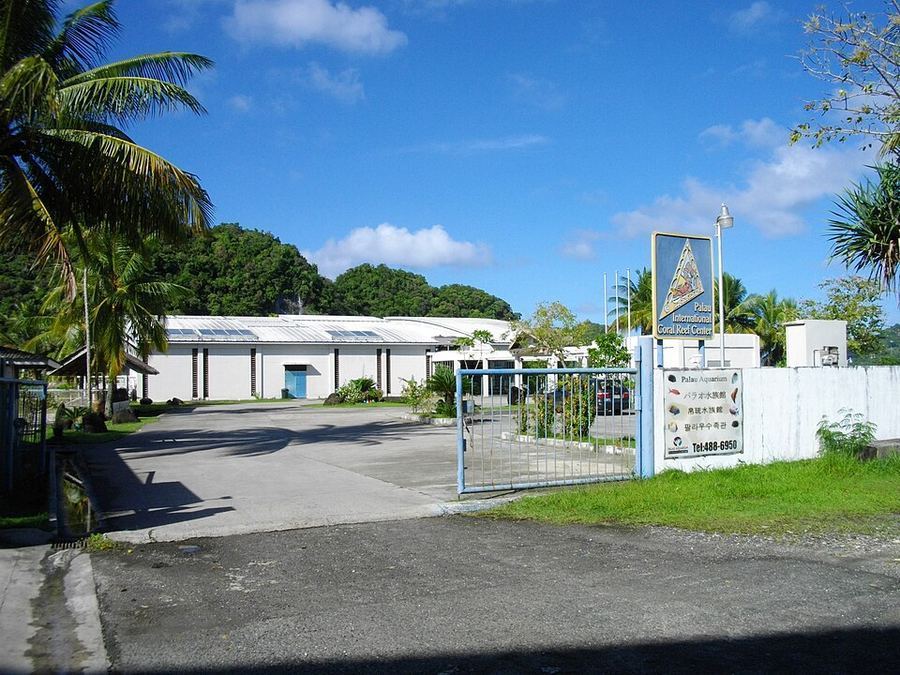
Palau's scientific weight is concentrated in marine science, where it is a genuinely significant location. The Palau International Coral Reef Center in Koror, established in 2001 with Japanese support, conducts research on reef ecology, coral bleaching and fisheries and operates a public aquarium; its work on corals in Palau's marine lakes and lagoons has attracted international attention because some Palauan reefs have shown unusual resilience to warming and acidification, making them a natural laboratory for understanding how reefs may survive climate change. The Coral Reef Research Foundation, also based in Palau, has conducted long-term surveys and supplied marine organisms for biomedical screening, including collections for United States cancer research programmes. Jellyfish Lake, whose golden jellyfish population is descended from ocean ancestors isolated when sea level fell and which has lost most of its stinging capacity, is studied as a case of rapid evolutionary change in a closed system, and the population's collapse during a severe drought and subsequent recovery has been closely documented. Palau's marine sanctuary has also made the country a test case for satellite-based fisheries surveillance, using vessel-tracking analysis to police an area far larger than its patrol capacity.
NatureScienceUNESCOFAO
On The World Stage

Champions & Defining Moments

Palau joined the International Olympic Committee in 1999 and has competed at every Summer Olympic Games since Sydney in 2000, sending small teams — usually a handful of athletes in swimming, athletics and wrestling or weightlifting — under the flag of one of the least populous nations in the movement. It has not won an Olympic medal, and its participation functions as a statement of sovereignty as much as a sporting entry; the flagbearer's walk at the opening ceremony is watched at home. Palau competes in the Pacific Games, the Micronesian Games and the Oceania regional championships, which are the arenas where its athletes are genuinely competitive and where the country has taken medals in baseball, athletics and swimming. It is a member of the Oceania National Olympic Committees and of regional federations in athletics and swimming, though it is not a FIFA member and its football activity is limited. Palau also has an international profile in ocean governance that intersects with sport and tourism: its marine sanctuary and the Palau Pledge are frequently presented at United Nations ocean conferences, where the country's diplomatic visibility far exceeds its size.

IOCOlympediaUN
Economy, Trade & Government

Currency & GDP

GDP (PPP): $280.025 million (2023 est.)

Per capita: $15,800 (2023 est.)

Exports

$24.48 million (2022 est.)

ships, refined petroleum (2023)

Partners: India 41%, Turkey 26%, Taiwan 10%, USA 9%, Japan 5% (2023)

Imports

$216.681 million (2022 est.)

ships, refined petroleum, additive manufacturing machines, cars, plastic products (2023)

Partners: Italy 32%, China 25%, USA 11%, Turkey 10%, Japan 6% (2023)

Government

Type: presidential republic in free association with the US

Independence: 1 October 1994 (from the US-administered UN trusteeship)

Terrain → Where People Live

How mountains, coasts, and rivers shape settlement (LandScan).

Coming — data

Migration & Ethnic Settlement

Where groups settled and how people move (GeoEPR + UNHCR).

Coming — data

Universities

Notable institutions, mappable as points.

Coming — data
Economy & government facts: CIA World Factbook (public domain), via OpenFactBook / factbook.json.
Every fact and narrative claim will carry a visible source citation. Data-driven sections light up automatically wherever HERA has coverage.