HERA · Human Entity Reference Atlas by Masego Inc

← Russia 🌐 3D View
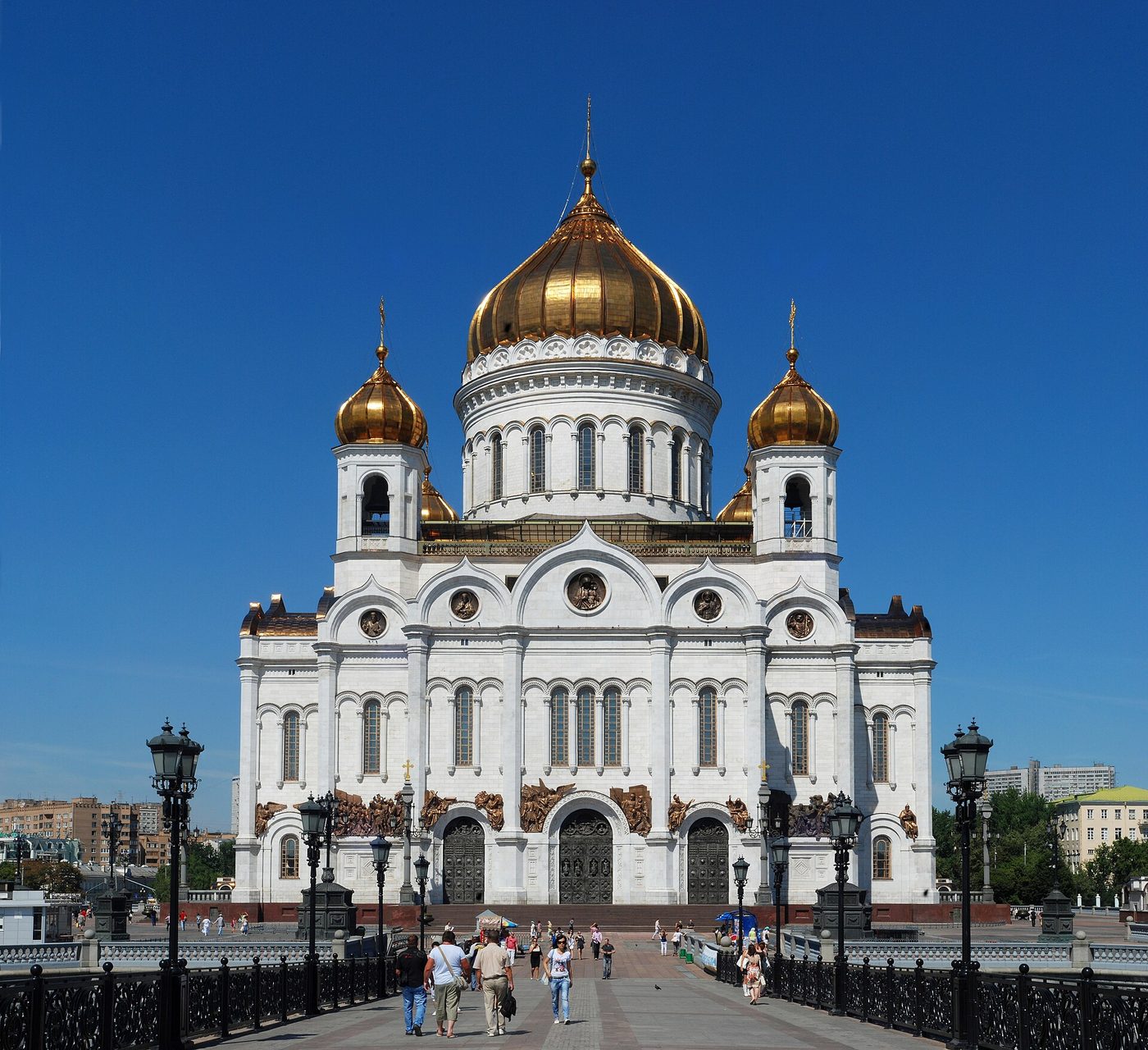
Cathedral of Christ the Saviour, Russia
Russia RUS
Cathedral of Christ the Saviour — Photo: Alvesgaspar / CC BY-SA 3.0 via Wikimedia Commons
Did You Know The Trans-Siberian Railway is the longest railway line in the world, running about 9,289 kilometers from Moscow to Vladivostok and crossing seven time zones on a journey of roughly a week. — Encyclopaedia Britannica

Russia is the largest country on Earth, sprawling across roughly 17.1 million square kilometers and eleven time zones — when commuters board the metro in Kaliningrad, fishermen in Kamchatka are already finishing dinner. Some 140 million people (2025 est.) inhabit this expanse, yet most cluster in the European west; Siberia, larger than any other country by itself, remains thinly settled taiga, steppe, and permafrost. Moscow, the capital, anchors a semi-presidential federation of republics, oblasts, and autonomous districts that reflects extraordinary human diversity: ethnic Russians form about 78 percent of the population, alongside Tatars, Ukrainians, Bashkirs, Chuvash, Chechens, and well over a hundred smaller peoples speaking dozens of languages. The economy leans heavily on hydrocarbons — crude oil, refined petroleum, natural gas, and coal dominate exports, with China and India the top buyers — producing a GDP of about $6.1 trillion at purchasing power parity (2024 est.). Culturally, Russia's footprint is outsized: its novels, ballets, symphonies, and space-program firsts belong to the shared inheritance of the modern world.

CIA World FactbookEncyclopaedia Britannica
Population
140,134,279
Capital
Moscow
Currency
₽ RUB
Time zones
Largest city
Moscow
Human Geography Themes
Loading national figures…
Largest Cities
Moscow14,384,082
Saint Petersburg4,878,966
Novosibirsk1,364,642
Nizhny Novgorod1,189,993
Kazan1,127,086
Yekaterinburg1,102,145
Rostov-on-Don1,028,672
Voronezh959,569
In Perspective

Moscow's urban core is home to about 14,384,082 people.

That's bigger than London, Paris, Madrid and Toronto — each a great world city in its own right.

Moscow14,384,082
London10,408,332
Paris9,366,654
Madrid5,680,137
Toronto5,566,382

Among the world's megacities, though, it's one of many — the giants of Asia and Latin America run larger still:

Moscow14,384,082
Jakarta40,545,126
Dhaka37,307,160
Tokyo33,244,670
Shanghai30,678,616
Cairo25,230,325

More people live in Moscow than in the entire nation of Sweden, Greece, Portugal or Israel.

The Country & Its People

History

Russian statehood traces to medieval Kievan Rus, a river-trading federation of East Slavic principalities that adopted Orthodox Christianity in 988. Mongol invasion shattered Rus in the thirteenth century, and out of the wreckage the once-minor principality of Moscow gathered lands and power. Ivan IV — 'the Terrible' — was crowned the first tsar in 1547; the Romanov dynasty followed in 1613 and ruled for three centuries. Peter the Great proclaimed the Russian Empire in 1721, dragging the country toward Europe and building St. Petersburg on Baltic marshland as his 'window on the West.' Catherine the Great expanded the empire across the Black Sea steppe; Alexander I's armies pursued Napoleon from burning Moscow to Paris in 1812–14; serfdom was abolished in 1861. Defeat and hunger in World War I brought two revolutions in 1917, and the Soviet Union was established in 1922. The USSR industrialized brutally under Stalin, absorbed staggering losses defeating Nazi Germany, and emerged as a nuclear superpower locked in the Cold War. On 25 December 1991 the Soviet Union dissolved, and the Russian Federation took its place among fifteen successor states.
History, Russia
Юрий Д.К. / CC BY 4.0

Culture

Russian culture runs on contrasts: severe winters and exuberant hospitality, vast distances and intense domestic intimacy. The literary canon — Pushkin, Gogol, Tolstoy, Dostoevsky, Chekhov, Akhmatova — is arguably the country's greatest export, still setting the global standard for the psychological novel. Orthodox Christianity, with its onion-domed churches, icons, and Easter midnight liturgies, shapes the calendar and the visual landscape even in a society where regular observance is modest; Islam, Buddhism, and Judaism are also long-rooted traditional faiths. Everyday culture has its own institutions: the dacha, a countryside cottage where city families grow potatoes and cucumbers each summer; the banya, a steam bath ritual complete with birch-branch thwacking and plunge pools; and the long kitchen-table conversation over tea, considered the true venue of Russian friendship. Superstitions endure — never shake hands across a threshold, always sit down in silence before a journey. Festivals like Maslenitsa, the pancake week that burns a straw effigy of winter, blend pagan and Christian roots. Across more than 190 recognized ethnic groups, from Tatar Sabantuy festivals to Yakut horse culture, the federation's cultural fabric is far broader than its Slavic core.
Culture, Russia
Wilfredor / CC0

Points Of Pride

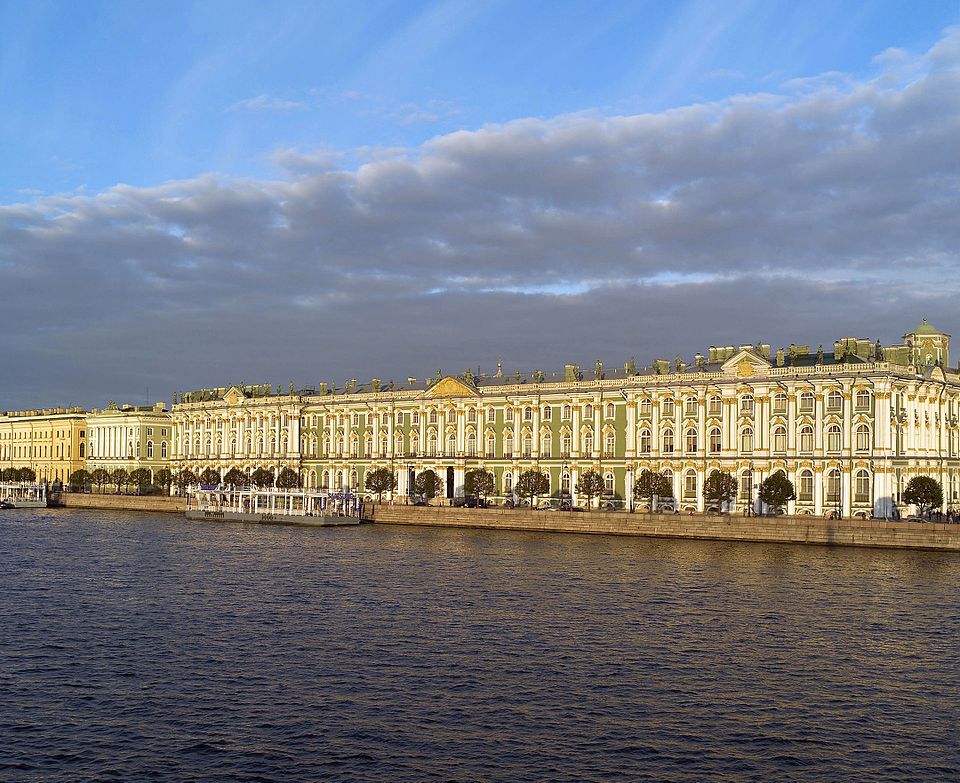
Russians can claim humanity's first steps beyond Earth: Sputnik 1, the first artificial satellite, in 1957; Yuri Gagarin, the first human in orbit, in 1961; and Valentina Tereshkova, the first woman in space, in 1963 — a cosmonaut tradition that still supplies crews to the International Space Station. The Hermitage in St. Petersburg, founded by Catherine the Great in 1764, ranks among the world's largest art museums, its collections numbering in the millions within the Winter Palace complex. The country counts around thirty UNESCO World Heritage sites, from the Moscow Kremlin and Red Square to the wooden churches of Kizhi and the volcanoes of Kamchatka. Russian and Soviet composers — Tchaikovsky, Rachmaninoff, Stravinsky, Shostakovich — and the Bolshoi and Mariinsky ballet companies define entire art forms. Chess is close to a national religion: Soviet and Russian grandmasters held the world championship almost continuously for half a century. Add the scientific lineage of Mendeleev's periodic table and Pavlov's Nobel Prize, and the memory of victory in what Russians call the Great Patriotic War, and the sources of national pride run deep and wide.
Points Of Pride, Russia
Godot13 / CC BY-SA 4.0

Cultural Fusion

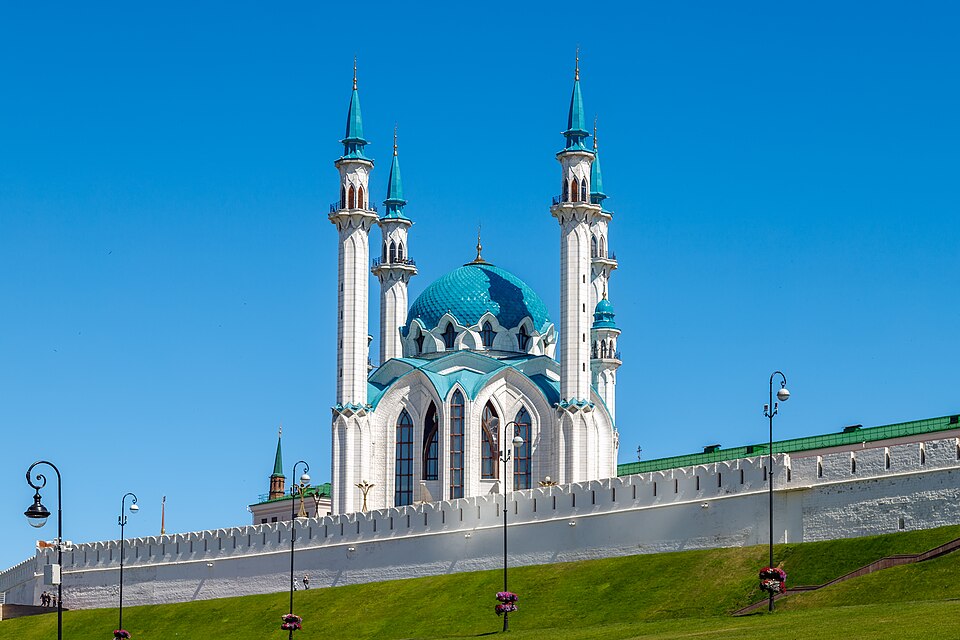
Russia is less a nation-state than a compressed Eurasia. Its 2010 census recorded more than 190 ethnic groups: the Slavic majority lives alongside Turkic peoples (Tatars, Bashkirs, Chuvash, Yakuts), Finno-Ugric peoples (Mordvins, Udmurts, Karelians), the dozens of nationalities of the North Caucasus (Chechens, Avars, Ossetians, Circassians), and small indigenous peoples of Siberia and the Arctic such as the Nenets, Evenks, and Chukchi, some still herding reindeer across the tundra. This produces striking juxtapositions: Kazan, capital of Tatarstan, pairs the Kul Sharif Mosque with an Orthodox cathedral inside one white-walled kremlin; Kalmykia, on the Caspian steppe, is Europe's only Buddhist-majority region; Buryatia and Tuva sustain Tibetan Buddhist and shamanic traditions near Lake Baikal and the Mongolian border. Linguists catalogue well over a hundred languages spoken across the federation, spanning Slavic, Turkic, Uralic, Caucasian, Mongolic, and Paleo-Siberian families. Centuries of contact flowed into the mainstream: Russian vocabulary absorbed Turkic words for money and markets, cuisine adopted pelmeni dumplings from Siberian and Ural traditions, and imperial-era churches borrowed ornament from the east. The federation's structure itself — with republics bearing the names of their titular peoples — encodes this layered inheritance.
Cultural Fusion, Russia
Mike1979 Russia / CC BY-SA 3.0

Music & Dance

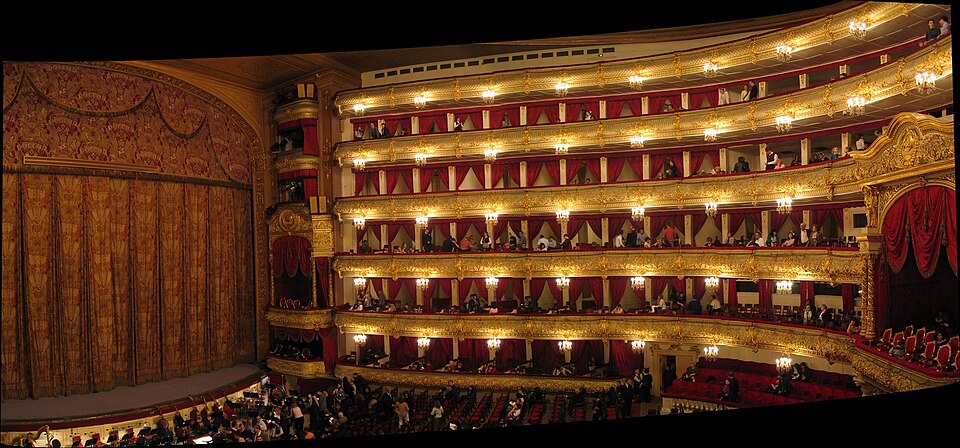
Few countries have shaped the world's concert halls and opera houses as thoroughly. Nineteenth-century composers built a national school on folk melody and Orthodox chant: Glinka first, then the 'Mighty Handful' — Mussorgsky's Boris Godunov, Rimsky-Korsakov's shimmering orchestration — and Tchaikovsky, whose Swan Lake, The Nutcracker, and Sleeping Beauty remain the heart of the ballet repertoire. The twentieth century added Rachmaninoff's late-Romantic pianism, Stravinsky's Rite of Spring (its Paris premiere provoked a riot), Prokofiev, and Shostakovich, whose symphonies bore witness to the Soviet era. Ballet itself is a Russian signature: the Bolshoi in Moscow and the Mariinsky in St. Petersburg trained the dancers — Pavlova, Nijinsky, Nureyev, Baryshnikov — who defined the art worldwide. Folk traditions are equally vivid: the triangular three-stringed balalaika and the garmon accordion accompany songs like 'Kalinka,' while the khorovod circle dance and the athletic squat-kicking prisyadka animate folk ensembles. Distinct regional treasures survive across the federation, from the Cossack choral tradition of the southern steppes to the astonishing overtone throat singing of Tuva, where one singer produces two or more notes at once.
Music & Dance, Russia
Photographed by Theefer / CC BY-SA 2.0

Cuisine & Misattributed Foods

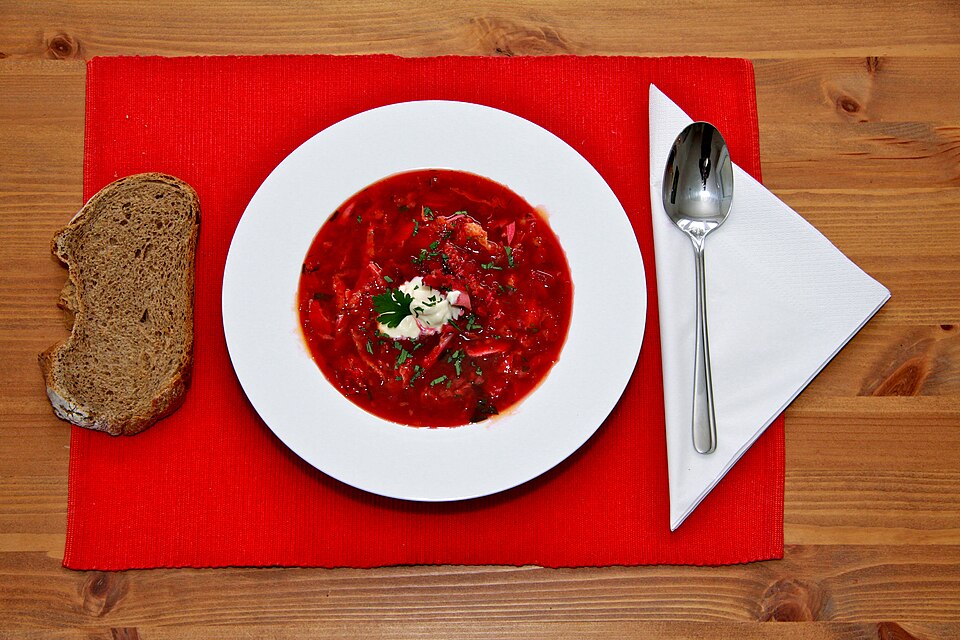
Russian cooking is winter food perfected: soups, grains, pickles, and pastry engineered to warm a continent. Shchi, cabbage soup, has anchored the table for a thousand years, joined by solyanka's sour-salty depth and cold summer okroshka bathed in kvass, a lightly fermented rye-bread drink. Beet borscht, shared with and originating in the cuisines of Ukraine and the wider region, is a staple in Russian homes as well. Pelmeni — little meat dumplings that Siberians traditionally froze outdoors by the sackful — are near-universal comfort food, while blini, thin pancakes eaten with butter, smetana (sour cream), jam, or caviar, crown the pre-Lenten Maslenitsa festival. Buckwheat kasha, black bread, herring, and an arsenal of pickled cucumbers, mushrooms, and cabbage carry the pantry through the cold months. Celebration dishes include beef stroganoff, born in a nineteenth-century aristocratic kitchen, and Olivier salad, obligatory on every New Year's table. Tea is the national drink, historically brewed strong atop a charcoal samovar and diluted cup by cup — vodka may be the famous export, but tea rules the household. The zakuski spread of appetizers, laid out before any feast, turns hospitality itself into a course.
Cuisine & Misattributed Foods, Russia
Juerg Vollmer from Zürich, Schweiz / CC BY-SA 2.0

National Dress

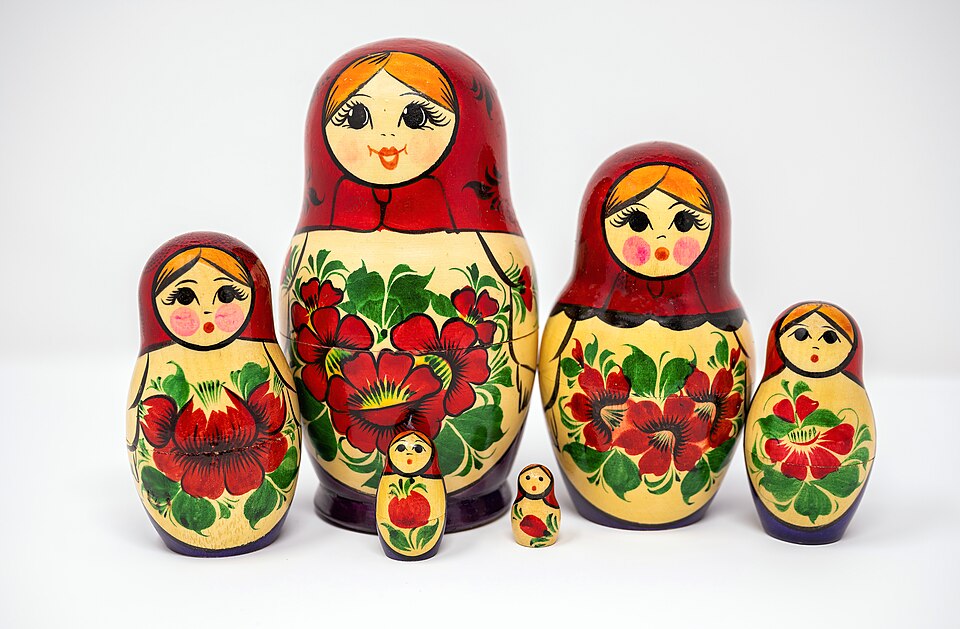
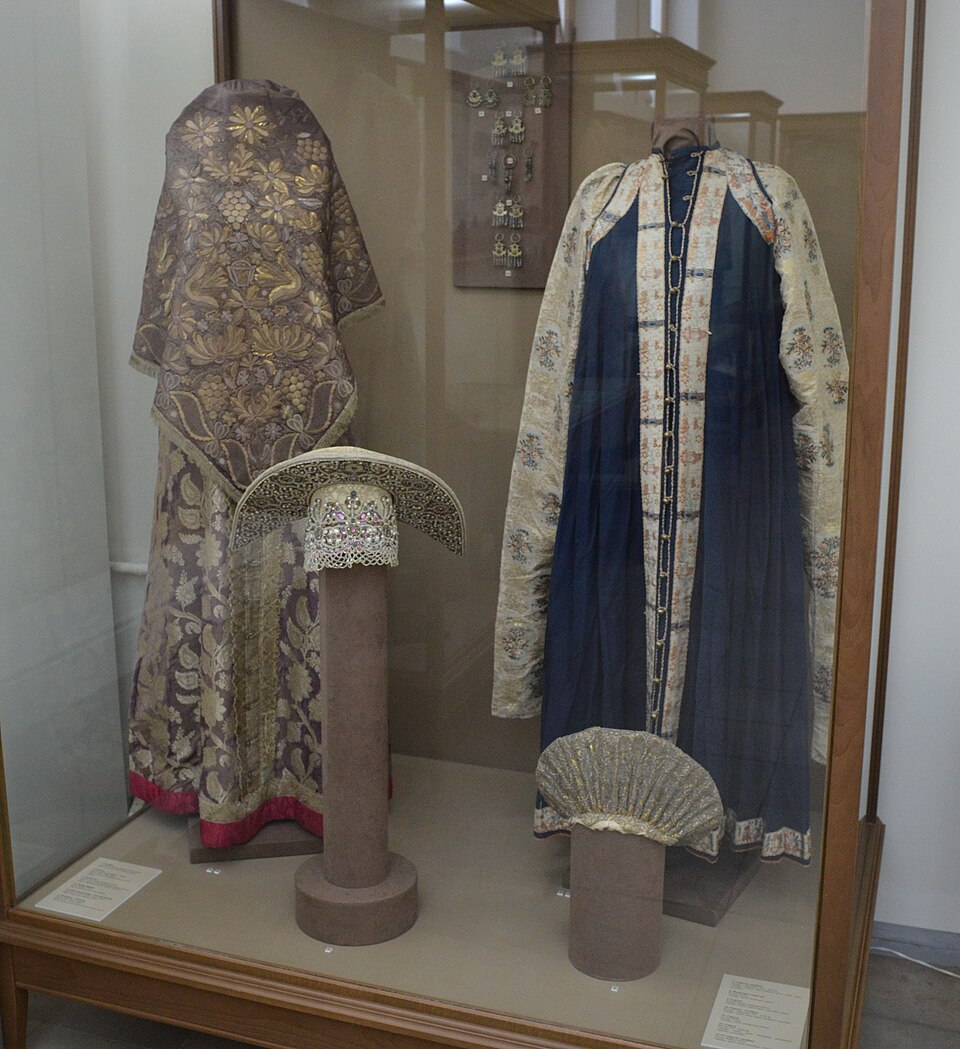
Traditional Russian dress is a study in practicality made beautiful. For women, the sarafan — a long, trapeze-shaped jumper dress worn over an embroidered linen blouse — became the emblematic costume of the central and northern provinces, paired with the kokoshnik, a stiff halo-shaped headdress often embellished with gold thread, river pearls, and beadwork; its silhouette still appears in ballet costume and stage folklore. Men wore the kosovorotka, a side-buttoned collarless shirt belted at the waist over loose trousers and boots. Winter demanded its own uniform: the fur-flapped ushanka hat, sheepskin coats, felted-wool valenki boots, and the goat-down Orenburg shawl, knitted so fine that a full shawl can famously be drawn through a wedding ring. Color and embroidery carried meaning — red was the color of beauty and festivity, and protective patterns edged collars and cuffs. Beyond the Slavic wardrobe, the federation's peoples keep their own traditions: Tatar embroidered caps and kalfak headdresses, the belted cherkeska coats of the North Caucasus, and the reindeer-hide parkas of Arctic herders. Today such dress is largely ceremonial, worn for festivals, weddings, and folk performance rather than daily life.
National Dress, Russia
Лапоть / CC0

Sports & Inspiring Athletes

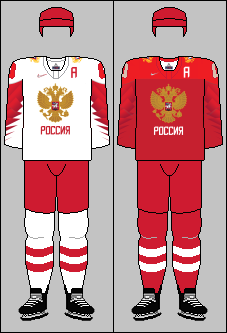
Sport in Russia carries the weight of Soviet athletic tradition, which treated Olympic and world championships as matters of state and built one of history's great sports systems. Ice hockey is the beloved winter game: the Soviet national team's dominance from the 1950s to the 1980s is legendary, and the Kontinental Hockey League remains one of the sport's strongest leagues outside North America. Figure skating is a conveyor belt of champions, particularly in women's and pairs disciplines; gymnastics, wrestling, weightlifting, fencing, and biathlon have supplied steady hauls of Olympic medals. Chess, recognized as a sport domestically, produced an almost unbroken line of world champions from Botvinnik through Karpov and Kasparov. Football is the most played game; Russia hosted the 2018 FIFA World Cup across eleven cities, and Sochi staged the 2014 Winter Olympics. Tennis stars from Sharapova to Medvedev have kept the country in Grand Slam finals. Recent years have been turbulent: doping scandals forced athletes to compete under neutral designations, and following the 2022 invasion of Ukraine, Russian teams were suspended from FIFA competitions and Russian athletes admitted to the Olympics only under strict neutral status.
Sports & Inspiring Athletes, Russia
Realismadder / CC BY-SA 4.0

Notable Educational Programs

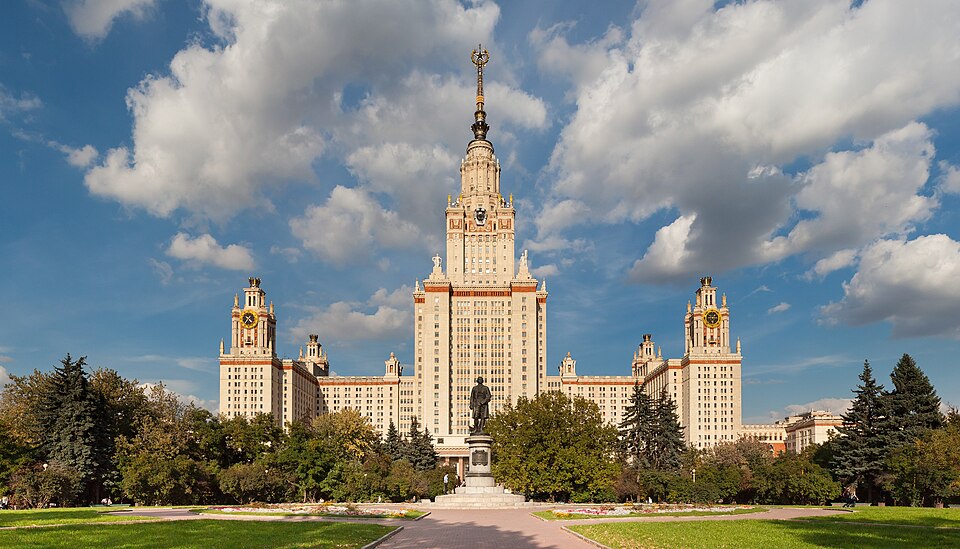
Russia inherits one of the world's most extensive education systems, with adult literacy effectively universal and a deep bench of scientific institutions. Eleven years of general schooling run from primary through upper secondary, capped since 2009 by the Unified State Exam (EGE), a standardized national test that serves as both graduation certificate and university entrance ticket — a reform meant to level access for students far from Moscow. The mathematics and physics tradition is a point of distinction: a network of specialized physics-and-mathematics schools, olympiad training, and academic 'gymnasium' tracks has long fed international competition podiums and research institutes. Higher education is anchored by historic universities — St. Petersburg State, founded in 1724 under Peter the Great, and Lomonosov Moscow State University, founded in 1755, whose Stalinist skyscraper crowns the Sparrow Hills — alongside elite technical institutes such as MIPT and Bauman. The tertiary attainment rate ranks among the highest of any large country. Vocational colleges, a legacy of Soviet workforce planning, still train a substantial share of each cohort. Persistent challenges include regional funding gaps between wealthy cities and remote areas, and the emigration of researchers, which has accelerated during periods of political and economic strain.
Notable Educational Programs, Russia
Dmitry A. Mottl (cropped by King of Hearts) / CC BY-SA 3.0

Wars & Conflicts

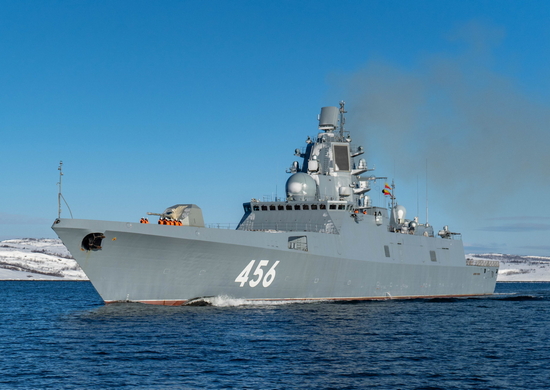
Russia's full-scale invasion of Ukraine, launched in February 2022 as an escalation of the war begun in 2014, remains the defining conflict of the decade and continues as of mid-2026. Conflict monitors including UCDP classify it as Europe's deadliest war since 1945; casualty estimates vary widely and cannot be independently verified, but observers on all sides acknowledge losses running into the hundreds of thousands. Fighting is concentrated in eastern and southern Ukraine, where front-line assessments reported by Reuters and analysts tracking the campaign showed Russia making slow, incremental territorial gains through mid-2026. Diplomacy intensified over 2025–26 — with US-brokered contacts and, per AP and BBC News reporting, a European 'Coalition of the Willing' meeting in Paris in July 2026 that called for an immediate ceasefire and direct negotiations — but talks remain stalled: Moscow demands Ukrainian withdrawal from the four partly occupied oblasts it claims and abandonment of NATO ambitions, while Kyiv rejects territorial concessions and insists on binding security guarantees. Sweeping Western sanctions continue; the EU renewed its measures into 2027. The International Criminal Court's 2023 arrest warrant for President Putin over the deportation of Ukrainian children stands, and Al Jazeera and Reuters reported Russia adopted a December 2025 law asserting a right to disregard such rulings, which Moscow calls politically motivated.
Current as of 2026-07-16
Wars & Conflicts, Russia
Unknown authorUnknown author / CC BY 4.0

Land & Border Disputes

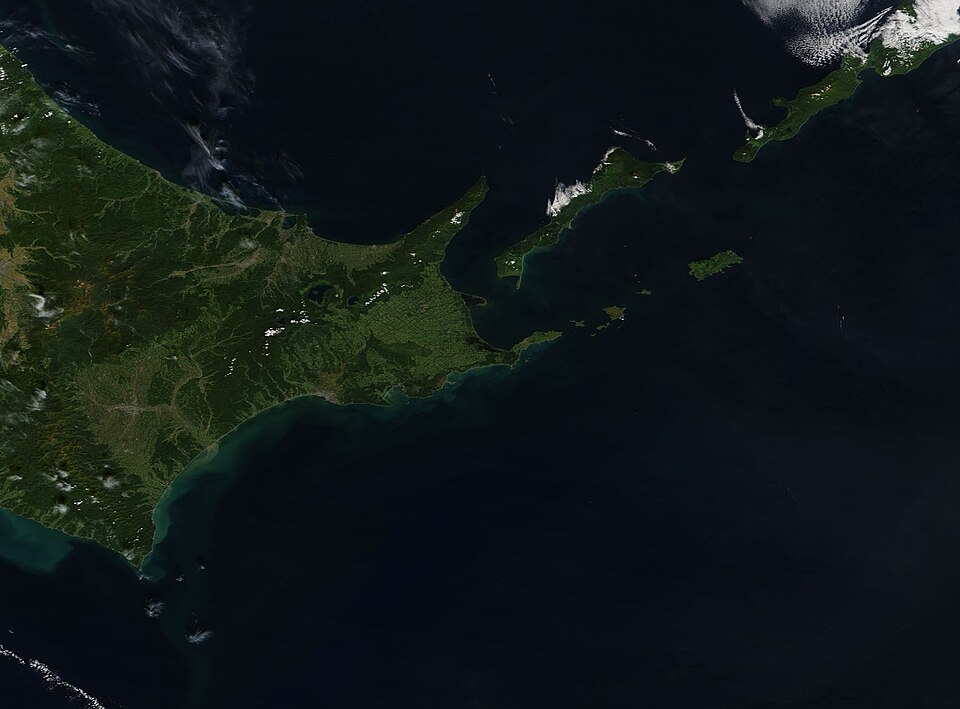
Russia's most consequential territorial disputes stem from the war in Ukraine. Its 2014 annexation of Crimea and its September 2022 declared annexations of Donetsk, Luhansk, Zaporizhzhia, and Kherson oblasts are not internationally recognized: UN General Assembly resolutions have affirmed Ukraine's territorial integrity within its internationally recognized borders, and related cases brought by Ukraine against Russia are before the ICJ, which in 2022 ordered Russia to suspend its military operations. A much older dispute concerns the southern Kuril Islands, seized by Soviet forces at the end of World War II and claimed by Japan as its 'Northern Territories'; the disagreement has prevented Moscow and Tokyo from ever signing a formal WWII peace treaty. In the Arctic, Russia has petitioned the UN Commission on the Limits of the Continental Shelf to recognize an extended shelf along the Lomonosov Ridge toward the North Pole, overlapping submissions by Denmark and Canada — a scientific-legal process rather than a confrontation, but one with high stakes for seabed resources. Additional friction points include the maritime delimitation of the Sea of Azov and Kerch Strait with Ukraine, and unresolved borders with Georgia around Abkhazia and South Ossetia, whose Russian-recognized independence most UN member states reject.
Land & Border Disputes, Russia
Jeff Schmaltz, MODIS Land Rapid Response Team, NASA GSFC / Public domain
Land, Life & Legacy

Land & Climate

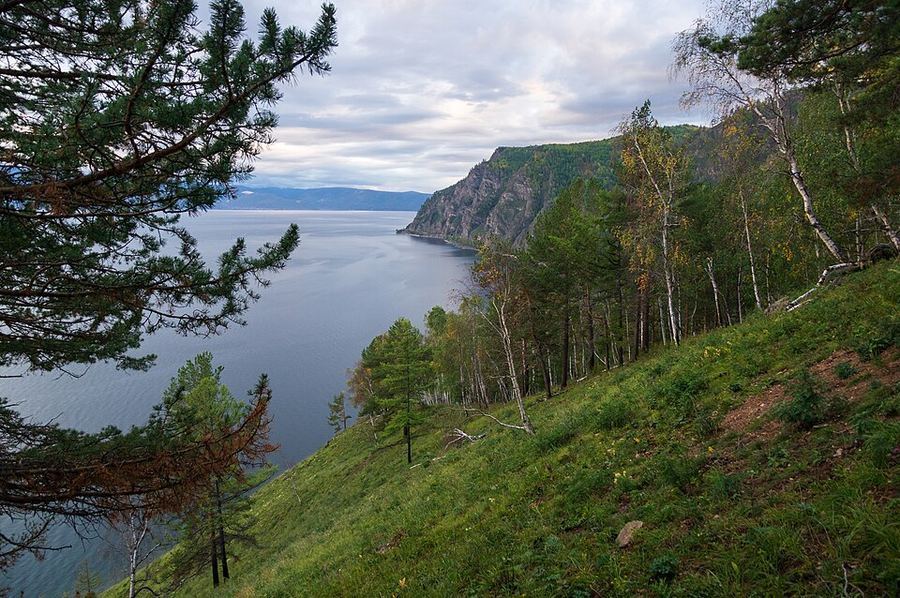
Russia is the largest country on earth at about 17 million square kilometres, spanning eleven time zones and two continents. The Ural Mountains divide European Russia, where most people live on the East European Plain, from Siberia. East of the Urals lie the West Siberian Plain, one of the largest flat and heavily bogged areas in the world, then the Central Siberian Plateau, and finally the mountainous far east with the volcanoes of the Kamchatka Peninsula, a World Heritage site with dozens of active cones. Lake Baikal in southern Siberia is the deepest and oldest lake in the world and holds roughly a fifth of the planet's unfrozen fresh surface water, with hundreds of species found nowhere else. The Volga, Europe's longest river, drains to the Caspian, while the Ob, Yenisei and Lena run north to the Arctic. Much of the territory sits on permafrost, and the climate is continental to subarctic, with Oymyakon in Yakutia among the coldest permanently inhabited places on earth. Arctic warming and permafrost thaw are unusually pronounced here, undermining infrastructure built on frozen ground.

Entertainment

Russian leisure follows the seasons. Summer belongs to the dacha, where tens of millions decamp on Friday evenings to garden plots, and to mushroom and berry foraging in the forests — a national pastime with its own etiquette and fierce secrecy about good spots. The banya steam bath is year-round therapy, ideally followed in winter by a roll in the snow. Vacationers head south to the Black Sea resorts around Sochi, east to Lake Baikal and the Altai Mountains, or along classic domestic circuits like the Golden Ring of medieval towns northeast of Moscow and the week-long Trans-Siberian rail journey to Vladivostok. City life revolves around theater, ballet, and opera — tickets to the Bolshoi and Mariinsky remain prized possessions — plus strolling renovated parks like Moscow's Gorky Park. The long New Year holiday, with its decorated trees, Grandfather Frost, salads, and Soviet-era films on television, is the emotional peak of the entire calendar.
Entertainment, Russia
Sergey A. Demidov / CC BY 4.0

Art & Museums

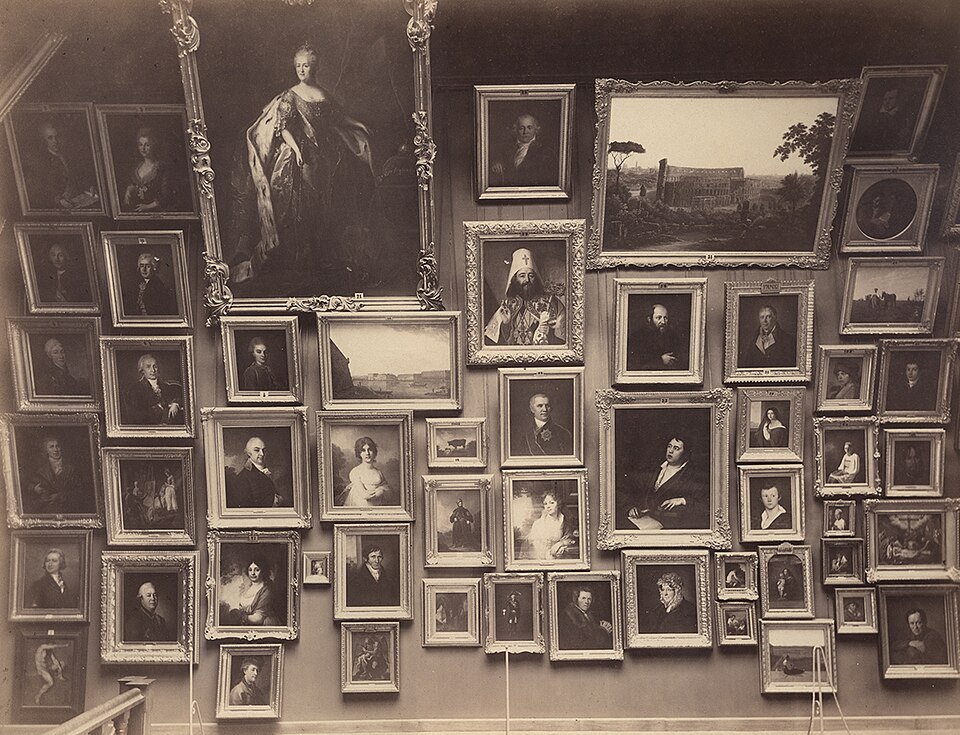
Russian art's first golden age was the icon: Andrei Rublev's early-fifteenth-century Trinity remains the most revered painting in the Orthodox tradition. The nineteenth century produced the Peredvizhniki — the 'Wanderers' — realists who took exhibitions to the provinces: Ilya Repin's Barge Haulers on the Volga, Ivan Shishkin's forests, and Isaac Levitan's melancholy landscapes, most of them now hanging in Moscow's Tretyakov Gallery, built on merchant Pavel Tretyakov's collection and gifted to the city in 1892. St. Petersburg answers with the Hermitage, one of the world's largest museums, and the Russian Museum's national collection. In the early twentieth century Russia briefly led the world's avant-garde: Wassily Kandinsky pioneered abstraction, Kazimir Malevich's Black Square (1915) reduced painting to pure geometry, and Marc Chagall floated his native Vitebsk into modernist dream imagery — while Vera Mukhina's stainless-steel Worker and Kolkhoz Woman, made for the 1937 Paris exposition, became the emblem of Soviet monumental sculpture.
Art & Museums, Russia
Karl Fischer / Public domain

Notable People

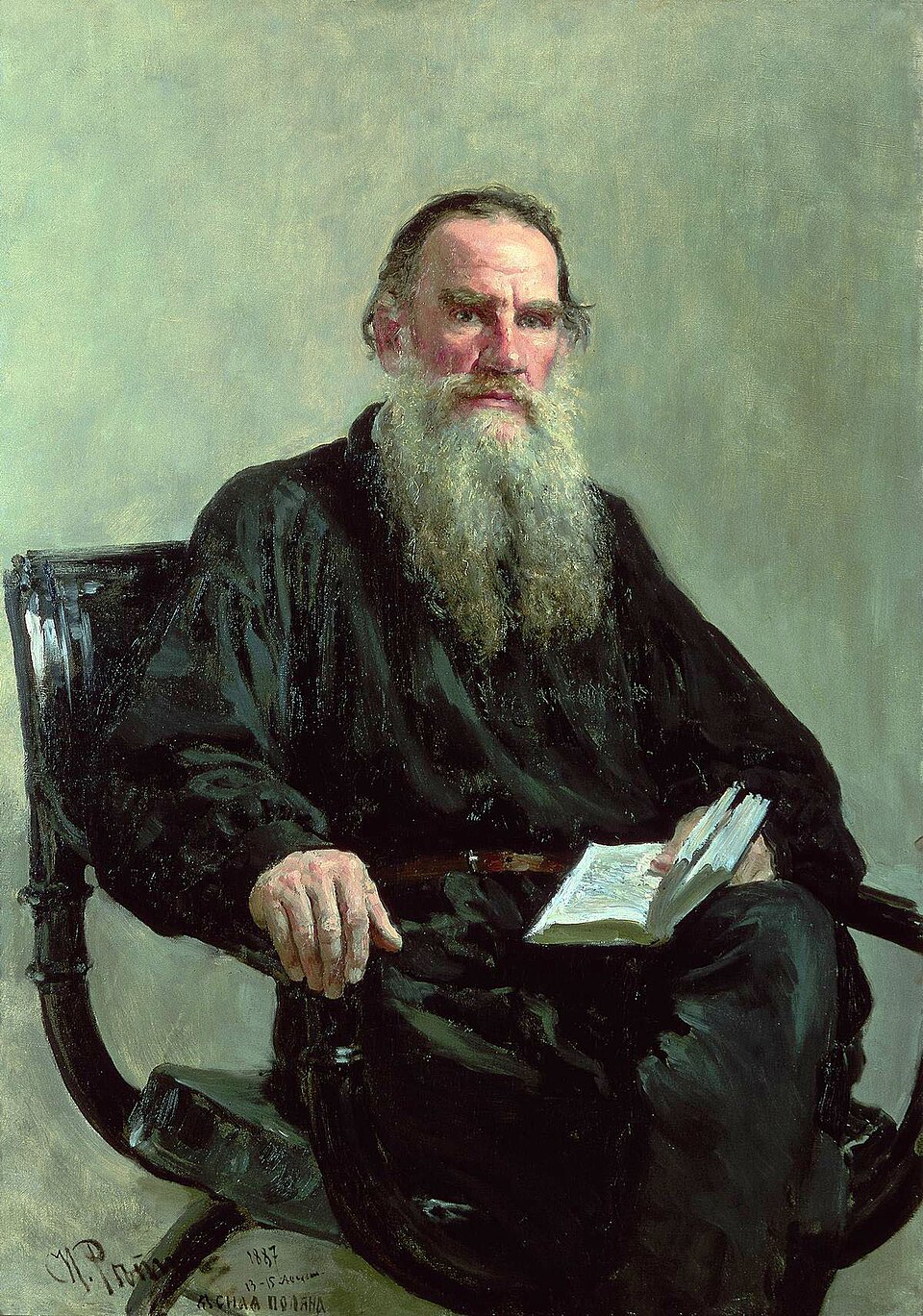
Russia's pantheon starts with its writers — Alexander Pushkin, the founding poet; the novelists Leo Tolstoy and Fyodor Dostoevsky; the playwright Anton Chekhov; and Anna Akhmatova, who chronicled the Soviet century's terrors in verse. Science claims Dmitri Mendeleev, architect of the periodic table; Nobel laureate Ivan Pavlov; and the polymath Mikhail Lomonosov, for whom Moscow State University is named. The state-builders Peter the Great and Catherine the Great dragged the empire toward Europe, while Yuri Gagarin, the first human in space, and Valentina Tereshkova, the first woman, define its cosmic age. The arts add the composers Tchaikovsky, Stravinsky, and Shostakovich, ballerina Anna Pavlova, and filmmaker Sergei Eisenstein, whose Battleship Potemkin still anchors film-school curricula. Chess supplies Garry Kasparov, world champion for fifteen years, and sport contributes gymnast Larisa Latynina, whose eighteen Olympic medals stood as the all-time record for nearly half a century.
Notable People, Russia
Ilya Repin / Public domain

Inventions & Breakthroughs

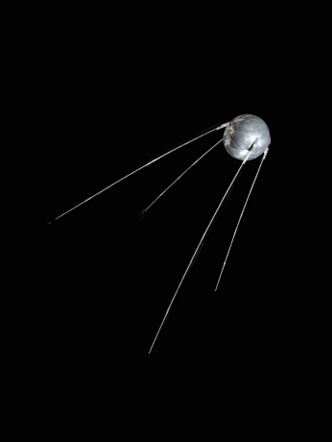
Russia's scientific signature is written across the sky. Konstantin Tsiolkovsky worked out the mathematics of rocketry as a provincial schoolteacher in the 1890s; six decades later Sergei Korolev's design bureau launched Sputnik 1 (1957), the first artificial satellite, and Vostok 1 (1961), carrying Yuri Gagarin — and the world's first civilian nuclear power plant had already opened at Obninsk in 1954. Dmitri Mendeleev's periodic table (1869) organized chemistry so well that it predicted elements not yet discovered. Alexander Popov demonstrated early radio reception in 1895; Vladimir Zvorykin, Russian-born and American-based, pioneered electronic television; and Kyiv-born Igor Sikorsky built the world's first four-engine aircraft for the Russian Empire before developing the practical helicopter in America. Nikolai Basov and Alexander Prokhorov shared the 1964 Nobel Prize for the physics behind the laser. And a softer export: Tetris, coded by Alexey Pajitnov at a Soviet computing center in 1984, became one of the best-selling video games ever made.
Inventions & Breakthroughs, Russia
Soyuz235 / Public domain

Science & Technology

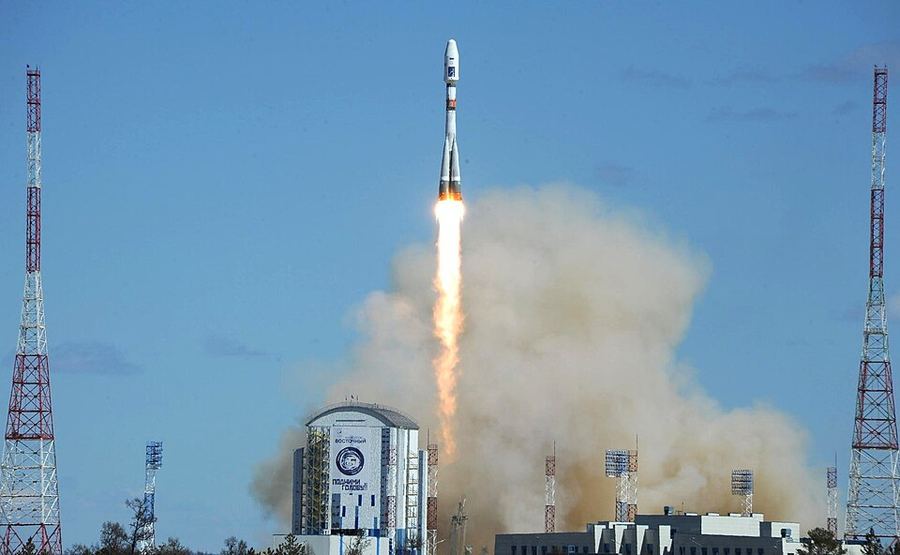
The Russian scientific tradition is anchored by the Academy of Sciences and the physics and mathematics schools at Moscow State University and the Moscow Institute of Physics and Technology. Dmitri Mendeleev's periodic table, Nikolai Lobachevsky's non-Euclidean geometry, Ivan Pavlov's work on conditioning, which won the 1904 Nobel Prize, and Pyotr Kapitsa's low-temperature physics are among its landmarks. Space is the most consequential achievement: Sputnik 1 opened the space age in 1957, Yuri Gagarin made the first human spaceflight in 1961 and Valentina Tereshkova the first by a woman in 1963, and the Soyuz launcher and spacecraft, flying from Baikonur, became among the longest-serving crewed systems ever built, carrying crews to the Mir station and then the International Space Station. In nuclear energy the Obninsk reactor supplied the first grid-connected electricity from atomic power in 1954, and Rosatom now builds and exports VVER reactors and operates the world's only fleet of nuclear-powered icebreakers. Software and security firms and a long record in competitive programming round out the picture.
NatureScienceIEAEncyclopaedia Britannica
On The World Stage
Champions of Russia

Champions & Defining Moments

The Soviet Union built one of history's dominant Olympic machines: from its 1952 debut to 1988 it topped the medal table at nearly every Games it entered, and gymnast Larisa Latynina's eighteen medals remained the all-time Olympic record until 2012. The 'Red Machine' hockey teams won seven of the nine Olympic tournaments between 1956 and 1988, and the line of Soviet and Russian world chess champions from Botvinnik through Karpov and Kasparov ran nearly unbroken for half a century. Post-Soviet Russia sustained excellence in figure skating, synchronized swimming, wrestling, and biathlon, while Maria Sharapova won five Grand Slam singles titles. Russia hosted the 2014 Winter Olympics in Sochi and the 2018 FIFA World Cup across eleven cities. The recent record carries asterisks: state doping findings forced athletes to compete under neutral designations from 2018, and after the 2022 invasion of Ukraine, Russian teams were barred from FIFA competition, with only vetted individual neutrals admitted to the Paris 2024 Games.

Alexxx1979 / CC BY-SA 4.0
Economy, Trade & Government

Currency & GDP

Russian Ruble — RUB (₽)

GDP (PPP): $6.089 trillion (2024 est.)

Per capita: $41,700 (2024 est.)

Exports

$475.277 billion (2024 est.)

crude petroleum, refined petroleum, natural gas, coal, fertilizers (2023)

Partners: China 33%, India 17%, Turkey 8%, Kazakhstan 4%, Brazil 3% (2023)

Imports

$381.45 billion (2024 est.)

cars, packaged medicine, broadcasting equipment, garments, plastic products (2023)

Partners: China 53%, Turkey 5%, Germany 5%, Kazakhstan 5%, Italy 2% (2023)

Government

Type: semi-presidential federation

Independence: 25 December 1991 (from the Soviet Union; Russian SFSR renamed Russian Federation); notable earlier dates: 1157 (Principality of Vladimir-Suzdal created); 16 January 1547 (Tsardom of Muscovy established); 22 October 1721 (Russian Empire proclaimed); 30 December 1922 (Soviet Union established)

Terrain → Where People Live

How mountains, coasts, and rivers shape settlement (LandScan).

Coming — data

Migration & Ethnic Settlement

Where groups settled and how people move (GeoEPR + UNHCR).

Coming — data

Universities

Notable institutions, mappable as points.

Coming — data
Economy & government facts: CIA World Factbook (public domain), via OpenFactBook / factbook.json.
Every fact and narrative claim will carry a visible source citation. Data-driven sections light up automatically wherever HERA has coverage.