HERA · Human Entity Reference Atlas by Masego Inc

← Somalia 🌐 3D View
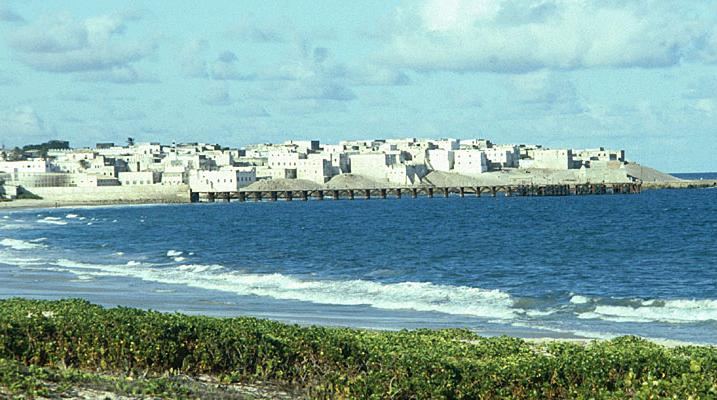
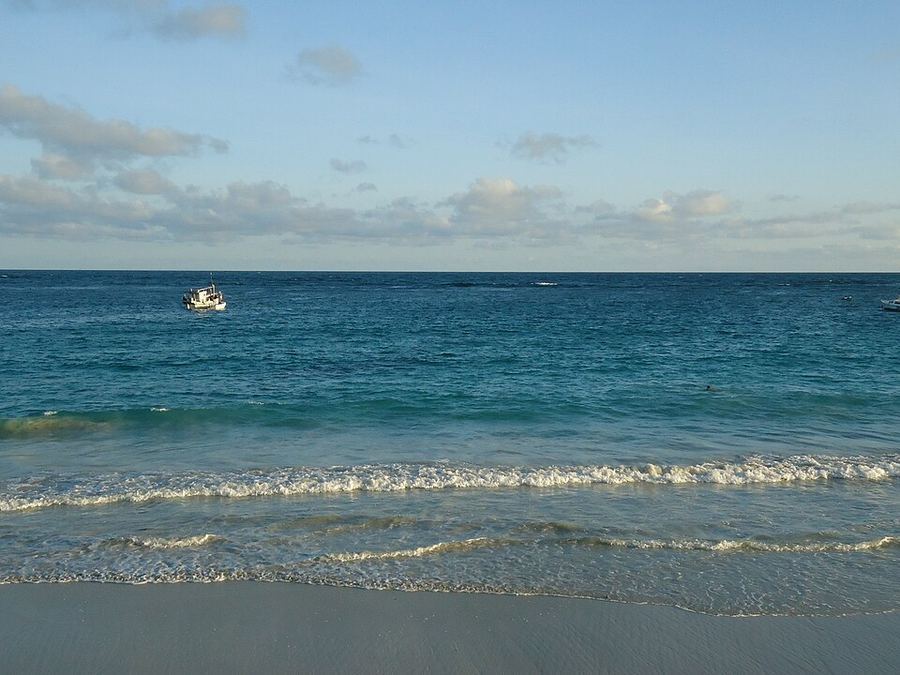
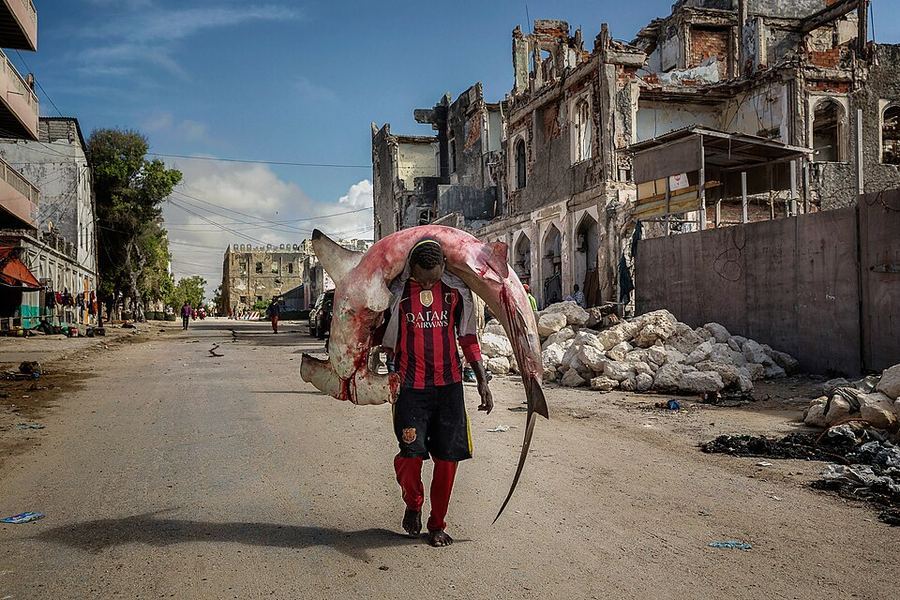
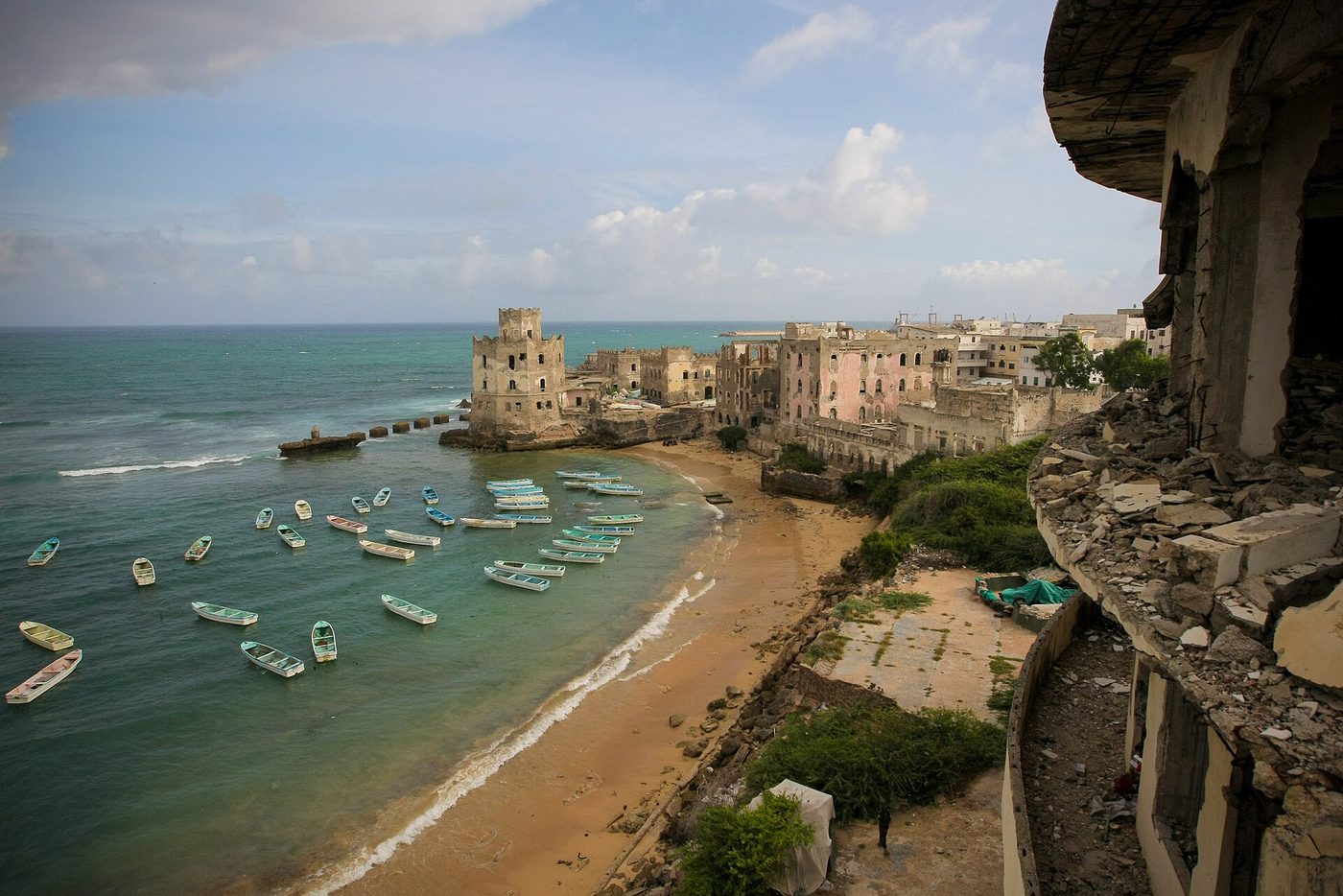
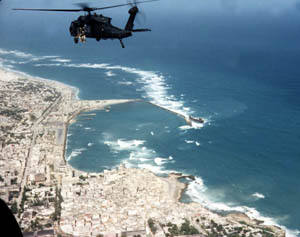
View of Mogadishu fishing harbour from the Aruba Hotel 2012, Somalia
Somalia SOM
View of Mogadishu fishing harbour from the Aruba Hotel 2012 — Photo: AMISOM Public Information / CC0 via Wikimedia Commons
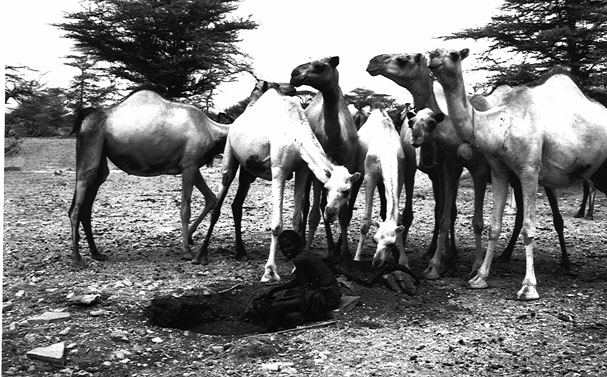
Did You Know Somalia holds the largest camel population of any country in the world — the animal serves at once as food, transport, wealth, bride price and the main subject of classical Somali poetry. — FAO

Somalia occupies the Horn of Africa, wrapping around the continent's northeastern corner from the Gulf of Aden to the Indian Ocean and holding the longest mainland coastline in Africa. Its roughly 20.3 million people are unusually homogeneous by African standards — predominantly ethnic Somali, speaking Somali, and 99.9% Muslim, almost entirely Sunni of the Shafi'i school — yet the society is divided in another dimension entirely, by a genealogical clan system that organises identity, obligation and politics. The median age is about 15.7 years, among the youngest of any country on earth. Somalia became independent on 1 July 1960 through the union of the former British and Italian territories, spent two decades under the military rule of Siad Barre, and collapsed into civil war when his government fell in 1991. A federal government was re-established in 2012 and is rebuilding institutions while fighting the al-Shabaab insurgency; Somaliland in the northwest has functioned separately since 1991 without international recognition. The economy runs on livestock — Somalia holds the world's largest camel herd — on the port trade of Berbera, Bosaso and Mogadishu, and above all on remittances from a global diaspora. Poetry, not architecture or painting, is the central Somali art.

CIA World FactbookEncyclopaedia BritannicaFAO
Population
20,324,160
Capital
Mogadishu
Currency
None SOS
Time zones
Largest city
Mogadishu
Human Geography Themes
Loading national figures…
Largest Cities
Mogadishu4,798,453
Hargeisa1,500,449
Kismayo452,404
Baidoa437,223
Burao403,481
Borama343,918
Wanlaweyn301,525
Bosaso246,624
In Perspective

Mogadishu's urban core is home to about 4,798,453 people.

That's bigger than Sydney, Barcelona, Berlin and Rome — each a great world city in its own right.

Mogadishu4,798,453
Sydney4,375,394
Barcelona3,908,362
Berlin3,601,776
Rome2,556,354

Among the world's megacities, though, it's one of many — the giants of Asia and Latin America run larger still:

Mogadishu4,798,453
Jakarta40,545,126
Dhaka37,307,160
Tokyo33,244,670
Shanghai30,678,616
Cairo25,230,325
The Country & Its People

History

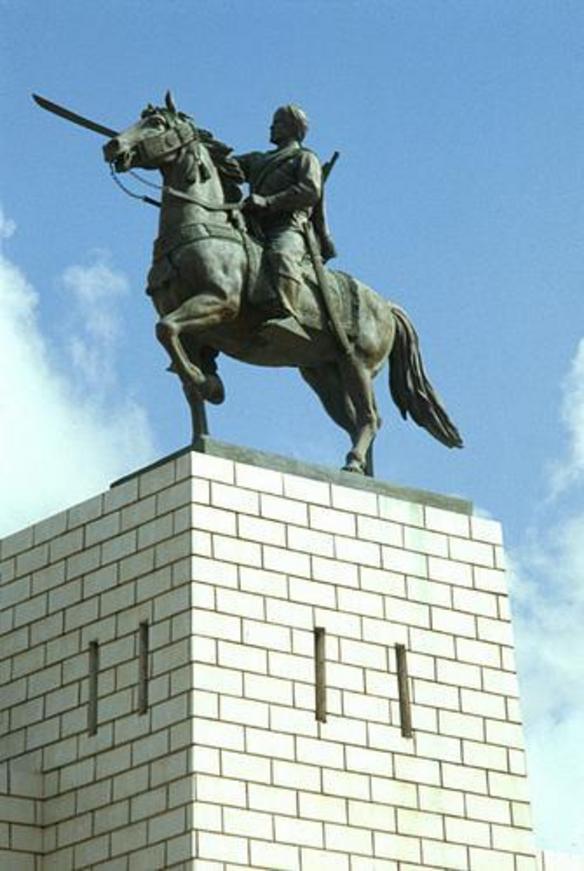
The Somali coast was a node of Indian Ocean commerce long before European contact: Zeila, Berbera, Mogadishu, Merca and Barawa were trading city-states dealing in aromatics, hides, ivory and slaves with Arabia, Persia, India and China, and Ibn Battuta, visiting Mogadishu in 1331, described a large and wealthy town whose sultan spoke both Somali and Arabic. Inland, a succession of Muslim sultanates — the Adal Sultanate, whose commander Ahmad ibn Ibrahim al-Ghazi invaded highland Ethiopia in the sixteenth century, then the Ajuran, Geledi, Majeerteen and Hobyo polities — organised trade and pasture. In the late nineteenth century the Horn was partitioned: Britain took the northern coast as a protectorate to supply meat to Aden, Italy took the south and centre, France took Djibouti, and Ethiopia absorbed the Ogaden. Resistance found its most famous form in the two-decade Dervish campaign of Sayyid Mohammed Abdullah Hassan, ended only in 1920 after British aerial bombardment of his fortresses. British Somaliland became independent on 26 June 1960 and joined Italian Somaliland five days later to form the Somali Republic. Siad Barre seized power in 1969, lost the Ogaden War against Ethiopia in 1977–78, and was driven out in January 1991.
Culture

Somali society is organised around patrilineal descent traced through named ancestors, grouped into the major clan families — Darod, Hawiye, Isaaq, Dir and the agropastoral Digil and Mirifle — and subdivided down to the diya-paying group, the small lineage that collectively pays and receives compensation for injury and death. That group is the working unit of xeer, the indigenous customary law administered by elders, which governs pasture, water, marriage and blood compensation and which continued to function through the decades when no state did. Islam is the second organising force and is universal; Sufi orders, particularly the Qadiriyya, shaped religious practice for centuries and remain influential, alongside more recent reformist currents. Somali social life is heavily oral and rhetorical: reputation is made in speech, and disputes, courtships, alliances and denunciations are conducted in verse. Hospitality obligations toward kin and travellers are strong, and the tea-and-conversation gathering is the standard social form. Pastoral nomadism, in which families move with camels, goats and sheep between seasonal pastures, remains the way a large share of the population lives and supplies the culture's central images even for city dwellers.

Points Of Pride

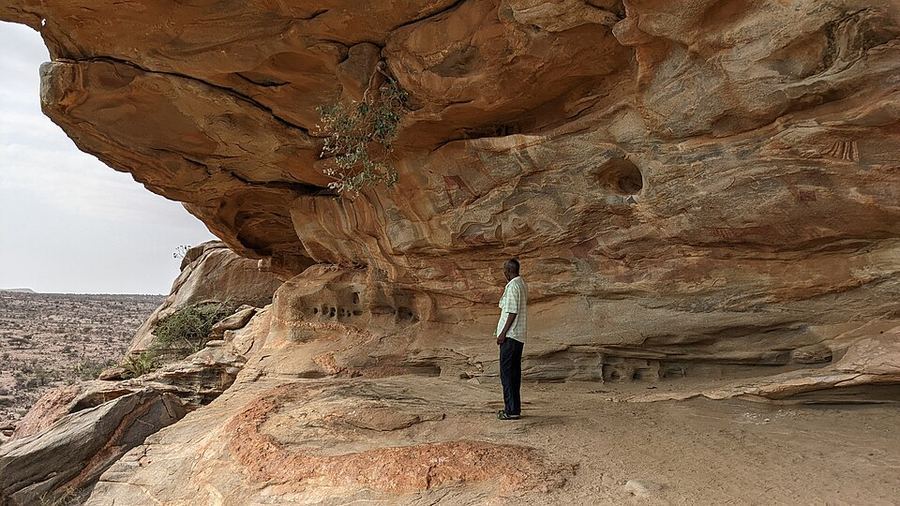
Somalis describe their country as a nation of poets, and the description is not decorative: the Victorian traveller Richard Burton called it a land of bards, and mastery of the alliterative gabay is a recognised form of public authority. The language itself is a source of pride for a second reason — it was written down as a matter of state policy in October 1972, when a Latin-based orthography was adopted after decades of argument, and the mass rural literacy campaign that followed sent students into the countryside to teach it. The camel is the third: Somalia holds the largest camel population of any country in the world, and the animal is simultaneously wealth, food, transport, bride price and the dominant subject of poetry. The rock shelters at Laas Geel, documented by a French archaeological team in 2002, contain some of the best-preserved Neolithic paintings in Africa, with cattle, humans and dogs in still-vivid pigment. Somalis also point to the antiquity of their coastal cities — Mogadishu's Fakr ad-Din mosque dates from the thirteenth century — and to a diaspora that has sustained the country financially through three decades of state collapse.

Cultural Fusion

For a country usually described as ethnically homogeneous, Somalia's coast is deeply mixed. Centuries of Indian Ocean trade brought Arab, Persian and Indian settlement to Mogadishu, Merca and Barawa, and left an architecture of coral-stone houses and a religious scholarship conducted in Arabic; Somalia joined the Arab League in 1974. Barawa's older families speak Chimwiini, a distinct northern variety of Swahili, evidence of the coast's link to the wider Swahili world rather than to the interior. The riverine south along the Jubba and Shabelle is home to Somali Bantu communities, many descended from people enslaved and brought from southeastern Africa in the nineteenth century, who farm rather than herd and who have historically been marginalised in national life. Colonial rule left two different administrative and linguistic inheritances, Italian in the south and British in the north, whose incompatible legal and educational systems complicated the 1960 union. Italian influence persists most visibly in food — pasta is a Somali staple — and in Mogadishu's older streetscape. The largest fusion now is outward: diaspora communities in Minneapolis, Toronto, London, Nairobi and Scandinavia shape money, media, politics and taste at home.

Music & Dance

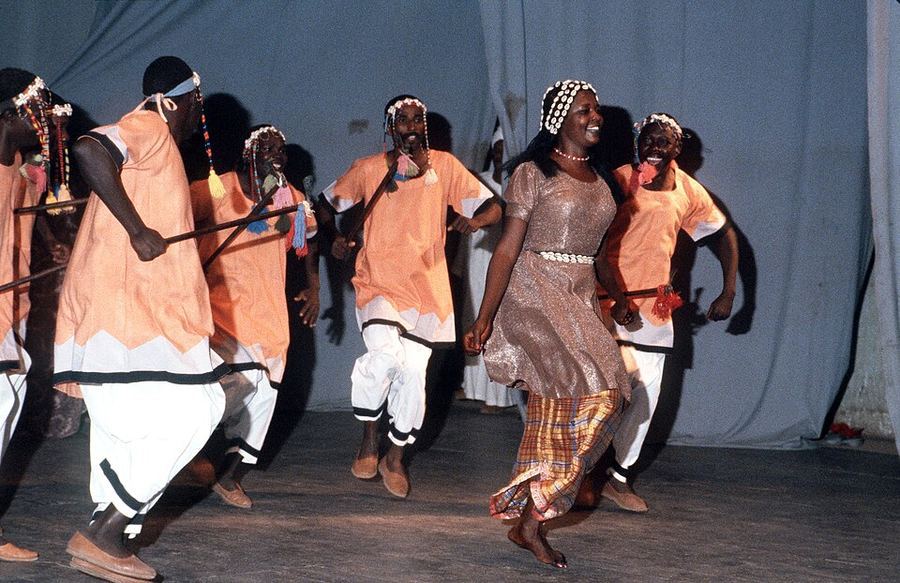
Somali music is built on poetry, and the boundary between the two is thin: a song is usually a poem set for the oud — the kaban — with drum and sometimes flute or violin, and its words are expected to carry weight. The mid-twentieth century produced a golden age centred on Radio Mogadishu and the state-supported Waaberi troupe, which trained a generation of singers, and on bands such as Dur-Dur and Iftin that fused Somali melody with funk, reggae and Indian film music. Magool, Hasan Adan Samatar and Maryam Mursal are the era's defining voices. Much of the recorded archive survived the war only because tapes were hidden, buried or carried abroad; tens of thousands of reels held at an archive in Hargeisa have since been digitised and returned to circulation. The best-known dance is the dhaanto, a line dance from the Ogaden whose rhythm imitates a camel's gait and which has been revived by younger performers as the country's signature form; saylici and other regional line dances are performed at weddings, and buraanbur — the women's poetic and dance form, chanted with drumming — remains central to female ceremonial life.

Cuisine & Misattributed Foods

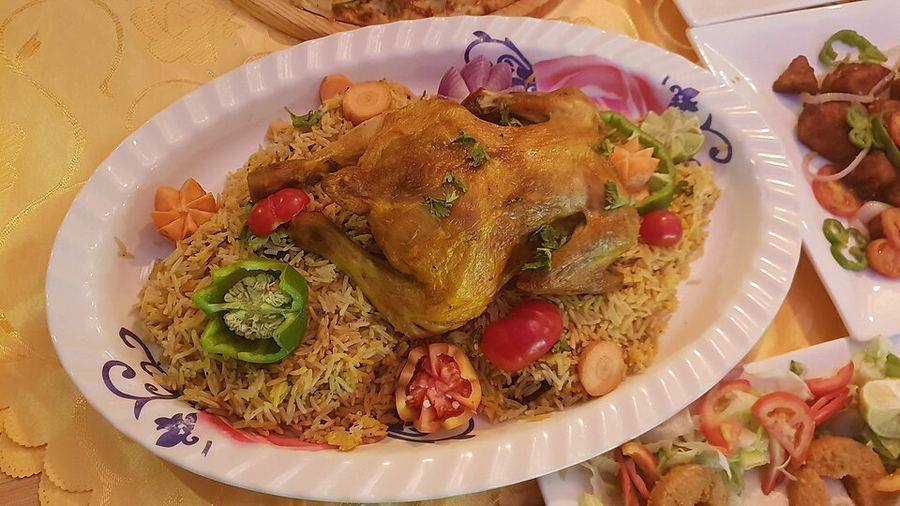
The Somali table reflects the pastoral economy and the Indian Ocean trade in equal measure. The everyday bread is canjeero, a thin fermented sorghum or flour pancake eaten at breakfast with sesame oil and sugar, ghee or stewed meat; muufo, a maize flatbread from the south, plays a similar role. Meat is central and is usually goat, sheep or camel — hilib ari grilled or stewed, or cut small and fried with peppers as suqaar. The great communal dish is bariis iskukaris, rice cooked with the spice blend xawaash of cumin, coriander, cardamom, cinnamon and cloves, served in a mound with meat and a banana on the side. That banana is not an accident: Italian rule made pasta a Somali staple, and baasto served with sauce and a whole banana is one of the most distinctive plates in the Horn. Camel milk, caano geel, is drunk fresh and is regarded as the finest of milks. Sambuusa, malawax pancakes, and the sticky sweet xalwo flavoured with cardamom and studded with peanuts fill out the repertoire, and everything is followed by shaah, tea boiled with spices and milk, or by cardamom coffee.

National Dress

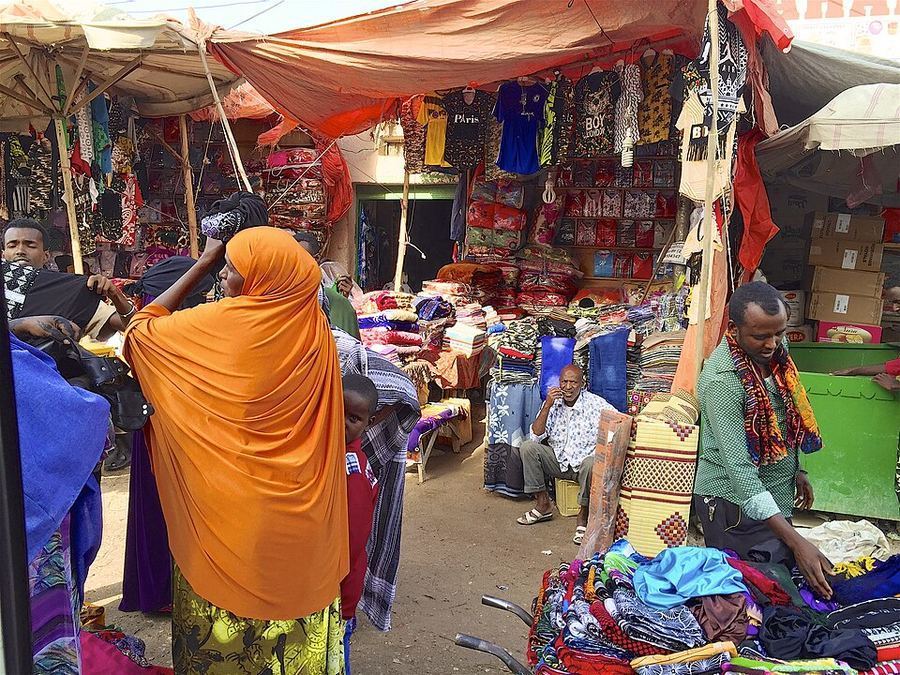
Men's everyday dress across Somalia is the macawis, a sarong of checked or striped cotton wrapped at the waist and worn with a shirt or a draped shawl, and often with the embroidered koofiyad cap; in the towns and among older men the long Arab-style thobe is equally common, and nomads carry a large plain cloth that serves as garment, blanket and shade. Women's dress falls into two distinct traditions. The older is the guntiino, a long unstitched length of cloth — historically the plain white alandi — wrapped around the body and knotted over one shoulder, still worn in rural areas and at cultural events. The urban form is the dirac, a light, wide, translucent dress in voile or chiffon, worn over a full-length underslip called the gorgorad, with a garbasaar shawl over the shoulders; brightly patterned and often heavily embroidered, it is the dress of weddings and celebration. Headcovering is universal for adult women, ranging from the loosely tied shash to the full jilbaab that has become far more common since the 1990s. Henna patterning on hands and feet, cilaan, is standard for brides and festivals.

Sports & Inspiring Athletes

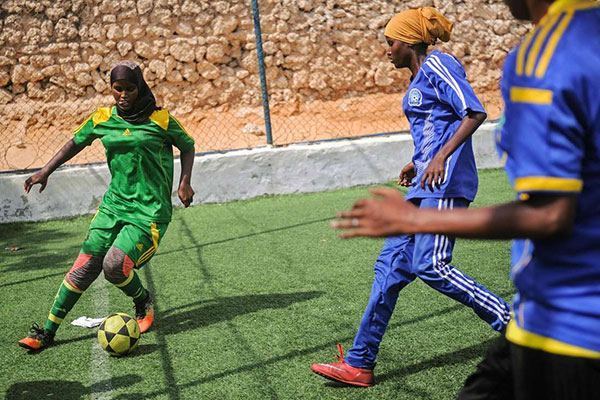
Football is the most popular sport by a wide margin, organised through the Somali Premier League and played on beaches, cleared lots and the rebuilt pitches of Mogadishu. Mogadishu Stadium, built in the 1970s, spent the war years as a military base for successive armed groups and then for African Union forces, and its return to sporting use in 2020 was treated as a national event in itself. Basketball has a strong urban following, and Somali women's basketball has persisted despite pressure from armed groups that at times banned the sport outright. Athletics, especially middle- and long-distance running, is the discipline in which Somalis have gone furthest internationally. The most distinctive traditional sport is the istunka, the stick-fighting festival held annually at Afgooye on the Shabelle river to mark the Somali solar new year, in which two sides of the town meet in a ritualised battle with sticks — a tradition several centuries old that has been revived after long interruption. Camel and horse racing are features of rural celebrations, and wrestling and long-distance running have always been part of pastoral life.

Notable Educational Programs

Somalia's educational history has a sharp peak and a long trough. After the Latin orthography for Somali was adopted in 1972, the government launched a mass literacy campaign, closing secondary schools in 1974 and sending tens of thousands of students into the countryside to teach reading and writing to nomadic families; literacy rose dramatically in a few years, and the campaign remains the single most celebrated achievement of the Barre period. The system then collapsed almost completely with the state in 1991, and what replaced it was private, community-funded and religious. Somalia today has among the lowest school enrolment rates in the world, with a large majority of children of pastoral families out of school entirely, and gender and rural gaps that are among the widest anywhere. Rebuilding has come mostly from below: Mogadishu University opened in 1997 and SIMAD University in 1999, both privately founded during the war years; the Somali National University reopened in 2014; and Amoud University in Borama was revived by community and diaspora subscription. The federal government has since worked with UNICEF and donors to establish a national curriculum and a teacher accreditation system where none existed.

Wars & Conflicts

Somalia has been at war, in shifting forms, since the late 1980s. Siad Barre's government fell in January 1991, and the clan militias that removed it turned on each other; famine and looting in 1992 drew a United Nations operation and an American-led intervention, which ended after the October 1993 battle in Mogadishu in which eighteen US soldiers and hundreds of Somalis died. State collapse persisted for over a decade. The Islamic Courts Union took Mogadishu in 2006 and was driven out by an Ethiopian invasion, from whose remnants al-Shabaab emerged as a jihadist insurgency pledged to al-Qaeda. Since 2007 the African Union force — AMISOM, then ATMIS, and now a successor mission — has fought alongside the Somali National Army to hold the cities, while al-Shabaab retains large rural areas, runs a parallel taxation system and mounts repeated mass-casualty bombings, including the October 2017 truck bomb in Mogadishu that killed more than 500 people. A smaller Islamic State affiliate operates in Puntland's Bari mountains. Piracy off the coast peaked between 2008 and 2012 before international naval patrols suppressed it. Recurrent drought and famine have compounded the displacement, which runs into the millions.
Current as of 2026-08-07

Land & Border Disputes

Somalia's principal international dispute was settled by litigation. In 2014 it brought Kenya before the International Court of Justice over the direction of their maritime boundary in the Indian Ocean, an area with potential hydrocarbon value: Somalia argued for a line perpendicular to the coast following the equidistance principle, Kenya for a line running due east along a parallel of latitude. The Court delivered judgment on 12 October 2021, largely accepting Somalia's approach and drawing a boundary close to equidistance, though not identical to Somalia's claim. Kenya rejected the ruling and had already withdrawn its acceptance of the Court's compulsory jurisdiction. The other disputes are unresolved and political. Somaliland, comprising the former British protectorate, declared independence in May 1991 and has held elections and issued its own currency since, but no state recognises it, and Mogadishu regards the territory as an integral part of Somalia; a 2024 memorandum between Ethiopia and Somaliland over access to the sea at Berbera provoked a severe crisis before Turkish mediation produced a declaration in Ankara. Historical Somali claims to the Ogaden in Ethiopia and Kenya's northeastern counties — represented by two points of the flag's five-pointed star — are no longer pressed by the federal government.
Land, Life & Legacy

Land & Climate

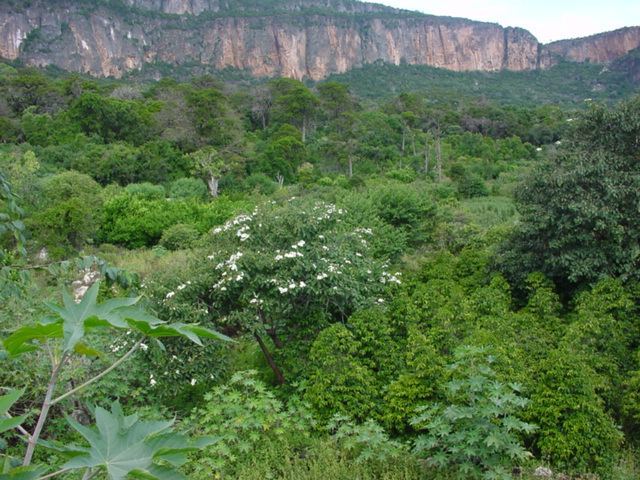
Somalia has the longest mainland coastline in Africa, running some 3,300 kilometres from the Djibouti border along the Gulf of Aden to Cape Guardafui at the tip of the Horn and then south along the Indian Ocean to Kenya. Behind the narrow, blisteringly hot northern coastal plain called the Guban rise the Golis and Cal Madow ranges, where Shimbiris reaches about 2,400 metres and isolated pockets of juniper and frankincense woodland survive; south of them the Ogo plateau falls away into the Haud, a broad limestone grazing plain that extends across the Ethiopian border. The south is lower and, uniquely in the country, watered: the Jubba and Shabelle, both rising in the Ethiopian highlands, are Somalia's only permanent rivers and support the country's irrigated farmland between them. The climate is arid to semi-arid, structured by four seasons — the gu rains from April, the hot dry hagaa, the deyr rains from October, and the long harsh jilaal dry season. Rainfall failure is the defining hazard: the 2011 famine killed roughly a quarter of a million people, and the drought of 2020 to 2023 displaced millions before flooding closed it out.

Entertainment

Somali leisure is conversational above all. The tea shop and, in the evening, the private gathering where friends chew qaat — the mildly stimulant leaf flown in daily from Ethiopia and Kenya — are the standard venues for hours of argument about politics, poetry, business and clan affairs, and both are overwhelmingly male spaces. Poetry itself is entertainment: recitation, memorised verse and the composition of replies to a rival's poem circulate now through voice notes and social media as they once did through travellers. Football is watched everywhere, mostly European leagues on satellite television in cafés, and played on any open ground and on the beaches. Mogadishu's Lido Beach, unusable for years, has become the emblem of the capital's partial recovery, filling on Friday afternoons with swimmers, footballers and fish restaurants. Weddings are the major social occasions, running for days with buraanbur performance, drumming and feasting. In rural areas the rhythm is set by livestock and rain, with wells, markets and the movement to seasonal pasture supplying the occasions for people to gather at all.

Art & Museums

Somalia's dominant art form is verbal. The gabay, the long alliterative poem in which every line must carry a chosen consonant, is the most demanding form, used for political argument, historical record and invective, and its masters are public figures; the shorter geeraar and jiifto and the women's buraanbur complete the classical repertoire. Visual art works within an aniconic Islamic tradition, favouring geometry, calligraphy and pattern over representation, and its finest objects are utilitarian: woven aqal mats, carved wooden headrests and combs, and the milk vessels — the haan and dhiil — built up from woven fibre and wood, sealed with butter and decorated with cowrie shells. Silverwork and amber jewellery are traditions of the coastal towns. Body art means henna, applied in dense floral and geometric patterning. The country's most significant heritage in paint is prehistoric: the granite shelters at Laas Geel, first documented archaeologically in 2002, hold Neolithic images of long-horned cattle in ceremonial dress, human figures and dogs, remarkably preserved. Contemporary Somali art has grown largely in the diaspora, and Mogadishu's small gallery and mural scene has revived since 2012.

Notable People

Sayyid Mohammed Abdullah Hassan, poet and religious leader, led the Dervish resistance against British, Italian and Ethiopian forces from 1899 until 1920 and is the country's foremost anticolonial figure. Hawa Tako, killed in Mogadishu in 1948 during protests over the territory's future, is remembered as a nationalist martyr. Mohamed Ibrahim Warsame, universally known as Hadraawi and often called the Somali Shakespeare, was the pre-eminent poet of the modern era until his death in 2022. Nuruddin Farah has built an international reputation as a novelist writing Somalia in English and won the Neustadt International Prize for Literature in 1998. The singer Magool remains the standard against which Somali voices are measured. Abroad, the model Iman and the writer and activist Waris Dirie made Somali faces globally recognisable; the musician K'naan and the American legislator Ilhan Omar are among the diaspora's best-known figures. In sport, Abdi Bile won the 1500 metres world title in Rome in 1987, and Mo Farah, born in Mogadishu and raised in Britain, won four Olympic gold medals over 5,000 and 10,000 metres.

Inventions & Breakthroughs

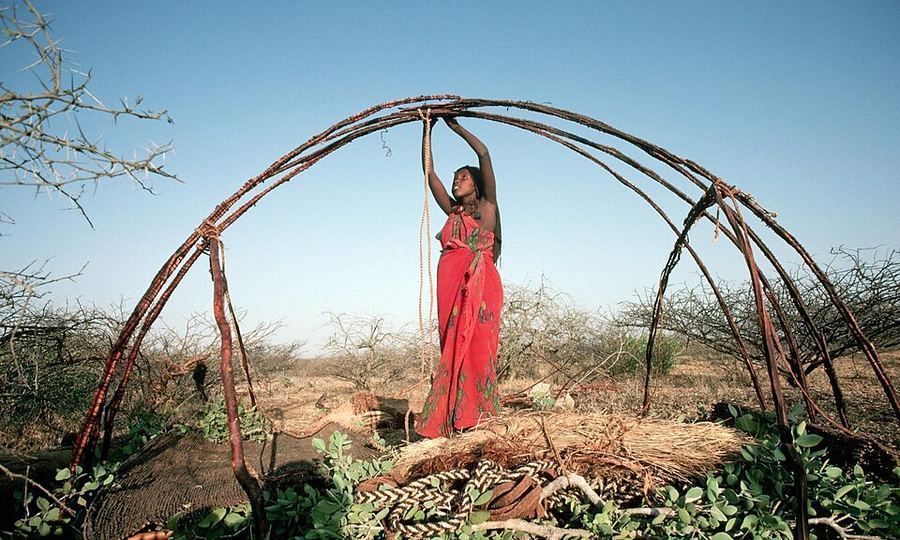
Somalia's inventions are institutional and architectural rather than industrial. The aqal soomaali is the outstanding example: a portable domed house framed from bent, springy sticks lashed into a lattice and covered with woven mats and hides, which can be dismantled, loaded onto a camel and rebuilt in a few hours — an engineering solution to nomadic life on arid rangeland refined over centuries. Xeer, the customary legal code, is a second: an oral body of law with rules of evidence, elder adjudication and collective compensation, which functioned as the effective justice system through thirty years without a central state and is studied internationally as a case of stateless legal order. The Somali language produced three indigenous writing systems in the twentieth century — the Osmanya script devised around 1920 by Osman Yusuf Kenadid, the Borama script of Sheikh Abdurahman Nuur, and the Kaddare script — before the Latin orthography was adopted in 1972. In the pastoral economy, Somali herders developed the selective breeding and husbandry that produced the region's distinctive camel and the fat-tailed blackhead sheep, the country's principal export animal to the Gulf.
Encyclopaedia BritannicaFAOOxford Reference

Science & Technology

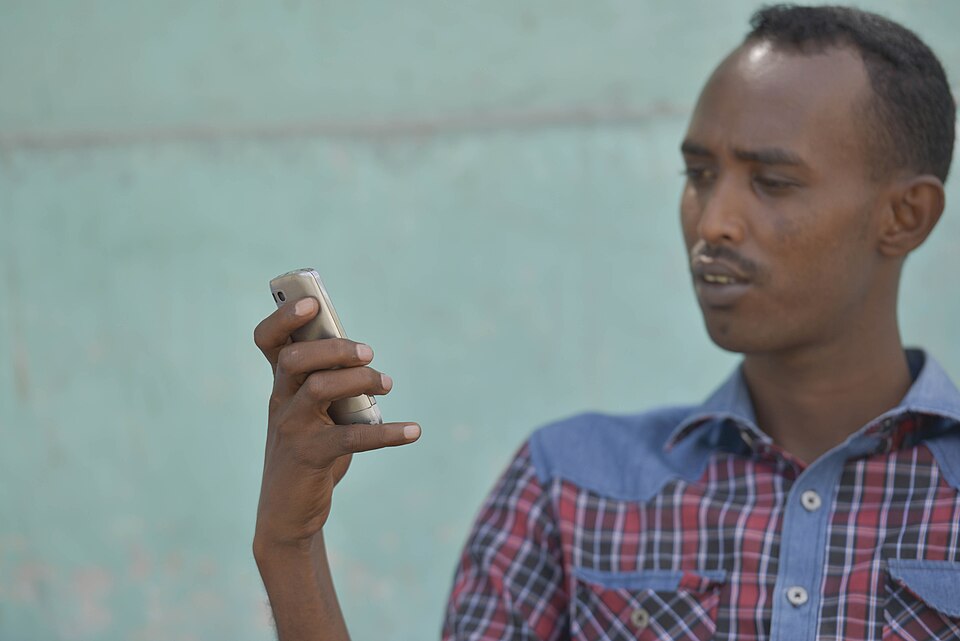
Somalia is the standard example of a country where private telecommunications outran the state that was supposed to regulate them. With no functioning central authority through the 1990s and 2000s, competing operators built mobile networks that reached most of the population and charged among the lowest call rates in Africa, and they layered mobile money on top: services such as Hormuud's EVC Plus made Somalia one of the most cash-free economies in the world by the mid-2010s, with market traders and taxi drivers routinely refusing banknotes. The financial infrastructure beneath it is the hawala remittance network, which moves money from the diaspora on trust and ledger rather than through correspondent banking, and which delivers well over a billion dollars a year — more than the country receives in foreign aid — through firms such as Dahabshiil. Scientific capacity is otherwise thin and concentrated in the reopened universities and in applied work by international agencies: rangeland and camel husbandry research with the FAO, and the drought and crop monitoring systems that now issue famine early warnings months in advance, a direct institutional response to the failure to act quickly enough in 2011.
On The World Stage

Champions & Defining Moments

Somalia first competed at the Olympic Games in Munich in 1972 and has appeared at most Summer Games since, in athletics and occasionally judo and swimming, without ever winning a medal; its athletes usually take part under wild-card entries. The country's single greatest international result belongs to Abdi Bile, who won the 1500 metres at the 1987 World Championships in Rome, still Somalia's only global athletics title. The story that has carried furthest, however, is Samia Yusuf Omar's: she ran the 200 metres at the 2008 Beijing Olympics in borrowed kit and finished last to a standing ovation, then drowned in the Mediterranean in 2012 attempting to reach Europe to train for London. Mo Farah, born in Mogadishu, won his four Olympic titles for Great Britain. In football, Somalia has never qualified for the World Cup or the Africa Cup of Nations, and for years played its home fixtures abroad for security reasons; a World Cup qualifying win over Zimbabwe in 2019 was a rare and much-celebrated result. Somalia also competes at the Islamic Solidarity Games and regional African championships.

IOCOlympediaWorld AthleticsFIFABBC
Economy, Trade & Government

Currency & GDP

Somali Shilling — SOS (None)

GDP (PPP): $26.77 billion (2024 est.)

Per capita: $1,400 (2024 est.)

Exports

$2.424 billion (2024 est.)

sheep and goats, gold, postage stamps/documents, other animals, cattle (2023)

Partners: UAE 35%, Saudi Arabia 27%, Oman 18%, Djibouti 8%, India 3% (2023)

Imports

$9.002 billion (2024 est.)

raw sugar, tobacco, broadcasting equipment, rice, milk (2023)

Partners: UAE 29%, China 19%, India 15%, Turkey 8%, Oman 5% (2023)

Government

Type: federal parliamentary republic

Independence: 1 July 1960 (from a merger of British Somaliland, which became independent from the UK on 26 June 1960, and Italian Somaliland, which became independent from the Italian-administered UN trusteeship on 1 July 1960 to form the Somali Republic)

Terrain → Where People Live

How mountains, coasts, and rivers shape settlement (LandScan).

Coming — data

Migration & Ethnic Settlement

Where groups settled and how people move (GeoEPR + UNHCR).

Coming — data

Universities

Notable institutions, mappable as points.

Coming — data
Economy & government facts: CIA World Factbook (public domain), via OpenFactBook / factbook.json.
Every fact and narrative claim will carry a visible source citation. Data-driven sections light up automatically wherever HERA has coverage.