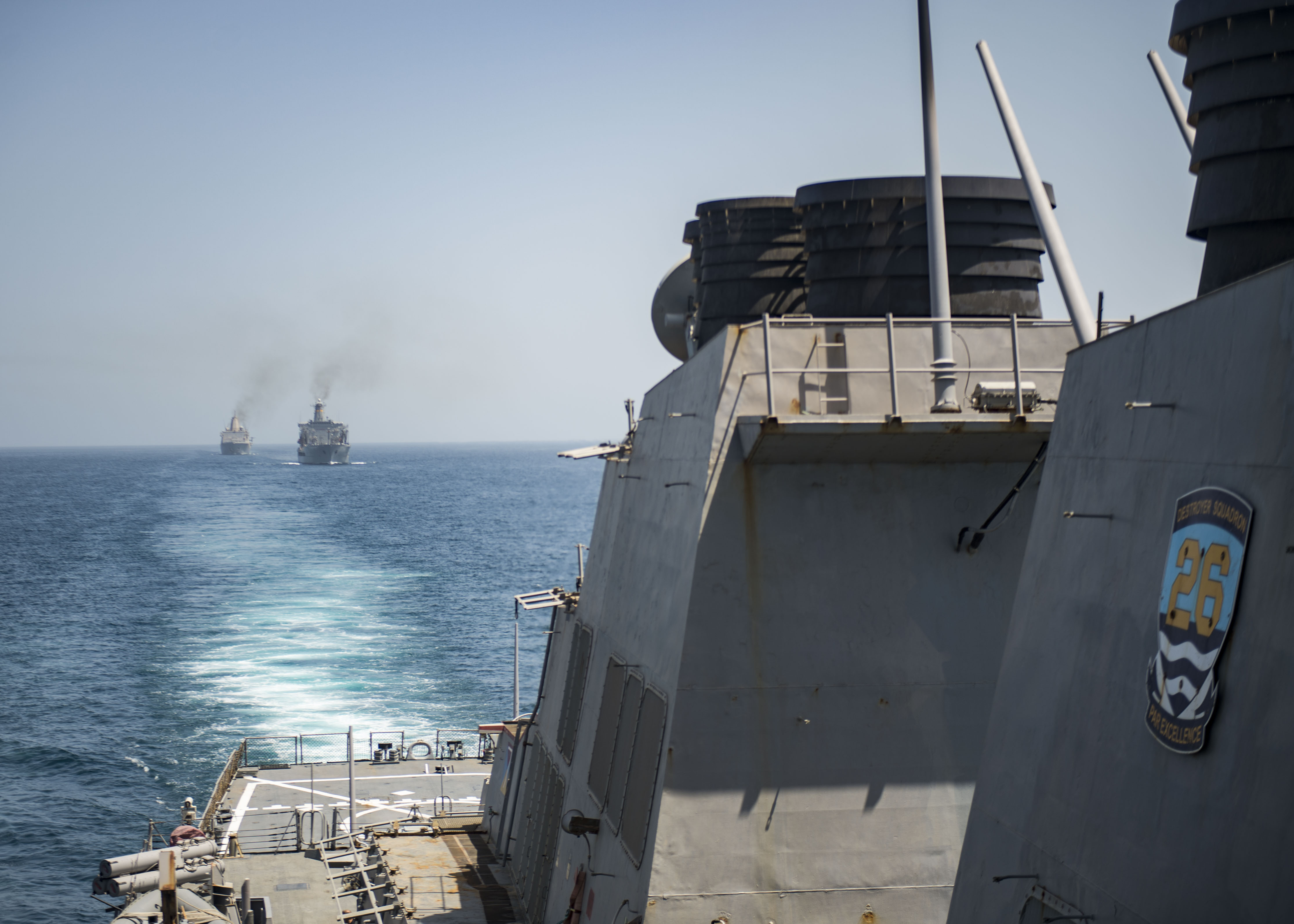
As of 21 September 2026 the war between the United States and Iran that began on 28 February 2026 remains in the maritime phase that reopened on 30 August, but the past week has been defined less by new exchanges of fire than by competing signals about how the war might end, by a sharp escalation on the Houthi front that reached the Saudi capital, and by a weekend of visible White House deliberation over whether to widen US military action. On the Hormuz front the pattern was enforcement rather than strikes: US Central Command said its forces had redirected 103 commercial vessels under the blockade as of 15 September, releasing footage of a Navy helicopter operating from USS Rafael Peralta in the Arabian Sea (ANI and Times of Oman, 16 September 2026), and 104 as of 17 September (Iran International, 17 September 2026), while GlobalSecurity's daily operational tracker recorded no announced US or coalition strike on Iranian territory in the 17-18 September window and no new CENTCOM release beyond the standing blockade tally (GlobalSecurity, 18 September 2026). Shipping data pointed in two directions at once: USNI News reported on 18 September that non-Iranian transits of the strait had climbed to 97 the previous week, a three-week high driven largely by very large crude carriers loading Saudi oil that can no longer move through the Houthi-threatened East-West pipeline to Yanbu, while preliminary Kpler figures cited in the same reporting showed commodity-ship transits falling to single digits on 17 September against a 10-day average of about 16, and Brent crude traded in the high $90s, near $100 a barrel (USNI News, 18 September 2026; CBS News, September 2026). Both capitals spent the week describing terms. President Donald Trump told reporters on 16 September that 'hopefully we are toward the end of the war. They want to make a deal, we'll see how that works out', and said he had spoken with Tehran 'directly' without elaborating (Reuters via US News, 16 September 2026; CNBC, 17 September 2026); Axios reported the same day that he is expected to meet leaders or foreign ministers of the six Gulf Cooperation Council states on the sidelines of the UN General Assembly in New York on 22 September to discuss a postwar strategy that his team expects to finalise after the November midterm elections (Axios, 16 September 2026; The Jerusalem Post, 16 September 2026). Foreign Minister Abbas Araghchi travelled to Beijing on 16 September for talks with Wang Yi, his second such trip since the war began, days ahead of a scheduled visit by Xi Jinping to the United States (Bloomberg and CNBC, 15 September 2026). On 19 September Mohsen Rezaei, secretary of Iran's Supreme National Security Council, told Al Jazeera that Iran had conveyed a formal set of conditions to Washington through Qatari mediators, naming the release of frozen Iranian assets, the lifting of the US naval blockade, an end to attacks on Iranian territory, non-interference in Iran's internal affairs and an end to the war on all fronts including Lebanon; in a post on X he said there were seven conditions in all, four of them undisclosed, and that Tehran was 'waiting for the Americans to accept and implement' them, with no US response reported (Al Jazeera, 19 and 20 September 2026; The Jerusalem Post and Doha News, September 2026). The same week Trump signed into law the Lindsey O. Graham Sanctioning Russia and Iran Act of 2026 on 18 September, which extends statutory US sanctions on Iran, according to Middle East Eye, through 2031 (CBS News and RFE/RL, 18 September 2026; ANI, 19 September 2026; Middle East Eye, September 2026). On 20 September Trump told Fox News that he was in 'deciding mode' on Iran and that 'very big things' would happen 'in the not too distant future', framing his options as destroying the country, letting its economy 'rot', or reaching a negotiated agreement, and asking 'if and when do I blow the entire nation up? They better behave'; he also said he would 'probably be open' to meeting President Masoud Pezeshkian at the General Assembly (The Washington Times, 20 September 2026; Arab Times, September 2026). Iran's central military command answered the same day on state media that it had information the United States had decided to resume attacks with the approval of some regional governments following a meeting in a European country, and that any new action would trigger 'continuous, effective and painful' attacks on US bases and interests across the region, with Washington's regional allies treated as parties to the conflict (Reuters via US News, 20 September 2026; IRNA and Tasnim, 20 September 2026); on 21 September army commander Amir Hatami said Iranian forces were 'fully prepared' to defend the country against a renewed US-Israeli attack (Al Jazeera, 21 September 2026). The Red Sea front hardened into a second war. Reporting citing Reuters said US embassy officials met a Houthi delegation including Mohammad Abdul Salam at the US embassy in Muscat on 14 September, with Omani facilitation, and that the Houthis pledged not to attack American, Israeli or other commercial shipping while explicitly excluding Saudi vessels; the State Department did not confirm the meeting but said safeguarding freedom of navigation in the Red Sea was important (Gulf News and The Times of Israel, September 2026; The Media Line, 16 September 2026). By mid-month the Houthis held Yemen's entire Red Sea coastline together with Perim and the Hanish Islands, and Al Jazeera characterised Washington as 'willing to watch from the sidelines' after Crown Prince Mohammed bin Salman's repeated requests for US strikes were refused in favour of intelligence-sharing and targeting support (Al Jazeera, 18 September 2026; The Hill and The National, 15 September 2026). On 19 September Saudi Arabia said its air defences had intercepted a Houthi ballistic missile targeting Riyadh - the first attack on the capital since the fighting intensified - as a fire burned at an Aramco-branded fuel tank at the depot beside King Khalid International Airport before being extinguished, with heavy flight disruption; the Houthis claimed strikes on 'sensitive sites' in Riyadh and on Aramco facilities at Yanbu (France 24 and NBC News, 19 September 2026; Dawn, September 2026). Over the weekend the two sides traded further strikes, with Houthi statements accusing Saudi Arabia of dozens of air raids on Hodeidah, Marib and Taiz, Yemen's internationally recognised government saying its warplanes had struck Houthi positions, and civilian injuries reported in Saudi Arabia (Al Jazeera, 21 September 2026). The State Department issued an alert warning US citizens that hostilities between Saudi Arabia and the Houthis had the 'potential to escalate rapidly', Trump cut short a Camp David weekend and returned to the White House a day early, and Defense Secretary Pete Hegseth left a sports event in Texas to return to Washington; the White House did not give a reason, while Israel Hayom and AOL, citing CNN's unnamed sources, reported that the Camp David meeting had reviewed options for strikes in Yemen (The Hill and Newsweek, 20 September 2026; Israel Hayom, 20 September 2026). Trump told Fox News on 20 September that Washington was in 'constant communication' with the Houthis, who he said had agreed not to fight the United States (The Washington Times, 20 September 2026). No US strike on the Houthis or on Iranian territory had been announced in the reporting reviewed as of 21 September. At home, the war's costs and toll came under new scrutiny: The Washington Post reported on 18 September that the Pentagon's public Defense Casualty Analysis System lists 18 US military deaths since the war began, hostile and non-hostile, but that six US officials familiar with internal casualty data said the true figure is higher, five of them putting it at a minimum of 22 (The Washington Post, 18 September 2026; Haaretz, 19 September 2026); a Fox News poll found a record 60 percent of voters saying military action against Iran was the wrong decision and 71 percent saying the administration 'lacks a clear strategy' for ending it, while a September Reuters/Ipsos poll put approval of Trump's handling of Iran at 28 percent against 62 percent disapproval (Al Jazeera, 18 September 2026). Iranian official and rights-group counts of deaths inside Iran continue to cluster around 3,500, with US and Israeli estimates higher and cross-source compilations diverging widely. In Congress, the House-passed stopgap that would fund the government through 11 December omits the administration's roughly $87.6 billion supplemental request, of which about $67.1 billion is for the Pentagon, leaving the Iran war unfunded beyond existing appropriations even as the administration presses its $1.5 trillion defense budget (Breaking Defense and Defense One, September 2026; NewsNation, September 2026; The Washington Times, 13 September 2026); the Pentagon has put the war's cost above $42 billion (NOTUS, September 2026) and the Congressional Budget Office at roughly $38 billion as of 1 August (ANI, citing CBO, 16 September 2026), and CBS News counts more than 80 generals and admirals fired or blocked from promotion under Hegseth, about a tenth of the military's top officers (CBS News, September 2026). Beyond the Iran theater, US Southern Command said Joint Task Force Western Hemisphere forces boarded and sank a fifth floating refueling station tied to Ecuador's Los Choneros in the eastern Pacific on 16 September, transferring those aboard to Ecuadorian authorities - the fourth such sinking in September and the fifth since the series began on 28 August (Washington Examiner and Fox News, 16 September 2026; BNO News, September 2026). In the Venezuela case there were again no new filings: the motions by Nicolas Maduro and Cilia Flores to dismiss their Manhattan narco-trafficking indictment on head-of-state and spousal immunity grounds await the prosecution's response due 2 October, with argument set for 17 November before Judge Alvin Hellerstein and trial scheduled for 1 June 2027 (JURIST and Al Jazeera, 3 September 2026). Domestically, National Guard contingents remain in Washington, D.C. under a mission extended through the end of 2026, and in Memphis and New Orleans under separate arrangements, while the federalized deployments to Los Angeles, Chicago and Portland ended in January 2026 (Task & Purpose and Capital B News, 2026). All figures and characterizations reflect reporting available as of 21 September 2026 in a rapidly evolving situation.
Last reviewed 2026-09-21 · 2 weeks ago